
-
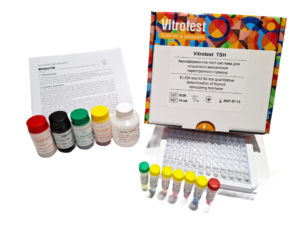
The test kit Vitrotest® TSH is an enzyme linked immunosorbent assay (ELISA) for the quantitative determination of thyroid-stimulating hormone (TSH) in human serum or plasma. Determination of thyroid-stimulating hormone concentration in the test kit Vitrotest® TSH is based on a solid-phase sandwich ELISA in a two-step incubation procedure.
- TK148 - 96 tests
- TK149 - 192 tests
- Solid phase: strip ELISA plate pre-coated with the first monoclonal antibodies specific to the β-subunit of human thyroid-stimulating hormone.
- Conjugate: monoclonal antibodies to human TSH conjugated with horseradish peroxidase.
- Chromogen: ready to use TMB solution.
- Sample volume: 50 μl.
- Assay time: 2 h.
- Analytical sensitivity: 0,106 μIU/ml.
- Linearity range: 0,125-16,4 µIU/ml.
According to the World Health Organization (WHO), thyroid diseases are the second most common endocrine disorders after diabetes mellitus. Over 200 million people worldwide suffer from various forms of thyroid dysfunction. In Ukraine, over the past 5 years, the number of people with thyroid diseases has increased fivefold. The main pathological conditions include hyperthyroidism, hypothyroidism, autoimmune thyroid diseases, benign and malignant neoplasms. A connection has also been established between thyroid dysfunction and other diseases such as diabetes, cardiovascular diseases, depression, oral diseases, and cancer.
A valuable biomarker of thyroid functional status widely used for screening, diagnosis, and monitoring of thyroid diseases is thyroid-stimulating hormone (TSH). TSH is a glycoprotein hormone synthesized by the anterior pituitary and is a key regulator of thyroid function. The TSH molecule consists of two different non-covalently bound subunits: the α-subunit, identical in amino acid sequence to the α-subunit of chorionic gonadotropin, luteinizing hormone, and follicle-stimulating hormone, and the hormone-specific β-subunit, which is unique. The main function of TSH is to stimulate the thyroid gland to synthesize and secrete thyroid hormones – thyroxine (T4) and triiodothyronine (T3). TSH binds to the TSH receptor on thyrocytes and activates intracellular signaling cascades that regulate iodine uptake, thyroid metabolism, thyroid growth, and hormone secretion. Through negative feedback, T3 and T4 inhibit TSH secretion.
In healthy adults, TSH serum levels are approximately 0.4 to 4.0 μIU/ml, although narrower ranges may be used to better detect subclinical hypothyroidism. Separate reference intervals for TSH are established for pregnant women, infants, and young children. TSH secretion has pulsatile and circadian patterns, and its concentration depends on factors such as age, sex, ethnicity, iodine intake, reproductive status, and body mass index.
Over the last three decades, laboratory methods used to determine TSH levels have significantly improved. Among immunochemical methods, ELISA has gained wide application due to its convenience, simplicity, high reproducibility, and sensitivity for determining thyroid-stimulating hormone in human serum and plasma.
The standardization of quantitative determination of TSH in human serum or plasma is ensured by the use of the WHO International Standard with assigned TSH concentration in μIU/ml for preparation of internal ELISA calibrators.
-
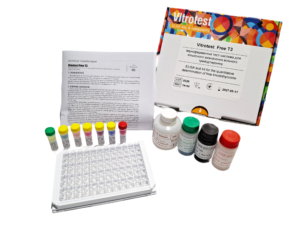
The test kit Vitrotest® Free T3 is an enzyme linked immunosorbent assay (ELISA) for the quantitative determination of free triiodothyronine (FT3) in human serum or plasma. Determination of free triiodothyronine concentration in the test kit Vitrotest® Free T3 is based on a competitive ELISA with a two-step incubation.
- TK150 - 96 tests
- Solid phase: strip ELISA plate pre-coated with triiodothyronine.
- Conjugate: buffer solution of monoclonal antibodies specific to triiodothyronine conjugated with horseradish peroxidase.
- Chromogen: ready to use TMB solution.
- Sample volume: 25 μl.
- Assay time: 1 h 15 min.
- Analytical sensitivity: 0,5 pg/ml.
According to data from the World Health Organization (WHO), thyroid diseases are the second most common endocrine disorders after diabetes mellitus. More than 200 million people worldwide suffer from various forms of thyroid dysfunction. In Ukraine, over the past five years, the number of people with thyroid diseases has increased fivefold. The main pathological conditions include hyperthyroidism, hypothyroidism, autoimmune thyroid diseases, benign and malignant neoplasms, etc.
The main hormones produced by the thyroid gland are thyroxine or tetraiodothyronine (T4, containing four iodine atoms) and triiodothyronine (T3, containing three iodine atoms). These hormones are lipophilic and circulate in the blood mainly bound to transport proteins: thyroxine-binding globulin (TBG), transthyretin (also known as thyroxine-binding prealbumin), and albumin. However, only free triiodothyronine and free thyroxine are functionally active, accounting for just 0.3% and 0.03% of total T3 and T4 in blood serum, respectively.
Free triiodothyronine is the biologically active form that directly enters target cells and binds to nuclear receptors to regulate gene expression and cellular function. Free thyroxine has minimal hormonal activity, but its long half-life (8 days) serves as a reservoir or prohormone for free triiodothyronine. All reactions required for the formation and release of T3 and T4 are controlled by thyroid-stimulating hormone (TSH) through a negative feedback mechanism.
Although determination of TSH and FT4 concentrations are considered the primary tests of choice for diagnosing thyroid dysfunction, measurement of FT3 levels is useful for detecting T3-thyrotoxicosis, complex or unusual manifestations of hyperthyroidism, monitoring thyroid disease treatment, and assessing metabolism.
Accumulated evidence indicates that changes in FT3 levels are also closely associated with a number of systemic disorders, such as cardiovascular diseases, dyslipidemia, type 2 diabetes mellitus, and liver dysfunction, highlighting the clinical importance of FT3 monitoring as a functional indicator of thyroid status.
-
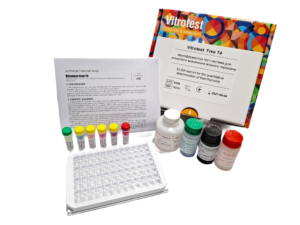
The test kit Vitrotest® Free T4 is an enzyme linked immunosorbent assay (ELISA) for the quantitative determination of free thyroxine (FT4) in human serum or plasma. Determination of free thyroxine concentration in the test kit Vitrotest® Free T4 is based on a competitive ELISA with a two-step incubation.
- TK151 - 96 tests
- Solid phase: strip ELISA plate pre-coated with monoclonal antibodies specific to thyroxine.
- Conjugate: buffer solution of thyroxine conjugated with horseradish peroxidase.
- Chromogen: ready to use TMB solution.
- Sample volume: 20 μl.
- Assay time: 1 h 15 min.
- Analytical sensitivity: 0,254 ng/dl.
According to WHO, thyroid diseases are the second most common endocrine disorders after diabetes mellitus. Over 200 million people worldwide suffer from various forms of thyroid dysfunction. In Ukraine, the number of people with thyroid diseases has increased fivefold over the past 5 years. The main pathological conditions include hyperthyroidism, hypothyroidism, autoimmune thyroid diseases, benign and malignant neoplasms.
The main hormones produced by the thyroid gland are thyroxine or tetraiodothyronine (T4, containing four iodine atoms) and triiodothyronine (T3, containing three iodine atoms). They are lipophilic and circulate in the blood mainly bound to transport proteins: thyroxine-binding globulin (TBG), transthyretin (thyroxine-binding prealbumin), and albumin. However, the biologically active forms are free triiodothyronine and free thyroxine, which represent only 0.3% and 0.03% of total T3 and T4 in serum, respectively.
Overall, FT4 has minimal hormonal activity, but its long half-life (8 days) serves as a reservoir or prohormone for active free triiodothyronine, which binds to nuclear receptors.
All processes required for the synthesis and release of T3 and T4 are controlled by thyroid-stimulating hormone (TSH), secreted by pituitary thyrotropic cells. TSH secretion is regulated through pituitary negative feedback: elevated free T4 and T3 levels suppress TSH synthesis and secretion, while decreased levels increase TSH secretion.
Determination of TSH and free thyroxine concentrations are the primary tests for diagnosing thyroid dysfunction. FT4 is an important marker for differentiating subclinical hyperthyroidism from overt hyperthyroidism or hypothyroidism, for investigating suspected abnormal TSH secretion, TSH-secreting pituitary adenomas, and for monitoring treatment of thyroid diseases.
-
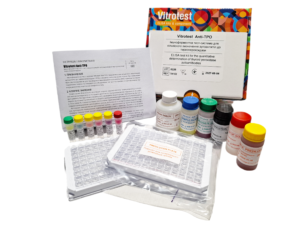
The test kit Vitrotest Anti-TPO is an enzyme linked immunosorbent assay (ELISA) for the quantitative determination of autoantibodies to thyroid peroxidase (TPO) in human serum or plasma. Determination of autoantibodies to thyroid peroxidase in the test kit Vitrotest Anti-TPO is based on a solid phase, indirect ELISA in a two-step incubation procedure.
- TK152 - 96 tests
- Solid phase: strip ELISA plate pre-coated with recombinant thyroid peroxidase.
- Conjugate: buffer solution of monoclonal antibodies to human IgG conjugated with horseradish peroxidase.
- Chromogen: ready to use TMB solution.
- Sample volume: 10 μl.
- Assay time: 1 h 15 min.
- Analytical sensitivity: 2,17 IU/ml.
- Linearity range: 3,125 - 410 IU/ml.
According to WHO, thyroid diseases are the second most widespread endocrine disorders after diabetes mellitus. Over 200 million people worldwide suffer from various types of thyroid dysfunction. In Ukraine, over the past 5 years, the number of people with thyroid diseases has increased fivefold.
Autoimmune thyroid diseases represent a diverse group of organ-specific autoimmune disorders, the most common of which are Hashimoto’s thyroiditis and Graves’ disease. The pathological process is associated with the formation of autoantibodies to thyroid peroxidase and thyroglobulin.
Thyroid peroxidase is a membrane-bound enzyme responsible for iodine oxidation and iodination of tyrosyl residues in the thyroglobulin molecule during the synthesis of thyroid hormones T3 and T4. Most anti-TPO antibodies belong to the IgG1 subclass, which activates complement. Additionally, anti-TPO antibodies can bind through their Fc fragment to natural killer cells, which in turn cause cytotoxic damage to thyrocytes.
Damage to thyroid cells, as well as direct enzyme inhibition, can lead to insufficient hormone production (hypothyroidism), sometimes preceded by transient hyperthyroidism. Besides thyroid disorders, elevated anti-TPO titers may also occur in a wide range of diseases: pernicious anemia, systemic lupus erythematosus, rheumatoid arthritis, insulin-dependent diabetes mellitus, breast cancer, and others. A correlation has also been established between anti-TPO antibodies and obstetric complications, such as postpartum thyroiditis or postpartum depression.
Anti-TPO antibodies may be present in individuals without clinical or laboratory signs of thyroid dysfunction. The presence of anti-TPO without overt disease is associated with a higher risk of developing autoimmune thyroiditis in the future and, together with TSH levels, is used to predict the development of hypo- and hyperthyroidism.
In modern laboratory diagnostics, ELISA is widely used for determining the concentration of autoantibodies to thyroid peroxidase due to its simplicity, convenience, high sensitivity, and specificity. Standardization of quantitative determination of anti-TPO in human serum or plasma is ensured by the use of the WHO International Standard with assigned concentration in IU/ml for preparation of internal ELISA calibrators.
-
The test kit Vitrotest® TSH is an enzyme linked immunosorbent assay (ELISA) for the quantitative determination of thyroid-stimulating hormone (TSH) in human serum or plasma. Determination of thyroid-stimulating hormone concentration in the test kit Vitrotest® TSH is based on a solid-phase sandwich ELISA in a two-step incubation procedure.
- TK148 - 96 tests
- TK149 - 192 tests
- Solid phase: strip ELISA plate pre-coated with the first monoclonal antibodies specific to the β-subunit of human thyroid-stimulating hormone.
- Conjugate: monoclonal antibodies to human TSH conjugated with horseradish peroxidase.
- Chromogen: ready to use TMB solution.
- Sample volume: 50 μl.
- Assay time: 2 h.
- Analytical sensitivity: 0,106 μIU/ml.
- Linearity range: 0,125-16,4 µIU/ml.
According to the World Health Organization (WHO), thyroid diseases are the second most common endocrine disorders after diabetes mellitus. Over 200 million people worldwide suffer from various forms of thyroid dysfunction. In Ukraine, over the past 5 years, the number of people with thyroid diseases has increased fivefold. The main pathological conditions include hyperthyroidism, hypothyroidism, autoimmune thyroid diseases, benign and malignant neoplasms. A connection has also been established between thyroid dysfunction and other diseases such as diabetes, cardiovascular diseases, depression, oral diseases, and cancer.
A valuable biomarker of thyroid functional status widely used for screening, diagnosis, and monitoring of thyroid diseases is thyroid-stimulating hormone (TSH). TSH is a glycoprotein hormone synthesized by the anterior pituitary and is a key regulator of thyroid function. The TSH molecule consists of two different non-covalently bound subunits: the α-subunit, identical in amino acid sequence to the α-subunit of chorionic gonadotropin, luteinizing hormone, and follicle-stimulating hormone, and the hormone-specific β-subunit, which is unique. The main function of TSH is to stimulate the thyroid gland to synthesize and secrete thyroid hormones – thyroxine (T4) and triiodothyronine (T3). TSH binds to the TSH receptor on thyrocytes and activates intracellular signaling cascades that regulate iodine uptake, thyroid metabolism, thyroid growth, and hormone secretion. Through negative feedback, T3 and T4 inhibit TSH secretion.
In healthy adults, TSH serum levels are approximately 0.4 to 4.0 μIU/ml, although narrower ranges may be used to better detect subclinical hypothyroidism. Separate reference intervals for TSH are established for pregnant women, infants, and young children. TSH secretion has pulsatile and circadian patterns, and its concentration depends on factors such as age, sex, ethnicity, iodine intake, reproductive status, and body mass index.
Over the last three decades, laboratory methods used to determine TSH levels have significantly improved. Among immunochemical methods, ELISA has gained wide application due to its convenience, simplicity, high reproducibility, and sensitivity for determining thyroid-stimulating hormone in human serum and plasma.
The standardization of quantitative determination of TSH in human serum or plasma is ensured by the use of the WHO International Standard with assigned TSH concentration in μIU/ml for preparation of internal ELISA calibrators.
-
The test kit Vitrotest® Free T3 is an enzyme linked immunosorbent assay (ELISA) for the quantitative determination of free triiodothyronine (FT3) in human serum or plasma. Determination of free triiodothyronine concentration in the test kit Vitrotest® Free T3 is based on a competitive ELISA with a two-step incubation.
- TK150 - 96 tests
- Solid phase: strip ELISA plate pre-coated with triiodothyronine.
- Conjugate: buffer solution of monoclonal antibodies specific to triiodothyronine conjugated with horseradish peroxidase.
- Chromogen: ready to use TMB solution.
- Sample volume: 25 μl.
- Assay time: 1 h 15 min.
- Analytical sensitivity: 0,5 pg/ml.
According to data from the World Health Organization (WHO), thyroid diseases are the second most common endocrine disorders after diabetes mellitus. More than 200 million people worldwide suffer from various forms of thyroid dysfunction. In Ukraine, over the past five years, the number of people with thyroid diseases has increased fivefold. The main pathological conditions include hyperthyroidism, hypothyroidism, autoimmune thyroid diseases, benign and malignant neoplasms, etc.
The main hormones produced by the thyroid gland are thyroxine or tetraiodothyronine (T4, containing four iodine atoms) and triiodothyronine (T3, containing three iodine atoms). These hormones are lipophilic and circulate in the blood mainly bound to transport proteins: thyroxine-binding globulin (TBG), transthyretin (also known as thyroxine-binding prealbumin), and albumin. However, only free triiodothyronine and free thyroxine are functionally active, accounting for just 0.3% and 0.03% of total T3 and T4 in blood serum, respectively.
Free triiodothyronine is the biologically active form that directly enters target cells and binds to nuclear receptors to regulate gene expression and cellular function. Free thyroxine has minimal hormonal activity, but its long half-life (8 days) serves as a reservoir or prohormone for free triiodothyronine. All reactions required for the formation and release of T3 and T4 are controlled by thyroid-stimulating hormone (TSH) through a negative feedback mechanism.
Although determination of TSH and FT4 concentrations are considered the primary tests of choice for diagnosing thyroid dysfunction, measurement of FT3 levels is useful for detecting T3-thyrotoxicosis, complex or unusual manifestations of hyperthyroidism, monitoring thyroid disease treatment, and assessing metabolism.
Accumulated evidence indicates that changes in FT3 levels are also closely associated with a number of systemic disorders, such as cardiovascular diseases, dyslipidemia, type 2 diabetes mellitus, and liver dysfunction, highlighting the clinical importance of FT3 monitoring as a functional indicator of thyroid status.
-
The test kit Vitrotest® Free T4 is an enzyme linked immunosorbent assay (ELISA) for the quantitative determination of free thyroxine (FT4) in human serum or plasma. Determination of free thyroxine concentration in the test kit Vitrotest® Free T4 is based on a competitive ELISA with a two-step incubation.
- TK151 - 96 tests
- Solid phase: strip ELISA plate pre-coated with monoclonal antibodies specific to thyroxine.
- Conjugate: buffer solution of thyroxine conjugated with horseradish peroxidase.
- Chromogen: ready to use TMB solution.
- Sample volume: 20 μl.
- Assay time: 1 h 15 min.
- Analytical sensitivity: 0,254 ng/dl.
According to WHO, thyroid diseases are the second most common endocrine disorders after diabetes mellitus. Over 200 million people worldwide suffer from various forms of thyroid dysfunction. In Ukraine, the number of people with thyroid diseases has increased fivefold over the past 5 years. The main pathological conditions include hyperthyroidism, hypothyroidism, autoimmune thyroid diseases, benign and malignant neoplasms.
The main hormones produced by the thyroid gland are thyroxine or tetraiodothyronine (T4, containing four iodine atoms) and triiodothyronine (T3, containing three iodine atoms). They are lipophilic and circulate in the blood mainly bound to transport proteins: thyroxine-binding globulin (TBG), transthyretin (thyroxine-binding prealbumin), and albumin. However, the biologically active forms are free triiodothyronine and free thyroxine, which represent only 0.3% and 0.03% of total T3 and T4 in serum, respectively.
Overall, FT4 has minimal hormonal activity, but its long half-life (8 days) serves as a reservoir or prohormone for active free triiodothyronine, which binds to nuclear receptors.
All processes required for the synthesis and release of T3 and T4 are controlled by thyroid-stimulating hormone (TSH), secreted by pituitary thyrotropic cells. TSH secretion is regulated through pituitary negative feedback: elevated free T4 and T3 levels suppress TSH synthesis and secretion, while decreased levels increase TSH secretion.
Determination of TSH and free thyroxine concentrations are the primary tests for diagnosing thyroid dysfunction. FT4 is an important marker for differentiating subclinical hyperthyroidism from overt hyperthyroidism or hypothyroidism, for investigating suspected abnormal TSH secretion, TSH-secreting pituitary adenomas, and for monitoring treatment of thyroid diseases.
-
The test kit Vitrotest Anti-TPO is an enzyme linked immunosorbent assay (ELISA) for the quantitative determination of autoantibodies to thyroid peroxidase (TPO) in human serum or plasma. Determination of autoantibodies to thyroid peroxidase in the test kit Vitrotest Anti-TPO is based on a solid phase, indirect ELISA in a two-step incubation procedure.
- TK152 - 96 tests
- Solid phase: strip ELISA plate pre-coated with recombinant thyroid peroxidase.
- Conjugate: buffer solution of monoclonal antibodies to human IgG conjugated with horseradish peroxidase.
- Chromogen: ready to use TMB solution.
- Sample volume: 10 μl.
- Assay time: 1 h 15 min.
- Analytical sensitivity: 2,17 IU/ml.
- Linearity range: 3,125 - 410 IU/ml.
According to WHO, thyroid diseases are the second most widespread endocrine disorders after diabetes mellitus. Over 200 million people worldwide suffer from various types of thyroid dysfunction. In Ukraine, over the past 5 years, the number of people with thyroid diseases has increased fivefold.
Autoimmune thyroid diseases represent a diverse group of organ-specific autoimmune disorders, the most common of which are Hashimoto’s thyroiditis and Graves’ disease. The pathological process is associated with the formation of autoantibodies to thyroid peroxidase and thyroglobulin.
Thyroid peroxidase is a membrane-bound enzyme responsible for iodine oxidation and iodination of tyrosyl residues in the thyroglobulin molecule during the synthesis of thyroid hormones T3 and T4. Most anti-TPO antibodies belong to the IgG1 subclass, which activates complement. Additionally, anti-TPO antibodies can bind through their Fc fragment to natural killer cells, which in turn cause cytotoxic damage to thyrocytes.
Damage to thyroid cells, as well as direct enzyme inhibition, can lead to insufficient hormone production (hypothyroidism), sometimes preceded by transient hyperthyroidism. Besides thyroid disorders, elevated anti-TPO titers may also occur in a wide range of diseases: pernicious anemia, systemic lupus erythematosus, rheumatoid arthritis, insulin-dependent diabetes mellitus, breast cancer, and others. A correlation has also been established between anti-TPO antibodies and obstetric complications, such as postpartum thyroiditis or postpartum depression.
Anti-TPO antibodies may be present in individuals without clinical or laboratory signs of thyroid dysfunction. The presence of anti-TPO without overt disease is associated with a higher risk of developing autoimmune thyroiditis in the future and, together with TSH levels, is used to predict the development of hypo- and hyperthyroidism.
In modern laboratory diagnostics, ELISA is widely used for determining the concentration of autoantibodies to thyroid peroxidase due to its simplicity, convenience, high sensitivity, and specificity. Standardization of quantitative determination of anti-TPO in human serum or plasma is ensured by the use of the WHO International Standard with assigned concentration in IU/ml for preparation of internal ELISA calibrators.