
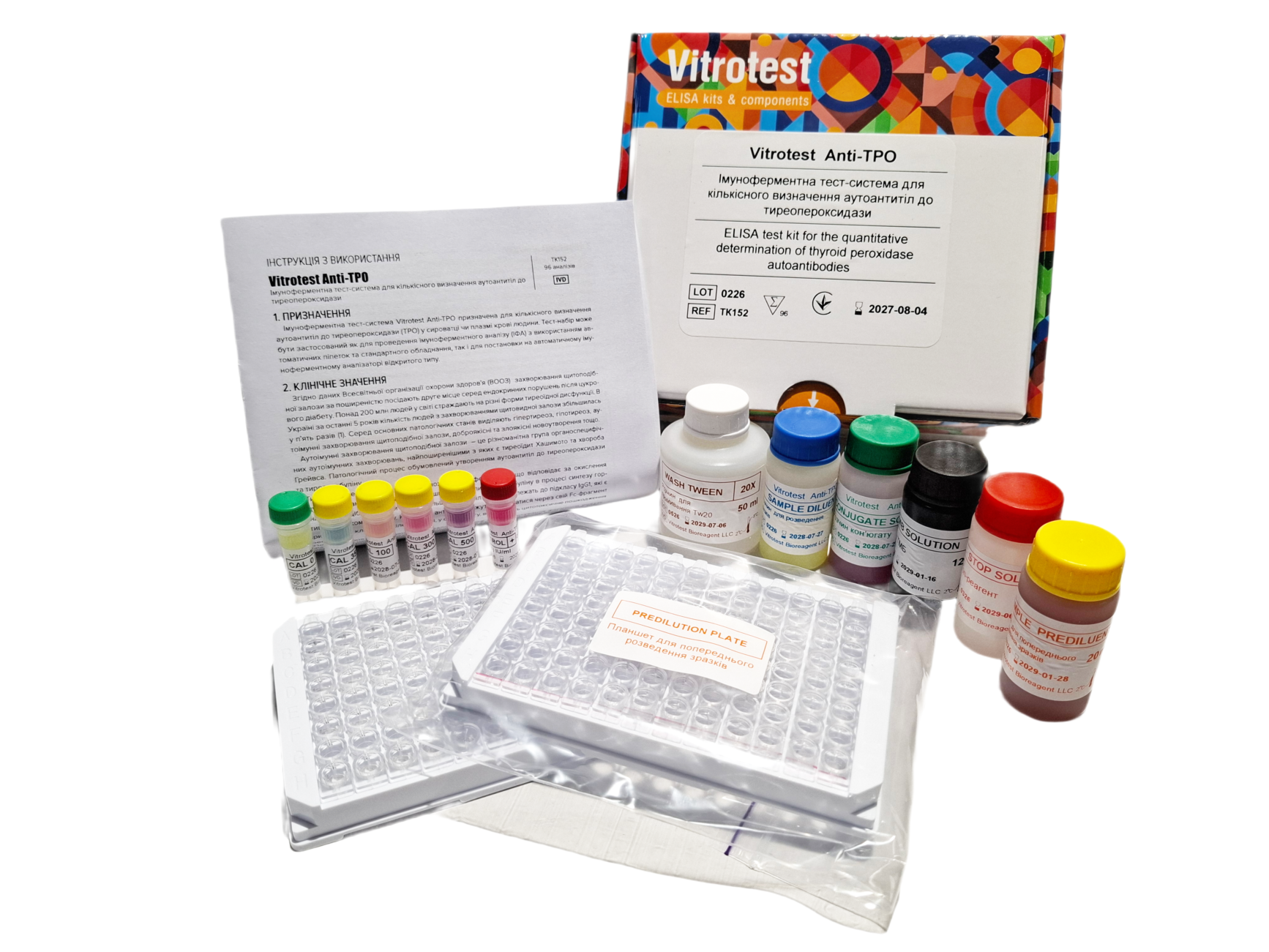
The test kit Vitrotest Anti-TPO is an enzyme linked immunosorbent assay (ELISA) for the quantitative determination of autoantibodies to thyroid peroxidase (TPO) in human serum or plasma.
Determination of autoantibodies to thyroid peroxidase in the test kit Vitrotest Anti-TPO is based on a solid phase, indirect ELISA in a two-step incubation procedure.
- TK152 – 96 tests
- Solid phase: strip ELISA plate pre-coated with recombinant thyroid peroxidase.
- Conjugate: buffer solution of monoclonal antibodies to human IgG conjugated with horseradish peroxidase.
- Chromogen: ready to use TMB solution.
- Sample volume: 10 μl.
- Assay time: 1 h 15 min.
- Analytical sensitivity: 2,17 IU/ml.
- Linearity range: 3,125 – 410 IU/ml.
According to WHO, thyroid diseases are the second most widespread endocrine disorders after diabetes mellitus. Over 200 million people worldwide suffer from various types of thyroid dysfunction. In Ukraine, over the past 5 years, the number of people with thyroid diseases has increased fivefold.
Autoimmune thyroid diseases represent a diverse group of organ-specific autoimmune disorders, the most common of which are Hashimoto’s thyroiditis and Graves’ disease. The pathological process is associated with the formation of autoantibodies to thyroid peroxidase and thyroglobulin.
Thyroid peroxidase is a membrane-bound enzyme responsible for iodine oxidation and iodination of tyrosyl residues in the thyroglobulin molecule during the synthesis of thyroid hormones T3 and T4. Most anti-TPO antibodies belong to the IgG1 subclass, which activates complement. Additionally, anti-TPO antibodies can bind through their Fc fragment to natural killer cells, which in turn cause cytotoxic damage to thyrocytes.
Damage to thyroid cells, as well as direct enzyme inhibition, can lead to insufficient hormone production (hypothyroidism), sometimes preceded by transient hyperthyroidism. Besides thyroid disorders, elevated anti-TPO titers may also occur in a wide range of diseases: pernicious anemia, systemic lupus erythematosus, rheumatoid arthritis, insulin-dependent diabetes mellitus, breast cancer, and others. A correlation has also been established between anti-TPO antibodies and obstetric complications, such as postpartum thyroiditis or postpartum depression.
Anti-TPO antibodies may be present in individuals without clinical or laboratory signs of thyroid dysfunction. The presence of anti-TPO without overt disease is associated with a higher risk of developing autoimmune thyroiditis in the future and, together with TSH levels, is used to predict the development of hypo- and hyperthyroidism.
In modern laboratory diagnostics, ELISA is widely used for determining the concentration of autoantibodies to thyroid peroxidase due to its simplicity, convenience, high sensitivity, and specificity. Standardization of quantitative determination of anti-TPO in human serum or plasma is ensured by the use of the WHO International Standard with assigned concentration in IU/ml for preparation of internal ELISA calibrators.