
-
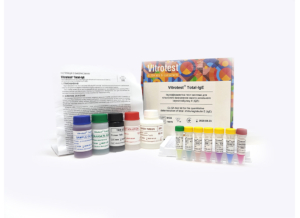
The test kit Vitrotest® Total-IgE is an enzyme linked immunosorbent assay (ELISA) for the quantitative determination of total immunoglobulin E (IgE) in human serum or plasma.
Determination of total IgE content in the test kit Vitrotest® Total-IgE is based on a solid-phase “sandwich” ELISA.
○ ТК070 - 96 tests- Solid phase: breakable microplate ELISA is coated with monoclonal antibodies specific to human IgE.
- Conjugate: a monoclonal antibodies to human IgЕ conjugated to horseradish peroxidase.
- Chromogen: ready to use TMB solution.
- Volume of sample for analysis: 10 μl.
- Assay time: 1h 15 min.
- Analytical sensitivity: 2,1 IU/ml.
- Linearity range: 2,1-1000 IU/ml.
According to the World Health Organization, 10-20 % of the world’s population suffers from allergic bronchial asthma, allergic rhinitis, atopic dermatitis and other allergic reactions, moreover, the number of such patients increases every year. According to statistics, from 5 to 15% of children have food allergies, which further leads to the development of various allergic diseases.
Allergy or hypersensitivity is a state of altered reactivity of the body in the form of its increased sensitivity to repeated exposure of substances called allergens. As a result of repeated contact with the allergen, an excessively strong immune reaction of the body occurs, accompanied by tissue damage. One of the mechanisms underlying this process is mast cell degranulation mediated by immunoglobulin class E (IgE). According to the literature data, in an adult, the normal concentration of IgE can reach 100 IU/ml and decreases in the elderly. During allergy the IgE level can rise to 2000 IU/ml and above.
Among often diseases that accompanied by an increase in total IgE in the blood, as well as the presence of specific IgE are allergic rhinitis, atopic bronchial asthma, atopic dermatitis, urticaria, aspergillosis and helminthiases, etc. Less common diseases with hyper-IgE syndrome include congenital immunodeficiencies (Job syndrome, DiGeorge syndrome), selective IgA deficiency, WiskottAldridge syndrome and IgEmyeloma. Also, in clinical practice, there are often cases of elevated IgE levels associated with the action of several medications.
Nowadays, the methods of in vitro allergy diagnostics are becoming increasingly popular, one of which is ELISA for the determination of the total IgE content. This method is characterized by several advantages: it has no contraindications to the test, it does not cause additional sensitization and there is no risk of anaphylactic reactions. Most test systems are based on the «sandwich» ELISA, in which the use of monoclonal antibodies to human immunoglobulins E provides high sensitivity and specificity of the analysis. Standardization of the quantitative determination of IgE in human serum or plasma is ensured by using for the manufacture of internal calibrators ELISA kits of the WHO International Standard with an established concentration of human IgE in international units IU/ml.
Since the ELISA method is a highly sensitive and specific analysis and has no contraindications for its application, it can be widely used for the diagnosis of allergic diseases. -
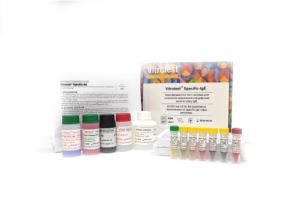
The test kit Vitrotest® Specific-IgE is an enzyme linked immunosorbent assay (ELISA) for the quantitative determination of specific IgE class antibodies in human serum or plasma. The test kit is used together with biotinylated allergens Vitrotest® XX-Biotin, where XX is a code of relevant allergen or mixture.
Quantitative determination of specific IgE antibodies in the Vitrotest® Specific-IgE test kit is based on the principle of capturing IgE antibodies followed by the use of biotin-streptavidin interaction.
○ ТК071 - 192 tests- Solid phase: breakable microplate ELISA is coated with monoclonal antibodies specific to human IgE.
- Biotinylated anti-IgE: biotinylated anti-IgE antibodies.
- Conjugate streptavidin-HRP: streptavidin сonjugated to horseradish peroxidase.
- Chromogen: ready to use TMB solution.
- Volume of sample for analysis: 50 μl.
- Assay time: 1h 30 min.
- Analytical sensitivity: 0,080 IU/ml.
- Linearity range: 0,2-50 IU/ml.
Allergic diseases are among the most common diseases in the world and the severity of these conditions continues to increase. Allergy, or hypersensitivity, is a state of altered reactivity of the body in the form of increased sensitivity to repeated exposure to substances called allergens. As a result of repeated contact with the allergen, an excessively strong immune reaction of the body occurs, accompanied by tissue damage. One mechanism underlying this process is immunoglobulin E (IgE)-mediated mast cell degranulation.
The most common allergic conditions that require proper diagnosis are: anaphylaxis, allergic rhinitis, allergic conjunctivitis, bronchial asthma, etc. Accurate diagnosis coupled with optimal therapy requires the use of appropriate tests to confirm sensitization to a specific allergen and detailed information about the effect of the suspected allergen.
To diagnose in vivo allergies, several types of skin tests are used (skin prick test, intradermal test, patch test). However, the use of these samples has a number of significant limitations, namely, the need for a highly qualified doctor conducting the test and the lack of laboratories conducting these studies. In addition, in vivo diagnosis is rarely performed in children due to possible adverse reactions.
However, in vitro diagnostics of IgE-mediated allergic diseases are useful for identifying the causative allergen and usually include the following laboratory approaches:
1) determination of the level of total IgE;
2) study of the concentration of specific IgE to various allergens - is the most commonly used in vitro
diagnostic approach, performed using a single or multiplex strategy;
3) basophil activation test (BAT), which is quite specific, but difficult to perform, and therefore limited to selected situations.
Today, to detect specific antibodies of the IgE class, the enzyme-linked immunosorbent assay method, which provides high sensitivity and specificity, has become widely used. A separate supply of a wide range of biotinylated allergens, depending on the needs of the diagnostic laboratory, ensures maximum convenience and cost-effectiveness of the study. -
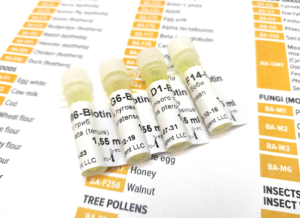
Biotinylated allergens Vitrotest® XX-Biotin for the quantitative determination of specific IgE class antibodies in human serum or plasma. It is used exclusively with the
Vitrotest® Specific-IgE test kit.
○ 1 vial - 30 testsBiotinylated allergens Vitrotest® XX-Biotin, where XX is the code of the relevant allergen or mixture - each microtube contains 1.55 ml of a solution of biotinylated allergens, ready to use. The content of one bottle is enough to conduct 30 studies.
№ Allergen name BA-D1 Dermatophagoides pteronyssinus BA-D2 Dermatophagoides farina BA-Н1 House Dust Mixture № Allergen name BA-E1 Cat (epithelial) BA-E2 Dog (epithelial) BA-E3 Horse (epithelial) BA-E6 Guinea Pig (epithelial) BA-E70 Goose (feathers) BA-E78 Budgerigar (feathers) BA-E82 Rabbit (еpithelia) BA-E84 Hamster (epithelia) BA-E85 Chicken (feathers) BA-E86 Duck (feathers) № Allergen name BA-F1 Egg white BA-F2 Cow milk BA-F3 Сod BA-F4 Wheat flour BA-F5 Rye flour BA-F6 Barley flour BA-F7 Oats flour BA-F8 Corn flour BA-F9 Rice BA-F10 Sesamе BA-F11 Buckwheat flour BA-F13 Peanut BA-F14 Soybean BA-F17 Hazelnut BA-F20 Almond BA-F23 Crab meat BA-F24 Shrimp BA-F25 Tomato BA-F26 Pork BA-F27 Beef BA-F31 Carrot BA-F33 Orange BA-F34 Mandarin BA-F35 Potato BA-F37 Mussel BA-F41 Salmon BA-F44 Strawberry BA-F45 Baker’s yeast BA-F49 Apple BA-F75 Egg yolk BA-F76 Alpha-lactalbumin BA-F77 Beta-lactoglobulin BA-F78 Caseine BA-F79 Gluten BA-F83 Chicken meat BA-F84 Kiwi BA-F92 Banana BA-F93 Cocoa BA-F94 Pear BA-F205 Herring BA-F206 Mackerel BA-F208 Lemon BA-F213 Rabbit meat BA-F221 Coffee BA-F245 Whole Egg BA-F247 Honey BA-F256 Walnut BA-F259 Grape BA-F328 Fig BA-F343 Raspberry № Allergen name BA-T2 European Alder / Alnus glutinosa BA-T3 Silver Birch/Betula verrucosa BA-T4 Common Hazel / Corylus avellana BA-T7 Common Oak/ Quercus robur BA-Т12 Goat Willow/ Salix caprea BA-T14 Eastern Cottonwood /Populus deltoides № Allergen name BA-W1 Common Ragweed/ Ambrosia elatior BA-W6 Common Mugwort/ Artemisia vulgaris BA-W8 Common Dandelion/ Taraxacum vulgare BA-W9 Ribwort Plantain/ Plantago lanceolata BA-W10 White Goosefoot/ Chenopodium album BA-W12 European Goldenrod/ Solidago virgaurea № Allergen name BA-G2 Bermuda Grass/ Cynodon dactylon BA-G3 Cock’s-foot/ Dactylis glomerata BA-G4 Red Fescue/ Festuca elatior BA-G5 Perennial Ryegrass/ Lolium perenne BA-G6 Timothy Grass/ Phleum pratense BA-G8 Kentucky Bluegrass/ Poa pratensis BA-G12 Rye/ Secale cereale № Allergen name BA-M1 Penicillium notatum BA-M2 Cladosporium herbarum BA-M3 Aspergillus fumigatus BA-M4 Mucor racemosus BA-M5 Candida albicans BA-M6 Alternaria alternata (tenius) № Allergen name BA-I1 Bee Venom/ Apis mellifera BA-I3 Wasp Venom/ Vespula spp. BA-I6 Cockroach/ Blatella germanica № Allergen name BA-DEM1 Indoor allergens mixture:
D. pteronyssinus (D1), D. farinae (D2), Cat (epithelial) (E1), Dog (epithelial) (E2)BA-EМ1 Feathers mixture:
Goose (E70), Chicken (E85), Duck (E86)BA-FM1 Food mixture (seafood):
Crab meat (F23), Shrimp (F24), Mussel (F37)BA-FM2 Food mixture (cereals):
Wheat flour (F4), Rye flour (F5), Barley flour (F6), Oats flour (F7), Corn flour (F8), Sesame (F10), Buckwheat flour (F11)BA-FM3 Food mixture (fish):
Cod (F3), Salmon (F41), Herring (F205), Mackerel (F206)BA-TM1 Tree pollens mixture:
Alnus glutinosa (T2), Corylus avellana (T4), Betula verrucosa (T3), Quercus robur (T7), Salix caprea (T12), Populus deltoides (T14)BA-TM2 Tree pollens mixture (early flowering):
Alnus glutinosa (T2), Betula verrucosa (T3), Corylus avellana (T4)BA-TM3 Tree pollens mixture (late flowering):
Quercus robur (T7), Salix caprea (T12), Populus deltoides (T14)BA-WМ1 Weed pollen mixture:
Ambrosia elatior (W1), Artemisia vulgaris (W6), Taraxacum officinale (W8), Plantago lanceolata (W9), Solidago virgaurea (W12)BA-GМ1 Meadow grass pollens mixture:
Cynodon dactylon (G2), Dactylis glomerata (G3), Festuca elatior (G4), Phleum pratense (G6), Secale cereale (G12)
-
The test kit Vitrotest® Total-IgE is an enzyme linked immunosorbent assay (ELISA) for the quantitative determination of total immunoglobulin E (IgE) in human serum or plasma.
Determination of total IgE content in the test kit Vitrotest® Total-IgE is based on a solid-phase “sandwich” ELISA.
○ ТК070 - 96 tests- Solid phase: breakable microplate ELISA is coated with monoclonal antibodies specific to human IgE.
- Conjugate: a monoclonal antibodies to human IgЕ conjugated to horseradish peroxidase.
- Chromogen: ready to use TMB solution.
- Volume of sample for analysis: 10 μl.
- Assay time: 1h 15 min.
- Analytical sensitivity: 2,1 IU/ml.
- Linearity range: 2,1-1000 IU/ml.
According to the World Health Organization, 10-20 % of the world’s population suffers from allergic bronchial asthma, allergic rhinitis, atopic dermatitis and other allergic reactions, moreover, the number of such patients increases every year. According to statistics, from 5 to 15% of children have food allergies, which further leads to the development of various allergic diseases.
Allergy or hypersensitivity is a state of altered reactivity of the body in the form of its increased sensitivity to repeated exposure of substances called allergens. As a result of repeated contact with the allergen, an excessively strong immune reaction of the body occurs, accompanied by tissue damage. One of the mechanisms underlying this process is mast cell degranulation mediated by immunoglobulin class E (IgE). According to the literature data, in an adult, the normal concentration of IgE can reach 100 IU/ml and decreases in the elderly. During allergy the IgE level can rise to 2000 IU/ml and above.
Among often diseases that accompanied by an increase in total IgE in the blood, as well as the presence of specific IgE are allergic rhinitis, atopic bronchial asthma, atopic dermatitis, urticaria, aspergillosis and helminthiases, etc. Less common diseases with hyper-IgE syndrome include congenital immunodeficiencies (Job syndrome, DiGeorge syndrome), selective IgA deficiency, WiskottAldridge syndrome and IgEmyeloma. Also, in clinical practice, there are often cases of elevated IgE levels associated with the action of several medications.
Nowadays, the methods of in vitro allergy diagnostics are becoming increasingly popular, one of which is ELISA for the determination of the total IgE content. This method is characterized by several advantages: it has no contraindications to the test, it does not cause additional sensitization and there is no risk of anaphylactic reactions. Most test systems are based on the «sandwich» ELISA, in which the use of monoclonal antibodies to human immunoglobulins E provides high sensitivity and specificity of the analysis. Standardization of the quantitative determination of IgE in human serum or plasma is ensured by using for the manufacture of internal calibrators ELISA kits of the WHO International Standard with an established concentration of human IgE in international units IU/ml.
Since the ELISA method is a highly sensitive and specific analysis and has no contraindications for its application, it can be widely used for the diagnosis of allergic diseases. -
The test kit Vitrotest® Specific-IgE is an enzyme linked immunosorbent assay (ELISA) for the quantitative determination of specific IgE class antibodies in human serum or plasma. The test kit is used together with biotinylated allergens Vitrotest® XX-Biotin, where XX is a code of relevant allergen or mixture.
Quantitative determination of specific IgE antibodies in the Vitrotest® Specific-IgE test kit is based on the principle of capturing IgE antibodies followed by the use of biotin-streptavidin interaction.
○ ТК071 - 192 tests- Solid phase: breakable microplate ELISA is coated with monoclonal antibodies specific to human IgE.
- Biotinylated anti-IgE: biotinylated anti-IgE antibodies.
- Conjugate streptavidin-HRP: streptavidin сonjugated to horseradish peroxidase.
- Chromogen: ready to use TMB solution.
- Volume of sample for analysis: 50 μl.
- Assay time: 1h 30 min.
- Analytical sensitivity: 0,080 IU/ml.
- Linearity range: 0,2-50 IU/ml.
Allergic diseases are among the most common diseases in the world and the severity of these conditions continues to increase. Allergy, or hypersensitivity, is a state of altered reactivity of the body in the form of increased sensitivity to repeated exposure to substances called allergens. As a result of repeated contact with the allergen, an excessively strong immune reaction of the body occurs, accompanied by tissue damage. One mechanism underlying this process is immunoglobulin E (IgE)-mediated mast cell degranulation.
The most common allergic conditions that require proper diagnosis are: anaphylaxis, allergic rhinitis, allergic conjunctivitis, bronchial asthma, etc. Accurate diagnosis coupled with optimal therapy requires the use of appropriate tests to confirm sensitization to a specific allergen and detailed information about the effect of the suspected allergen.
To diagnose in vivo allergies, several types of skin tests are used (skin prick test, intradermal test, patch test). However, the use of these samples has a number of significant limitations, namely, the need for a highly qualified doctor conducting the test and the lack of laboratories conducting these studies. In addition, in vivo diagnosis is rarely performed in children due to possible adverse reactions.
However, in vitro diagnostics of IgE-mediated allergic diseases are useful for identifying the causative allergen and usually include the following laboratory approaches:
1) determination of the level of total IgE;
2) study of the concentration of specific IgE to various allergens - is the most commonly used in vitro
diagnostic approach, performed using a single or multiplex strategy;
3) basophil activation test (BAT), which is quite specific, but difficult to perform, and therefore limited to selected situations.
Today, to detect specific antibodies of the IgE class, the enzyme-linked immunosorbent assay method, which provides high sensitivity and specificity, has become widely used. A separate supply of a wide range of biotinylated allergens, depending on the needs of the diagnostic laboratory, ensures maximum convenience and cost-effectiveness of the study. -
Biotinylated allergens Vitrotest® XX-Biotin for the quantitative determination of specific IgE class antibodies in human serum or plasma. It is used exclusively with the
Vitrotest® Specific-IgE test kit.
○ 1 vial - 30 testsBiotinylated allergens Vitrotest® XX-Biotin, where XX is the code of the relevant allergen or mixture - each microtube contains 1.55 ml of a solution of biotinylated allergens, ready to use. The content of one bottle is enough to conduct 30 studies.
№ Allergen name BA-D1 Dermatophagoides pteronyssinus BA-D2 Dermatophagoides farina BA-Н1 House Dust Mixture № Allergen name BA-E1 Cat (epithelial) BA-E2 Dog (epithelial) BA-E3 Horse (epithelial) BA-E6 Guinea Pig (epithelial) BA-E70 Goose (feathers) BA-E78 Budgerigar (feathers) BA-E82 Rabbit (еpithelia) BA-E84 Hamster (epithelia) BA-E85 Chicken (feathers) BA-E86 Duck (feathers) № Allergen name BA-F1 Egg white BA-F2 Cow milk BA-F3 Сod BA-F4 Wheat flour BA-F5 Rye flour BA-F6 Barley flour BA-F7 Oats flour BA-F8 Corn flour BA-F9 Rice BA-F10 Sesamе BA-F11 Buckwheat flour BA-F13 Peanut BA-F14 Soybean BA-F17 Hazelnut BA-F20 Almond BA-F23 Crab meat BA-F24 Shrimp BA-F25 Tomato BA-F26 Pork BA-F27 Beef BA-F31 Carrot BA-F33 Orange BA-F34 Mandarin BA-F35 Potato BA-F37 Mussel BA-F41 Salmon BA-F44 Strawberry BA-F45 Baker’s yeast BA-F49 Apple BA-F75 Egg yolk BA-F76 Alpha-lactalbumin BA-F77 Beta-lactoglobulin BA-F78 Caseine BA-F79 Gluten BA-F83 Chicken meat BA-F84 Kiwi BA-F92 Banana BA-F93 Cocoa BA-F94 Pear BA-F205 Herring BA-F206 Mackerel BA-F208 Lemon BA-F213 Rabbit meat BA-F221 Coffee BA-F245 Whole Egg BA-F247 Honey BA-F256 Walnut BA-F259 Grape BA-F328 Fig BA-F343 Raspberry № Allergen name BA-T2 European Alder / Alnus glutinosa BA-T3 Silver Birch/Betula verrucosa BA-T4 Common Hazel / Corylus avellana BA-T7 Common Oak/ Quercus robur BA-Т12 Goat Willow/ Salix caprea BA-T14 Eastern Cottonwood /Populus deltoides № Allergen name BA-W1 Common Ragweed/ Ambrosia elatior BA-W6 Common Mugwort/ Artemisia vulgaris BA-W8 Common Dandelion/ Taraxacum vulgare BA-W9 Ribwort Plantain/ Plantago lanceolata BA-W10 White Goosefoot/ Chenopodium album BA-W12 European Goldenrod/ Solidago virgaurea № Allergen name BA-G2 Bermuda Grass/ Cynodon dactylon BA-G3 Cock’s-foot/ Dactylis glomerata BA-G4 Red Fescue/ Festuca elatior BA-G5 Perennial Ryegrass/ Lolium perenne BA-G6 Timothy Grass/ Phleum pratense BA-G8 Kentucky Bluegrass/ Poa pratensis BA-G12 Rye/ Secale cereale № Allergen name BA-M1 Penicillium notatum BA-M2 Cladosporium herbarum BA-M3 Aspergillus fumigatus BA-M4 Mucor racemosus BA-M5 Candida albicans BA-M6 Alternaria alternata (tenius) № Allergen name BA-I1 Bee Venom/ Apis mellifera BA-I3 Wasp Venom/ Vespula spp. BA-I6 Cockroach/ Blatella germanica № Allergen name BA-DEM1 Indoor allergens mixture:
D. pteronyssinus (D1), D. farinae (D2), Cat (epithelial) (E1), Dog (epithelial) (E2)BA-EМ1 Feathers mixture:
Goose (E70), Chicken (E85), Duck (E86)BA-FM1 Food mixture (seafood):
Crab meat (F23), Shrimp (F24), Mussel (F37)BA-FM2 Food mixture (cereals):
Wheat flour (F4), Rye flour (F5), Barley flour (F6), Oats flour (F7), Corn flour (F8), Sesame (F10), Buckwheat flour (F11)BA-FM3 Food mixture (fish):
Cod (F3), Salmon (F41), Herring (F205), Mackerel (F206)BA-TM1 Tree pollens mixture:
Alnus glutinosa (T2), Corylus avellana (T4), Betula verrucosa (T3), Quercus robur (T7), Salix caprea (T12), Populus deltoides (T14)BA-TM2 Tree pollens mixture (early flowering):
Alnus glutinosa (T2), Betula verrucosa (T3), Corylus avellana (T4)BA-TM3 Tree pollens mixture (late flowering):
Quercus robur (T7), Salix caprea (T12), Populus deltoides (T14)BA-WМ1 Weed pollen mixture:
Ambrosia elatior (W1), Artemisia vulgaris (W6), Taraxacum officinale (W8), Plantago lanceolata (W9), Solidago virgaurea (W12)BA-GМ1 Meadow grass pollens mixture:
Cynodon dactylon (G2), Dactylis glomerata (G3), Festuca elatior (G4), Phleum pratense (G6), Secale cereale (G12)