
-
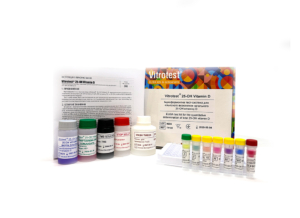
The test kit Vitrotest® 25-OH Vitamin Dis an enzyme linked immunosorbent assay (ELISA) for the quantitative determination of total 25-OH vitamin D (25-OH vitamin D2 and 25-OH vitamin D3) in human serum or plasma.
Determination of total 25-OH vitamin D concentration in the test kit Vitrotest® 25-OH Vitamin D is based on a competitive ELISA with a two-step incubation.
○ TK122 - 96 tests
○ TK124 - 192 tests- Solid phase: a stripped ELISA plate with wells pre-coated with monoclonal antibodies specific to 25-OH vitamin D.
- Biotinylated 25-OH vitamin D solution: biotinylated 25-OH vitamin D.
- Streptavidin-HRP conjugate: streptavidin conjugated with horseradish peroxidase.
- Chromogen: ready to use TMB solution.
- Volume of sample for analysis: 10 µl.
- Assay time: 1 h 30 min.
- Analytical sensitivity: 1,34 ng/ml.
Vitamin D is a fat-soluble steroid prohormone, whose active form is involved in the metabolism of phosphorus and calcium in the human body. Vitamin D, which is produced in the skin (D3, cholecalciferol) or obtained from food (D2, ergocalciferol), is biologically inert and requires two successive hydroxylations. First, 25-OH vitamin D (D2 and D3) is formed in the liver, which, in complex with a binding protein (vitamin D binding protein, VDBP), enters the bloodstream and is transported to the kidneys, where it is converted into the biologically active form 1,25-(OH)2 vitamin D and other metabolites whose roles are still being studied.
25-OH vitamin D is the main storage form of vitamin D in the human body and is present in the blood at much higher concentrations than its active form, 1,25-(OH)2 vitamin D. Its half-life is 2–3 weeks compared to 4-6 hours for 1,25-(OH)2 vitamin D. Additionally, the level of 1,25-(OH)2 vitamin D in serum does not provide information about the vitamin D status and is often normal or even elevated due to secondary hyperparathyroidism associated with vitamin D deficiency. For this reason, 25-OH vitamin D is the analyte of choice for determining the body’s vitamin D status.
According to the literature, the concentration of 25-OH vitamin D in human serum (plasma) within the range of 30-100 ng/ml is sufficient to support all necessary processes in the body that require vitamin D. Most experts consider a level of 25-OH vitamin D < 20 ng/ml to indicate vitamin D deficiency, while 20-30 ng/ml is considered an insufficient level. In Ukraine, only 3.3% of the population have a normal level of vitamin D, 14.9% have an insufficient level, and 81.8% live with its deficiency.
Hypovitaminosis D is widespread in the human population due to minimal exposure to sunlight and low dietary intake of vitamin D. As a result, vitamin D deficiency leads to secondary hyperparathyroidism, followed by loss of bone mass and osteoporosis. There is also evidence that vitamin D deficiency may have other adverse health effects, including an increased risk of malignant neoplasms, cardiovascular diseases, multiple sclerosis, diabetes, and more.
Currently, the reference method for determining the concentration of 25-OH vitamin D is tandem liquid chromatography with mass spectrometry (LC-MS/MS). However, in routine laboratory practice, this method is impractical due to its complexity and the need for specialized personnel. Therefore, immunoassay and immunochemiluminescent methods for determining 25-OH vitamin D have gained widespread use in diagnostic laboratories.
-
The test kit Vitrotest® 25-OH Vitamin Dis an enzyme linked immunosorbent assay (ELISA) for the quantitative determination of total 25-OH vitamin D (25-OH vitamin D2 and 25-OH vitamin D3) in human serum or plasma.
Determination of total 25-OH vitamin D concentration in the test kit Vitrotest® 25-OH Vitamin D is based on a competitive ELISA with a two-step incubation.
○ TK122 - 96 tests
○ TK124 - 192 tests- Solid phase: a stripped ELISA plate with wells pre-coated with monoclonal antibodies specific to 25-OH vitamin D.
- Biotinylated 25-OH vitamin D solution: biotinylated 25-OH vitamin D.
- Streptavidin-HRP conjugate: streptavidin conjugated with horseradish peroxidase.
- Chromogen: ready to use TMB solution.
- Volume of sample for analysis: 10 µl.
- Assay time: 1 h 30 min.
- Analytical sensitivity: 1,34 ng/ml.
Vitamin D is a fat-soluble steroid prohormone, whose active form is involved in the metabolism of phosphorus and calcium in the human body. Vitamin D, which is produced in the skin (D3, cholecalciferol) or obtained from food (D2, ergocalciferol), is biologically inert and requires two successive hydroxylations. First, 25-OH vitamin D (D2 and D3) is formed in the liver, which, in complex with a binding protein (vitamin D binding protein, VDBP), enters the bloodstream and is transported to the kidneys, where it is converted into the biologically active form 1,25-(OH)2 vitamin D and other metabolites whose roles are still being studied.
25-OH vitamin D is the main storage form of vitamin D in the human body and is present in the blood at much higher concentrations than its active form, 1,25-(OH)2 vitamin D. Its half-life is 2–3 weeks compared to 4-6 hours for 1,25-(OH)2 vitamin D. Additionally, the level of 1,25-(OH)2 vitamin D in serum does not provide information about the vitamin D status and is often normal or even elevated due to secondary hyperparathyroidism associated with vitamin D deficiency. For this reason, 25-OH vitamin D is the analyte of choice for determining the body’s vitamin D status.
According to the literature, the concentration of 25-OH vitamin D in human serum (plasma) within the range of 30-100 ng/ml is sufficient to support all necessary processes in the body that require vitamin D. Most experts consider a level of 25-OH vitamin D < 20 ng/ml to indicate vitamin D deficiency, while 20-30 ng/ml is considered an insufficient level. In Ukraine, only 3.3% of the population have a normal level of vitamin D, 14.9% have an insufficient level, and 81.8% live with its deficiency.
Hypovitaminosis D is widespread in the human population due to minimal exposure to sunlight and low dietary intake of vitamin D. As a result, vitamin D deficiency leads to secondary hyperparathyroidism, followed by loss of bone mass and osteoporosis. There is also evidence that vitamin D deficiency may have other adverse health effects, including an increased risk of malignant neoplasms, cardiovascular diseases, multiple sclerosis, diabetes, and more.
Currently, the reference method for determining the concentration of 25-OH vitamin D is tandem liquid chromatography with mass spectrometry (LC-MS/MS). However, in routine laboratory practice, this method is impractical due to its complexity and the need for specialized personnel. Therefore, immunoassay and immunochemiluminescent methods for determining 25-OH vitamin D have gained widespread use in diagnostic laboratories.