Skip to content
  • Home
  • About us
  • Products
    ELISA kit
    • HIV infection
    • Viral Hepatitis
    • Syphilis
    • Herpes Infections
    • TORCH Infections
    • Vaccine-Preventable Diseases
    • Сovid-19COVID-19 is an infectious disease caused by a new SARS-CoV-2 coronavirus which had not previously been detected in humans. The viral infection leads to the development of a respiratory flu-like disease with symptoms such as cough and fever. In more severe cases pneumonia can develop. The average incubation period of the COVID-19 is 6.5 days, but it can range from 3 to 21 days. SARS-CoV-2 is an RNA-virus with a specific envelope with spikes in the form of a “corona”. The main structural proteins of the virus include envelope protein (E), membrane protein (M), spike (S) glycoprotein, and nucleocapsid (N) protein. S protein on the surface of the SARS-CoV-2 virion mediates the receptor recognition and cell membrane fusion with ACE2 molecules, which are mainly expressed on type II pneumocytes, colon and kidney epithelial cells. It contains three fragments, namely the ectodomain, the transmembrane domain and the short intracellular segment. The ectodomain consists of a receptor-binding subunit S1 containing the RBD domain and a fusion subunit (S2). During viral infection, S1 C-terminal domain binds to the extracellular peptidase (PD) domain of ACE2 to ensure that the virus attaches to the surface of the target cell. The S1 N-terminal domain binds to…
    • Borreliosis
    • Parasites
    • Urogenital Infections
    • Gastroenteric Diseases
    • Tumor Markers
    • Metabolism
    • Allergy
    • Biotinylated Allergens
    • Thyroid function
    Download catalog ELISA kits
    IMMUNOGLOBULINS LEVEL
    Raw materials
    DOWNLOAD CATALOG RAW MATERIALS
  • News
  • Contact
  • EN
  • UA
  • RU
  • Home
  • About us
  • Products
    • ELISA kits
      • HIV infection
      • Parasites
      • Syphilis
      • Borreliosis
      • Viral Hepatitis
      • TORCH Infections
      • Herpes Infections
      • Vaccine-Preventable Diseases
      • Сovid-19COVID-19 is an infectious disease caused by a new SARS-CoV-2 coronavirus which had not previously been detected in humans. The viral infection leads to the development of a respiratory flu-like disease with symptoms such as cough and fever. In more severe cases pneumonia can develop. The average incubation period of the COVID-19 is 6.5 days, but it can range from 3 to 21 days. SARS-CoV-2 is an RNA-virus with a specific envelope with spikes in the form of a “corona”. The main structural proteins of the virus include envelope protein (E), membrane protein (M), spike (S) glycoprotein, and nucleocapsid (N) protein. S protein on the surface of the SARS-CoV-2 virion mediates the receptor recognition and cell membrane fusion with ACE2 molecules, which are mainly expressed on type II pneumocytes, colon and kidney epithelial cells. It contains three fragments, namely the ectodomain, the transmembrane domain and the short intracellular segment. The ectodomain consists of a receptor-binding subunit S1 containing the RBD domain and a fusion subunit (S2). During viral infection, S1 C-terminal domain binds to the extracellular peptidase (PD) domain of ACE2 to ensure that the virus attaches to the surface of the target cell. The S1 N-terminal domain binds to…
      • Urogenital Infections
      • Gastroenteric Diseases
      • Tumor Markers
      • Metabolism
      • Allergy
      • Biotinylated Allergens
      • Thyroid function
    • IMMUNOGLOBULINS LEVEL
    • RAW MATERIALS
    • DOWNLOAD CATALOG ELISA
    • DOWNLOAD CATALOG RAW MATERIALS
  • News
  • Contact
  • EN
    • EN
    • UA
    • RU
  • DOWNLOAD CATALOG ELISA
  • Home
  • About us
  • Products
    • ELISA kits
      • HIV infection
      • Parasites
      • Syphilis
      • Borreliosis
      • Viral Hepatitis
      • TORCH Infections
      • Herpes Infections
      • Vaccine-Preventable Diseases
      • Сovid-19COVID-19 is an infectious disease caused by a new SARS-CoV-2 coronavirus which had not previously been detected in humans. The viral infection leads to the development of a respiratory flu-like disease with symptoms such as cough and fever. In more severe cases pneumonia can develop. The average incubation period of the COVID-19 is 6.5 days, but it can range from 3 to 21 days. SARS-CoV-2 is an RNA-virus with a specific envelope with spikes in the form of a “corona”. The main structural proteins of the virus include envelope protein (E), membrane protein (M), spike (S) glycoprotein, and nucleocapsid (N) protein. S protein on the surface of the SARS-CoV-2 virion mediates the receptor recognition and cell membrane fusion with ACE2 molecules, which are mainly expressed on type II pneumocytes, colon and kidney epithelial cells. It contains three fragments, namely the ectodomain, the transmembrane domain and the short intracellular segment. The ectodomain consists of a receptor-binding subunit S1 containing the RBD domain and a fusion subunit (S2). During viral infection, S1 C-terminal domain binds to the extracellular peptidase (PD) domain of ACE2 to ensure that the virus attaches to the surface of the target cell. The S1 N-terminal domain binds to…
      • Urogenital Infections
      • Gastroenteric Diseases
      • Tumor Markers
      • Metabolism
      • Allergy
      • Biotinylated Allergens
      • Thyroid function
    • IMMUNOGLOBULINS LEVEL
    • RAW MATERIALS
    • DOWNLOAD CATALOG ELISA
    • DOWNLOAD CATALOG RAW MATERIALS
  • News
  • Contact
  • EN
    • EN
    • UA
    • RU
  • DOWNLOAD CATALOG ELISA

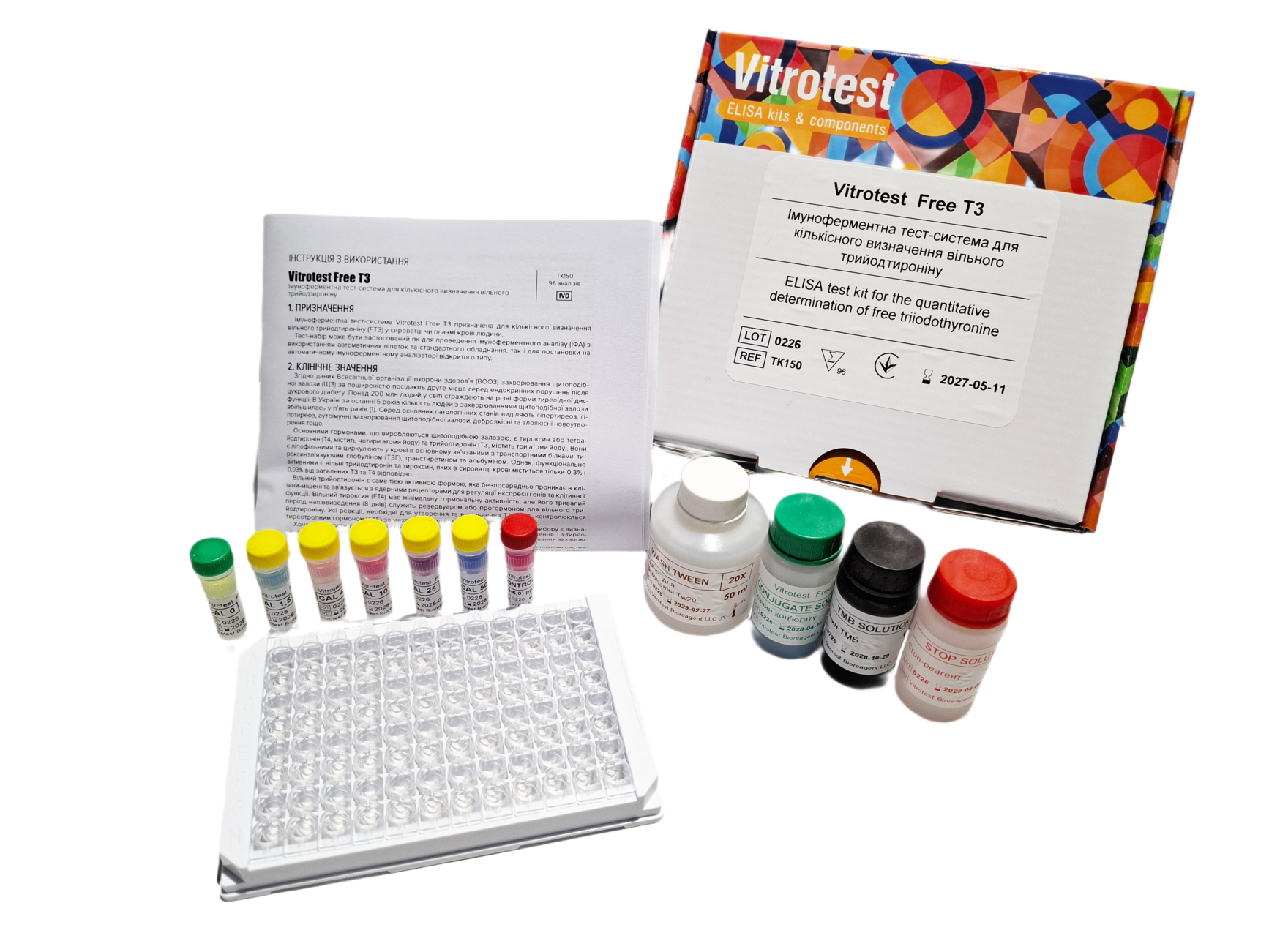
Vitrotest® Free T3

Home page » Products » Vitrotest® Free T3
  • Description

  • Features

  • Thyroid Dysfunction

  • Description

The test kit Vitrotest® Free T3 is an enzyme linked immunosorbent assay (ELISA) for the quantitative determination of free triiodothyronine (FT3) in human serum or plasma.

Determination of free triiodothyronine concentration in the test kit Vitrotest® Free T3 is based on a competitive ELISA with a two-step incubation.

  • TK150 – 96 tests

  • Features

  • Solid phase: strip ELISA plate pre-coated with triiodothyronine.
  • Conjugate: buffer solution of monoclonal antibodies specific to triiodothyronine conjugated with horseradish peroxidase.
  • Chromogen: ready to use TMB solution.
  • Sample volume: 25 μl.
  • Assay time: 1 h 20 min.

  • Thyroid Dysfunction

According to data from the World Health Organization (WHO), thyroid diseases are the second most common endocrine disorders after diabetes mellitus. More than 200 million people worldwide suffer from various forms of thyroid dysfunction. In Ukraine, over the past five years, the number of people with thyroid diseases has increased fivefold. The main pathological conditions include hyperthyroidism, hypothyroidism, autoimmune thyroid diseases, benign and malignant neoplasms, etc.

The main hormones produced by the thyroid gland are thyroxine or tetraiodothyronine (T4, containing four iodine atoms) and triiodothyronine (T3, containing three iodine atoms). These hormones are lipophilic and circulate in the blood mainly bound to transport proteins: thyroxine-binding globulin (TBG), transthyretin (also known as thyroxine-binding prealbumin), and albumin. However, only free triiodothyronine and free thyroxine are functionally active, accounting for just 0.3% and 0.03% of total T3 and T4 in blood serum, respectively.

Free triiodothyronine is the biologically active form that directly enters target cells and binds to nuclear receptors to regulate gene expression and cellular function. Free thyroxine has minimal hormonal activity, but its long half-life (8 days) serves as a reservoir or prohormone for free triiodothyronine. All reactions required for the formation and release of T3 and T4 are controlled by thyroid-stimulating hormone (TSH) through a negative feedback mechanism.

Although determination of TSH and FT4 concentrations are considered the primary tests of choice for diagnosing thyroid dysfunction, measurement of FT3 levels is useful for detecting T3-thyrotoxicosis, complex or unusual manifestations of hyperthyroidism, monitoring thyroid disease treatment, and assessing metabolism.

Accumulated evidence indicates that changes in FT3 levels are also closely associated with a number of systemic disorders, such as cardiovascular diseases, dyslipidemia, type 2 diabetes mellitus, and liver dysfunction, highlighting the clinical importance of FT3 monitoring as a functional indicator of thyroid status.

ELISA kits, Thyroid function

tel./fax: +380972227672, +380442227672 | e-mail: info@vitrotest.ua, order@vitrotest.ua

© Vitrotest 2006 - 2026 | All Rights Reserved | Privacy policy | Terms of use

Page load link
Go to Top