
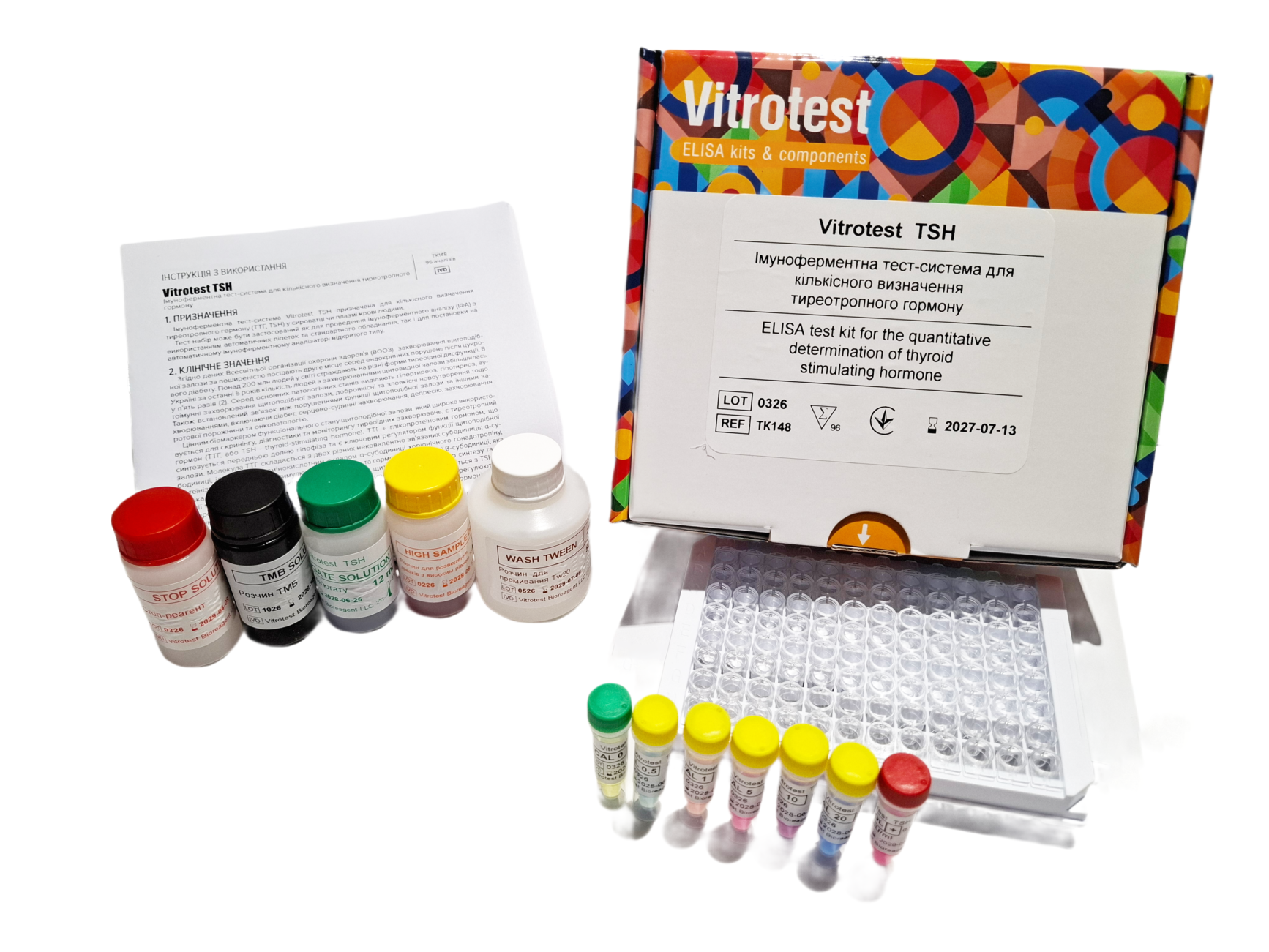
The test kit Vitrotest® TSH is an enzyme linked immunosorbent assay (ELISA) for the quantitative determination of thyroid-stimulating hormone (TSH) in human serum or plasma.
Determination of thyroid-stimulating hormone concentration in the test kit Vitrotest® TSH is based on a solid-phase sandwich ELISA in a two-step incubation procedure.
- TK148 – 96 tests
- TK149 – 192 tests
- Solid phase: strip ELISA plate pre-coated with the first monoclonal antibodies specific to the β-subunit of human thyroid-stimulating hormone.
- Conjugate: monoclonal antibodies to human TSH conjugated with horseradish peroxidase.
- Chromogen: ready to use TMB solution.
- Sample volume: 50 μl.
- Assay time: 2 h.
- Analytical sensitivity: 0,106 μIU/ml.
- Linearity range: 0,125-16,4 µIU/ml.
According to the World Health Organization (WHO), thyroid diseases are the second most common endocrine disorders after diabetes mellitus. Over 200 million people worldwide suffer from various forms of thyroid dysfunction. In Ukraine, over the past 5 years, the number of people with thyroid diseases has increased fivefold. The main pathological conditions include hyperthyroidism, hypothyroidism, autoimmune thyroid diseases, benign and malignant neoplasms. A connection has also been established between thyroid dysfunction and other diseases such as diabetes, cardiovascular diseases, depression, oral diseases, and cancer.
A valuable biomarker of thyroid functional status widely used for screening, diagnosis, and monitoring of thyroid diseases is thyroid-stimulating hormone (TSH). TSH is a glycoprotein hormone synthesized by the anterior pituitary and is a key regulator of thyroid function. The TSH molecule consists of two different non-covalently bound subunits: the α-subunit, identical in amino acid sequence to the α-subunit of chorionic gonadotropin, luteinizing hormone, and follicle-stimulating hormone, and the hormone-specific β-subunit, which is unique. The main function of TSH is to stimulate the thyroid gland to synthesize and secrete thyroid hormones – thyroxine (T4) and triiodothyronine (T3). TSH binds to the TSH receptor on thyrocytes and activates intracellular signaling cascades that regulate iodine uptake, thyroid metabolism, thyroid growth, and hormone secretion. Through negative feedback, T3 and T4 inhibit TSH secretion.
In healthy adults, TSH serum levels are approximately 0.4 to 4.0 μIU/ml, although narrower ranges may be used to better detect subclinical hypothyroidism. Separate reference intervals for TSH are established for pregnant women, infants, and young children. TSH secretion has pulsatile and circadian patterns, and its concentration depends on factors such as age, sex, ethnicity, iodine intake, reproductive status, and body mass index.
Over the last three decades, laboratory methods used to determine TSH levels have significantly improved. Among immunochemical methods, ELISA has gained wide application due to its convenience, simplicity, high reproducibility, and sensitivity for determining thyroid-stimulating hormone in human serum and plasma.
The standardization of quantitative determination of TSH in human serum or plasma is ensured by the use of the WHO International Standard with assigned TSH concentration in μIU/ml for preparation of internal ELISA calibrators.