
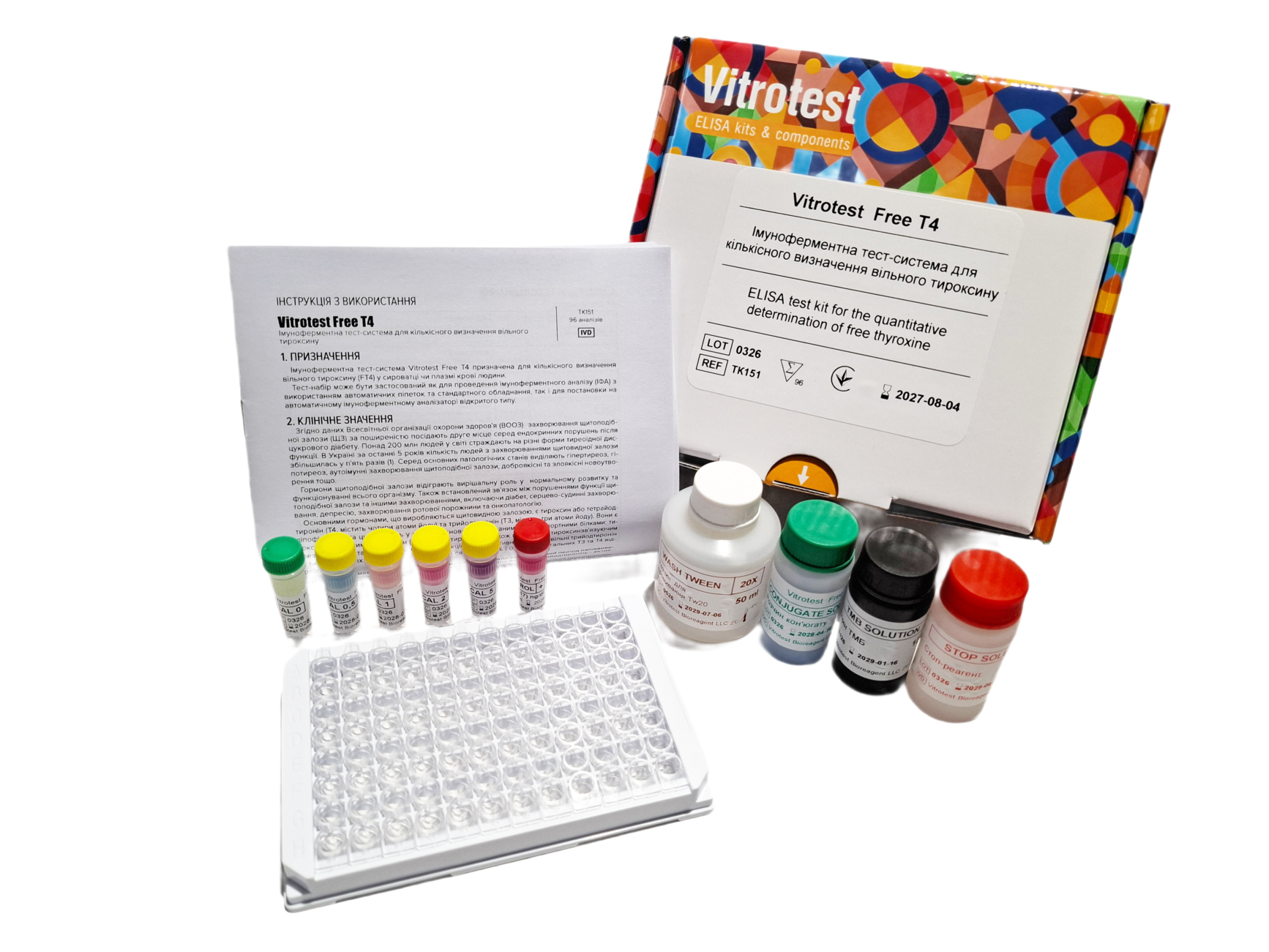
The test kit Vitrotest® Free T4 is an enzyme linked immunosorbent assay (ELISA) for the quantitative determination of free thyroxine (FT4) in human serum or plasma.
Determination of free thyroxine concentration in the test kit Vitrotest® Free T4 is based on a competitive ELISA with a two-step incubation.
- TK151 – 96 tests
- Solid phase: strip ELISA plate pre-coated with monoclonal antibodies specific to thyroxine.
- Conjugate: buffer solution of thyroxine conjugated with horseradish peroxidase.
- Chromogen: ready to use TMB solution.
- Sample volume: 20 μl.
- Assay time: 1 h 15 min.
- Analytical sensitivity: 0,254 ng/dl.
According to WHO, thyroid diseases are the second most common endocrine disorders after diabetes mellitus. Over 200 million people worldwide suffer from various forms of thyroid dysfunction. In Ukraine, the number of people with thyroid diseases has increased fivefold over the past 5 years. The main pathological conditions include hyperthyroidism, hypothyroidism, autoimmune thyroid diseases, benign and malignant neoplasms.
The main hormones produced by the thyroid gland are thyroxine or tetraiodothyronine (T4, containing four iodine atoms) and triiodothyronine (T3, containing three iodine atoms). They are lipophilic and circulate in the blood mainly bound to transport proteins: thyroxine-binding globulin (TBG), transthyretin (thyroxine-binding prealbumin), and albumin. However, the biologically active forms are free triiodothyronine and free thyroxine, which represent only 0.3% and 0.03% of total T3 and T4 in serum, respectively.
Overall, FT4 has minimal hormonal activity, but its long half-life (8 days) serves as a reservoir or prohormone for active free triiodothyronine, which binds to nuclear receptors.
All processes required for the synthesis and release of T3 and T4 are controlled by thyroid-stimulating hormone (TSH), secreted by pituitary thyrotropic cells. TSH secretion is regulated through pituitary negative feedback: elevated free T4 and T3 levels suppress TSH synthesis and secretion, while decreased levels increase TSH secretion.
Determination of TSH and free thyroxine concentrations are the primary tests for diagnosing thyroid dysfunction. FT4 is an important marker for differentiating subclinical hyperthyroidism from overt hyperthyroidism or hypothyroidism, for investigating suspected abnormal TSH secretion, TSH-secreting pituitary adenomas, and for monitoring treatment of thyroid diseases.