Skip to content
  • Home
  • About us
  • Products
    ELISA kit
    • HIV infection
    • Viral Hepatitis
    • Syphilis
    • Herpes Infections
    • TORCH Infections
    • Vaccine-Preventable Diseases
    • Сovid-19COVID-19 is an infectious disease caused by a new SARS-CoV-2 coronavirus which had not previously been detected in humans. The viral infection leads to the development of a respiratory flu-like disease with symptoms such as cough and fever. In more severe cases pneumonia can develop. The average incubation period of the COVID-19 is 6.5 days, but it can range from 3 to 21 days. SARS-CoV-2 is an RNA-virus with a specific envelope with spikes in the form of a “corona”. The main structural proteins of the virus include envelope protein (E), membrane protein (M), spike (S) glycoprotein, and nucleocapsid (N) protein. S protein on the surface of the SARS-CoV-2 virion mediates the receptor recognition and cell membrane fusion with ACE2 molecules, which are mainly expressed on type II pneumocytes, colon and kidney epithelial cells. It contains three fragments, namely the ectodomain, the transmembrane domain and the short intracellular segment. The ectodomain consists of a receptor-binding subunit S1 containing the RBD domain and a fusion subunit (S2). During viral infection, S1 C-terminal domain binds to the extracellular peptidase (PD) domain of ACE2 to ensure that the virus attaches to the surface of the target cell. The S1 N-terminal domain binds to…
    • Borreliosis
    • Parasites
    • Urogenital Infections
    • Gastroenteric Diseases
    • Tumor Markers
    • Metabolism
    • Allergy
    • Biotinylated Allergens
    • Thyroid function
    • Brucellosis
    Download catalog ELISA kits
    IMMUNOGLOBULINS LEVEL
    Raw materials
    DOWNLOAD CATALOG RAW MATERIALS
  • News
  • Contact
  • EN
  • UA
  • RU
  • Home
  • About us
  • Products
    • ELISA kits
      • HIV infection
      • Parasites
      • Syphilis
      • Borreliosis
      • Viral Hepatitis
      • TORCH Infections
      • Herpes Infections
      • Vaccine-Preventable Diseases
      • Сovid-19COVID-19 is an infectious disease caused by a new SARS-CoV-2 coronavirus which had not previously been detected in humans. The viral infection leads to the development of a respiratory flu-like disease with symptoms such as cough and fever. In more severe cases pneumonia can develop. The average incubation period of the COVID-19 is 6.5 days, but it can range from 3 to 21 days. SARS-CoV-2 is an RNA-virus with a specific envelope with spikes in the form of a “corona”. The main structural proteins of the virus include envelope protein (E), membrane protein (M), spike (S) glycoprotein, and nucleocapsid (N) protein. S protein on the surface of the SARS-CoV-2 virion mediates the receptor recognition and cell membrane fusion with ACE2 molecules, which are mainly expressed on type II pneumocytes, colon and kidney epithelial cells. It contains three fragments, namely the ectodomain, the transmembrane domain and the short intracellular segment. The ectodomain consists of a receptor-binding subunit S1 containing the RBD domain and a fusion subunit (S2). During viral infection, S1 C-terminal domain binds to the extracellular peptidase (PD) domain of ACE2 to ensure that the virus attaches to the surface of the target cell. The S1 N-terminal domain binds to…
      • Urogenital Infections
      • Gastroenteric Diseases
      • Tumor Markers
      • Metabolism
      • Allergy
      • Biotinylated Allergens
      • Thyroid function
    • IMMUNOGLOBULINS LEVEL
    • RAW MATERIALS
    • DOWNLOAD CATALOG ELISA
    • DOWNLOAD CATALOG RAW MATERIALS
  • News
  • Contact
  • EN
    • EN
    • UA
    • RU
  • DOWNLOAD CATALOG ELISA
  • Home
  • About us
  • Products
    • ELISA kits
      • HIV infection
      • Parasites
      • Syphilis
      • Borreliosis
      • Viral Hepatitis
      • TORCH Infections
      • Herpes Infections
      • Vaccine-Preventable Diseases
      • Сovid-19COVID-19 is an infectious disease caused by a new SARS-CoV-2 coronavirus which had not previously been detected in humans. The viral infection leads to the development of a respiratory flu-like disease with symptoms such as cough and fever. In more severe cases pneumonia can develop. The average incubation period of the COVID-19 is 6.5 days, but it can range from 3 to 21 days. SARS-CoV-2 is an RNA-virus with a specific envelope with spikes in the form of a “corona”. The main structural proteins of the virus include envelope protein (E), membrane protein (M), spike (S) glycoprotein, and nucleocapsid (N) protein. S protein on the surface of the SARS-CoV-2 virion mediates the receptor recognition and cell membrane fusion with ACE2 molecules, which are mainly expressed on type II pneumocytes, colon and kidney epithelial cells. It contains three fragments, namely the ectodomain, the transmembrane domain and the short intracellular segment. The ectodomain consists of a receptor-binding subunit S1 containing the RBD domain and a fusion subunit (S2). During viral infection, S1 C-terminal domain binds to the extracellular peptidase (PD) domain of ACE2 to ensure that the virus attaches to the surface of the target cell. The S1 N-terminal domain binds to…
      • Urogenital Infections
      • Gastroenteric Diseases
      • Tumor Markers
      • Metabolism
      • Allergy
      • Biotinylated Allergens
      • Thyroid function
    • IMMUNOGLOBULINS LEVEL
    • RAW MATERIALS
    • DOWNLOAD CATALOG ELISA
    • DOWNLOAD CATALOG RAW MATERIALS
  • News
  • Contact
  • EN
    • EN
    • UA
    • RU
  • DOWNLOAD CATALOG ELISA

IVD

  • View Cart
    Details

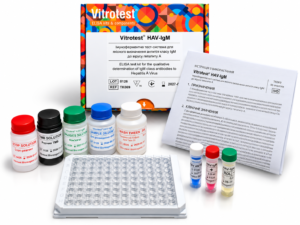
    Vitrotest® HAV-IgM

    • Description

    • Features

    • Hepatitits A

    • Description

    The test kit Vitrotest® HAV-IgM is an enzyme linked immunosorbent assay (ELISA) for the qualitative determination of IgM class antibodies to Hepatitis A Virus in human serum or plasma.

    Determination of IgM antibodies to Hepatitis A Virus in the test kit Vitrotest® HAV-IgM is based on a solid phase, «IgM-capture» ELISA in a two-step incubation procedure.

    • TK069 - 96 tests
    • Features

    • Solid phase: strip ELISA plate pre-coated with monoclonal anti-IgM antibodies.
    • Conjugate: monoclonal antibodies to human HAV conjugated with horseradish peroxidase.
    • Chromogen: ready to use TMB solution.
    • Sample volume: 100 μl.
    • Assay time: 2 h.
    • Hepatitits A

    Hepatitis A is an acute infectious disease of the liver (also known as Botkin’s disease) caused by the hepatitis A virus (HAV), which belongs to the genus Hepatovirus of the family Picornaviridae. The virus has a single-stranded RNA genome and lacks a lipid envelope, which determines its high stability in the environment, in particular, it is able to remain infectious in water, soil, and on surfaces for prolonged periods and is resistant to low temperatures and the acidic environment of the stomach.

    According to the World Health Organization, approximately 100 million HAV infections and 1.5 million clinically apparent cases are reported worldwide each year, of which 15,000–30,000 result in death annually. The main routes of transmission are fecal–oral, including through contaminated water and food, as well as household contact. After infection, HAV penetrates through the intestinal epithelium into the bloodstream and is transported to the liver, where it replicates in hepatocytes and Kupffer cells. Due to its cytolytic effect on liver cells, the virus is excreted with bile into the intestine and released into the environment even before clinical symptoms appear.

    The incubation period of hepatitis A usually ranges from 14 to 28 days, although it may extend to 15–50 days depending on immune status, age, concomitant diseases, and other factors. In most cases, the disease is accompanied by weakness, body aches, sore throat, fever, loss of appetite, vomiting, pain, and heaviness in the right upper quadrant of the abdomen. The clinical course varies with age: in young children the infection is often asymptomatic, whereas in adults an icteric form with pronounced intoxication syndrome develops more frequently.

    The immune response to HAV is characterized by the sequential appearance of specific antibodies. IgM antibodies appear in the early stages of infection, often before symptoms develop, and are the primary marker of acute infection. Their levels peak during the first weeks of illness and gradually decline over 3–6 months, sometimes persisting for up to 12 months after infection. IgG antibodies appear later and provide long-term, usually lifelong, immunity. They are also produced after vaccination against HAV, which forms the basis of specific disease prevention. The presence of IgG in the absence of IgM indicates past infection or immunization. Therefore, the determination of HAV-specific IgM antibodies by ELISA is a key tool for the early diagnosis of acute hepatitis A, which is essential for timely treatment and epidemiological control of the disease.

tel./fax: +380972227672, +380442227672 | e-mail: info@vitrotest.ua, order@vitrotest.ua

© Vitrotest 2006 - 2026 | All Rights Reserved | Privacy policy | Terms of use

Page load link
We use cookies to ensure that we give you the best experience on our website. If you continue to use this site we will assume that you are happy with it.
Go to Top