
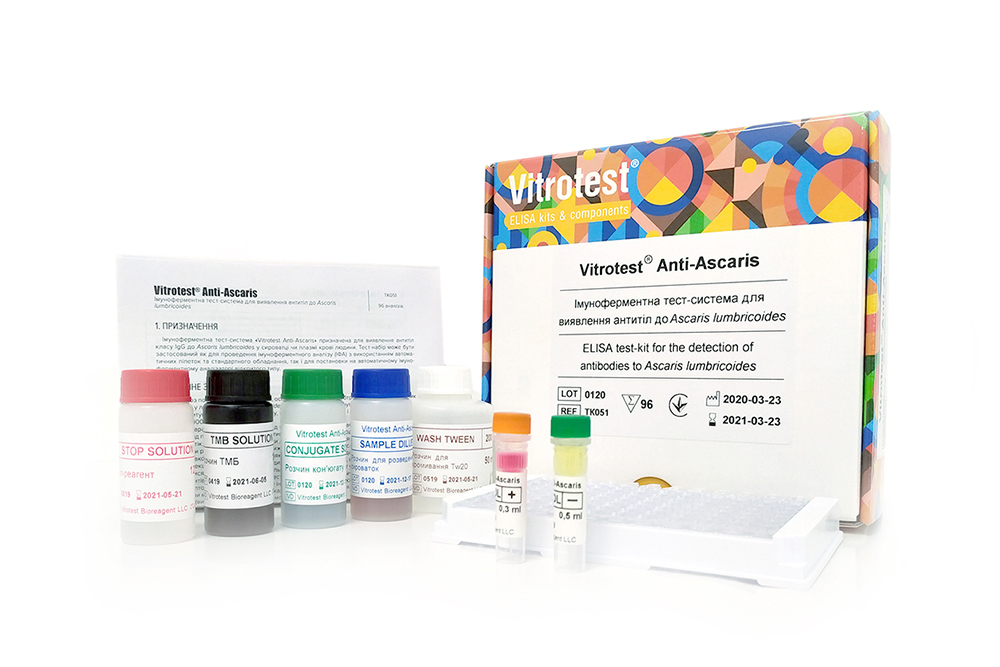
Determination of IgG antibodies to Ascaris lumbricoides in the test kit Vitrotest® Anti-Ascaris is based on a solid phase, indirect ELISA in a two-step incubation procedure.
○ ТК051 – 96 tests
○ ТК110 – 192 tests
- Solid phase: breakable microplate ELISA is coated Ascaris lumbricoides antigens.
- Conjugate: a monoclonal antibodies to human IgG conjugated to horseradish peroxidase.
- Chromogen: ready to use TMB solution.
- Volume of sample for analysis 10 μl.
- Assay time: 1h 15 min.
Fertile eggs of ascaris become infective after an embryo moults twice within an egg (18 days to several weeks depending on the environmental conditions). After infective eggs are swallowed, the larvae hatch, invade the intestinal mucosa, and are carried via bloodstream to the lungs. The larvae undergo two moults in the lungs (10 to 14 days), penetrate the alveolar walls, ascend the bronchial tree to the throat, and are swallowed. Upon reaching the small intestine, they develop into adult worms which can live 1-2 years.
Daily ascaris egg production is around 200,000 eggs, which are shed in the feces. An infection can occur if a person swallows the microscopic eggs in contaminated food or water, or the eggs are transferred from hands to mouth after touching contaminated soil. Eggs can remain viable in the soil for up to 15 years.
The manifestations of ascariasis can be divided into acute and chronic. Patients experience acute lung inflammation, difficulty in breathing and fever as a result of larval migration through the pulmonary tissue (acute ascariasis). Abdominal distension and pain, nausea and diarrhoea are characteristic symptoms of adult worm invasion (chronic ascariasis). In small percentage of patients, entangled adult worms could lead to mechanical intestinal obstruction. The majority of invasions with A.lumbricoides are asymptomatic, and patients usually seek medical advice because they have seen a worm in their faeces.