Skip to content
  • Home
  • About us
  • Products
    ELISA kit
    • HIV infection
    • Viral Hepatitis
    • Syphilis
    • Herpes Infections
    • TORCH Infections
    • Vaccine-Preventable Diseases
    • Сovid-19COVID-19 is an infectious disease caused by a new SARS-CoV-2 coronavirus which had not previously been detected in humans. The viral infection leads to the development of a respiratory flu-like disease with symptoms such as cough and fever. In more severe cases pneumonia can develop. The average incubation period of the COVID-19 is 6.5 days, but it can range from 3 to 21 days. SARS-CoV-2 is an RNA-virus with a specific envelope with spikes in the form of a “corona”. The main structural proteins of the virus include envelope protein (E), membrane protein (M), spike (S) glycoprotein, and nucleocapsid (N) protein. S protein on the surface of the SARS-CoV-2 virion mediates the receptor recognition and cell membrane fusion with ACE2 molecules, which are mainly expressed on type II pneumocytes, colon and kidney epithelial cells. It contains three fragments, namely the ectodomain, the transmembrane domain and the short intracellular segment. The ectodomain consists of a receptor-binding subunit S1 containing the RBD domain and a fusion subunit (S2). During viral infection, S1 C-terminal domain binds to the extracellular peptidase (PD) domain of ACE2 to ensure that the virus attaches to the surface of the target cell. The S1 N-terminal domain binds to…
    • Borreliosis
    • Parasites
    • Urogenital Infections
    • Gastroenteric Diseases
    • Tumor Markers
    • Metabolism
    • Allergy
    • Biotinylated Allergens
    • Thyroid function
    Download catalog ELISA kits
    IMMUNOGLOBULINS LEVEL
    Raw materials
    DOWNLOAD CATALOG RAW MATERIALS
  • News
  • Contact
  • EN
  • UA
  • RU
  • Home
  • About us
  • Products
    • ELISA kits
      • HIV infection
      • Parasites
      • Syphilis
      • Borreliosis
      • Viral Hepatitis
      • TORCH Infections
      • Herpes Infections
      • Vaccine-Preventable Diseases
      • Сovid-19COVID-19 is an infectious disease caused by a new SARS-CoV-2 coronavirus which had not previously been detected in humans. The viral infection leads to the development of a respiratory flu-like disease with symptoms such as cough and fever. In more severe cases pneumonia can develop. The average incubation period of the COVID-19 is 6.5 days, but it can range from 3 to 21 days. SARS-CoV-2 is an RNA-virus with a specific envelope with spikes in the form of a “corona”. The main structural proteins of the virus include envelope protein (E), membrane protein (M), spike (S) glycoprotein, and nucleocapsid (N) protein. S protein on the surface of the SARS-CoV-2 virion mediates the receptor recognition and cell membrane fusion with ACE2 molecules, which are mainly expressed on type II pneumocytes, colon and kidney epithelial cells. It contains three fragments, namely the ectodomain, the transmembrane domain and the short intracellular segment. The ectodomain consists of a receptor-binding subunit S1 containing the RBD domain and a fusion subunit (S2). During viral infection, S1 C-terminal domain binds to the extracellular peptidase (PD) domain of ACE2 to ensure that the virus attaches to the surface of the target cell. The S1 N-terminal domain binds to…
      • Urogenital Infections
      • Gastroenteric Diseases
      • Tumor Markers
      • Metabolism
      • Allergy
      • Biotinylated Allergens
      • Thyroid function
    • IMMUNOGLOBULINS LEVEL
    • RAW MATERIALS
    • DOWNLOAD CATALOG ELISA
    • DOWNLOAD CATALOG RAW MATERIALS
  • News
  • Contact
  • EN
    • EN
    • UA
    • RU
  • DOWNLOAD CATALOG ELISA
  • Home
  • About us
  • Products
    • ELISA kits
      • HIV infection
      • Parasites
      • Syphilis
      • Borreliosis
      • Viral Hepatitis
      • TORCH Infections
      • Herpes Infections
      • Vaccine-Preventable Diseases
      • Сovid-19COVID-19 is an infectious disease caused by a new SARS-CoV-2 coronavirus which had not previously been detected in humans. The viral infection leads to the development of a respiratory flu-like disease with symptoms such as cough and fever. In more severe cases pneumonia can develop. The average incubation period of the COVID-19 is 6.5 days, but it can range from 3 to 21 days. SARS-CoV-2 is an RNA-virus with a specific envelope with spikes in the form of a “corona”. The main structural proteins of the virus include envelope protein (E), membrane protein (M), spike (S) glycoprotein, and nucleocapsid (N) protein. S protein on the surface of the SARS-CoV-2 virion mediates the receptor recognition and cell membrane fusion with ACE2 molecules, which are mainly expressed on type II pneumocytes, colon and kidney epithelial cells. It contains three fragments, namely the ectodomain, the transmembrane domain and the short intracellular segment. The ectodomain consists of a receptor-binding subunit S1 containing the RBD domain and a fusion subunit (S2). During viral infection, S1 C-terminal domain binds to the extracellular peptidase (PD) domain of ACE2 to ensure that the virus attaches to the surface of the target cell. The S1 N-terminal domain binds to…
      • Urogenital Infections
      • Gastroenteric Diseases
      • Tumor Markers
      • Metabolism
      • Allergy
      • Biotinylated Allergens
      • Thyroid function
    • IMMUNOGLOBULINS LEVEL
    • RAW MATERIALS
    • DOWNLOAD CATALOG ELISA
    • DOWNLOAD CATALOG RAW MATERIALS
  • News
  • Contact
  • EN
    • EN
    • UA
    • RU
  • DOWNLOAD CATALOG ELISA

Vitrotest® Anti-Opisthorchis

Home page » Products » Vitrotest® Anti-Opisthorchis
  • Description

  • Features

  • Opisthorchiasis

  • Description

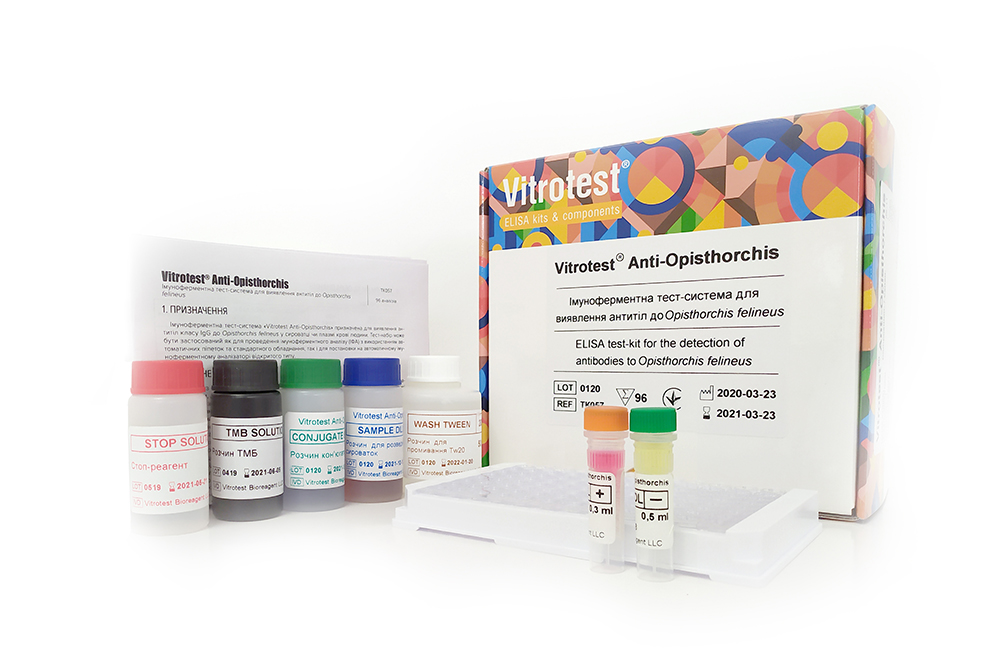
The test kit Vitrotest® Anti-Opisthorchis is an enzyme linked immunosorbent assay (ELISA) for the detection of IgG class antibodies to Opisthorchis felineus in human serum or plasma.

Determination of IgG antibodies to Opisthorchis felineus in the test kit Vitrotest® Anti-Opisthorchis is based on a solid phase, indirect ELISA in a two-step incubation procedure.

○ ТК057 – 96 tests

  • Features

  • Solid phase: breakable microplate ELISA is coated Opisthorchis felineus antigens.
  • Conjugate: a monoclonal antibodies to human IgG conjugated to horseradish peroxidase.
  • Chromogen: ready to use TMB solution.
  • Volume of sample for analysis: 10 μl.
  • Assay time: 1h 15 min.

  • Opisthorchiasis

Opisthorchiasis – helminthiasis, affecting mainly the hepatobiliary system and the pancreas of humans, cats, dogs, etc. The disease is marked by a long course (in human body the parasite exists for 10-20 years), proceeds with frequent exacerbations, contributes to the occurrence of primary cancer of the liver and pancreas.

The causative agents of opisthorchiasis are two species of trematodes of the Opisthorchidae family – Opisthorchis felineus (Siberian fluke), common in Western Siberia, Kazakhstan and some areas of the Dnieper region; and Opisthorchis viverrini (squirrel fluke), found in countries with tropical climates (mainly in Thailand).

These small trematodes have a flat body 4-13 mm long and 1-3.5 mm wide. The oral sucker is located at the anterior end of the body, and the abdominal sucker is located at the border of the first and second quarter of the body.

Infection occurs when eating raw fish (thawed, frozen), slightly salted and insufficiently calcined carp fish containing helminth larvae – metacercariae. In the stomach, the upper parts of the small intestine, metacercariae are freed from the membrane and through 3-5 h reach the gallbladder, liver, pancreatic ducts, where after 2 weeks turn into sexually mature forms, capable of further releasing eggs.

At the early stage of invasion, a pronounced allergization of the body is observed. Mature opisthorchis injure mucous membranes of the pancreatic and bile ducts, create barriers to the outflow of bile, contribute to the development of cystic enlargements and neoplasms of the liver and carry out toxic and neuro-reflex effect.

Diagnosis of opisthorchiasis according to the clinical manifestations of the disease is difficult due to the absence of symptoms and syndromes characteristic only for this disease. Therefore, it is necessary to carry out a thorough clinical, laboratory and X-ray (ultrasound inclusive) examination.

In the laboratory analysis, it is possible to detect the invasion of opisthorchis one month after the infection when helminths begin to lay eggs (ovoscopic examination of feces and duodenal juice of the patient). More significant complications arise in recognizing early phases of opisthorchiasis. However, more and more studies are being carried out to detect specific antibodies to Opisthorchis felineus by enzyme immunoassay. In the chronic stage invasion is diagnosed by detecting helminth eggs in bile and stools, as well as by ELISA.

ELISA kits, Parasites

tel./fax: +380972227672, +380442227672 | e-mail: info@vitrotest.ua, order@vitrotest.ua

© Vitrotest 2006 - 2026 | All Rights Reserved | Privacy policy | Terms of use

Page load link
Go to Top