
-
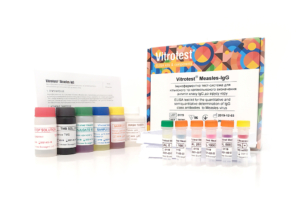
The test kit Vitrotest® Measles-IgG is an enzyme linked immunosorbent assay (ELISA) for the quantitative and semiquantitative determination of IgG class antibodies to measles virus in human serum or plasma.
Determination of IgG antibodies to measles virus in the test kit Vitrotest® Measles-IgG is based on a solid phase, indirect ELISA in a two-step incubation procedure.
○ ТК080 - 96 tests- Solid phase: breakable microplate ELISA is coated with purified antigens of measles virus.
- Conjugate: a monoclonal antibodies to human IgG conjugated to horseradish peroxidase.
- Chromogen: ready to use TMB solution.
- Volume of sample for analysis: 10 μl.
- Assay time: 1h 15 min.
- Analytical sensitivity: 12 mIU/ml.
- Linearity range: 70-3000 mIU/ml.
Measles is a dangerous, rapidly spreading, highly contagious viral disease that can lead to severe complications and death. The causative agent of measles (eng. Measles virus) is an RNA-containing virus of the Paramyxoviruses family.
The measles virus is usually transmitted through direct contact, as well as through the air, infects the mucous membrane of a person, and then spreads throughout the body. The first sign of measles is usually a significant fever, runny nose, cough, red eyes and watery eyes, and small white spots on the inside of the cheeks. After a few days, a rash appears, first on the face and upper neck. After about three days, the rash spreads all over the body, including the arms and legs, lasts for 5 to 6 days, and then disappears.
Most measles deaths are due to complications associated with the disease. Complications are more common in children under the age of five or in adults over 30 years old.
Introduced in 1963, measures to vaccinate against measles have significantly reduced mortality from this disease.
Screening of pregnant women, young people and patients at risk to determine the level of protective immunity is extremely important during periods of epidemic outbreaks. For this purpose, the most common quantitative determination of IgG antibodies specific to the measles virus is by enzyme immunoassay. -
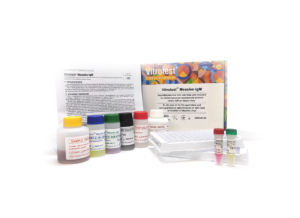
The test kit Vitrotest® Measles-IgM is an enzyme linked immunosorbent assay (ELISA) for the qualitative and semiquantitative determination of IgM class antibodies to measles virus in human serum or plasma.
Determination of IgM antibodies to measles virus in the test kit Vitrotest® Measles-IgM is based on a solid phase, indirect ELISA in a two-step incubation procedure.
○ ТК079 - 96 tests- Solid phase: breakable microplate ELISA is coated with purified antigens of measles virus.
- Conjugate: a monoclonal antibodies to human IgM conjugated to horseradish peroxidase.
- Chromogen: ready to use TMB solution.
- Volume of sample for analysis: 10 μl.
- Assay time: 1h 15 min.
Measles is a dangerous, rapidly spreading, highly contagious viral disease that can lead to severe complications and death. The causative agent of measles (eng. Measles virus) is an RNA-containing virus of the Paramyxoviruses family.
The measles virus is usually transmitted through direct contact, as well as through the air, infects the mucous membrane of a person, and then spreads throughout the body. The first sign of measles is usually a significant fever, runny nose, cough, red eyes and watery eyes, and small white spots on the inside of the cheeks. After a few days, a rash appears, first on the face and upper neck. After about three days, the rash spreads all over the body, including the arms and legs, lasts for 5 to 6 days, and then disappears.
Most measles deaths are due to complications associated with the disease. Complications are more common in children under the age of five or in adults over 30 years old.
Introduced in 1963, measures to vaccinate against measles have significantly reduced mortality from this disease.
Screening of pregnant women, young people and patients at risk to determine the level of protective immunity is extremely important during periods of epidemic outbreaks. For this purpose, the most common quantitative determination of IgG antibodies specific to the measles virus is by enzyme immunoassay. -
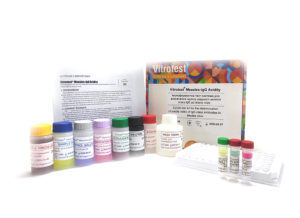
The test kit Vitrotest® Measles-IgG Avidity is an enzyme linked immunosorbent assay (ELISA) for the determination of avidity index of IgG class antibodies to to measles virus in human serum or plasma.
Determination of avidity index of IgG antibodies to to measles virus in the test kit Vitrotest® Measles-IgG Avidity is based on a solid phase, indirect ELISA.
○ ТК103 - 48 tests- Solid phase: breakable microplate ELISA is coated with purified antigens of measles virus.
- Conjugate: a monoclonal antibodies to human IgG conjugated to horseradish peroxidase.
- Chromogen: ready to use TMB solution.
- Volume of sample for analysis: 10 μl.
- Assay time: 1h 25 min.
Measles is a dangerous, rapidly spreading, highly contagious viral disease that can lead to severe complications and death. The causative agent of measles (eng. Measles virus) is an RNA-containing virus of the Paramyxoviruses family.
The measles virus is usually transmitted through direct contact, as well as through the air, infects the mucous membrane of a person, and then spreads throughout the body. The first sign of measles is usually a significant fever, runny nose, cough, red eyes and watery eyes, and small white spots on the inside of the cheeks. After a few days, a rash appears, first on the face and upper neck. After about three days, the rash spreads all over the body, including the arms and legs, lasts for 5 to 6 days, and then disappears.
Most measles deaths are due to complications associated with the disease. Complications are more common in children under the age of five or in adults over 30 years old.
Introduced in 1963, measures to vaccinate against measles have significantly reduced mortality from this disease.
Screening of pregnant women, young people and patients at risk to determine the level of protective immunity is extremely important during periods of epidemic outbreaks. For this purpose, the most common quantitative determination of IgG antibodies specific to the measles virus is by enzyme immunoassay.
-
The test kit Vitrotest® Measles-IgG is an enzyme linked immunosorbent assay (ELISA) for the quantitative and semiquantitative determination of IgG class antibodies to measles virus in human serum or plasma.
Determination of IgG antibodies to measles virus in the test kit Vitrotest® Measles-IgG is based on a solid phase, indirect ELISA in a two-step incubation procedure.
○ ТК080 - 96 tests- Solid phase: breakable microplate ELISA is coated with purified antigens of measles virus.
- Conjugate: a monoclonal antibodies to human IgG conjugated to horseradish peroxidase.
- Chromogen: ready to use TMB solution.
- Volume of sample for analysis: 10 μl.
- Assay time: 1h 15 min.
- Analytical sensitivity: 12 mIU/ml.
- Linearity range: 70-3000 mIU/ml.
Measles is a dangerous, rapidly spreading, highly contagious viral disease that can lead to severe complications and death. The causative agent of measles (eng. Measles virus) is an RNA-containing virus of the Paramyxoviruses family.
The measles virus is usually transmitted through direct contact, as well as through the air, infects the mucous membrane of a person, and then spreads throughout the body. The first sign of measles is usually a significant fever, runny nose, cough, red eyes and watery eyes, and small white spots on the inside of the cheeks. After a few days, a rash appears, first on the face and upper neck. After about three days, the rash spreads all over the body, including the arms and legs, lasts for 5 to 6 days, and then disappears.
Most measles deaths are due to complications associated with the disease. Complications are more common in children under the age of five or in adults over 30 years old.
Introduced in 1963, measures to vaccinate against measles have significantly reduced mortality from this disease.
Screening of pregnant women, young people and patients at risk to determine the level of protective immunity is extremely important during periods of epidemic outbreaks. For this purpose, the most common quantitative determination of IgG antibodies specific to the measles virus is by enzyme immunoassay. -
The test kit Vitrotest® Measles-IgM is an enzyme linked immunosorbent assay (ELISA) for the qualitative and semiquantitative determination of IgM class antibodies to measles virus in human serum or plasma.
Determination of IgM antibodies to measles virus in the test kit Vitrotest® Measles-IgM is based on a solid phase, indirect ELISA in a two-step incubation procedure.
○ ТК079 - 96 tests- Solid phase: breakable microplate ELISA is coated with purified antigens of measles virus.
- Conjugate: a monoclonal antibodies to human IgM conjugated to horseradish peroxidase.
- Chromogen: ready to use TMB solution.
- Volume of sample for analysis: 10 μl.
- Assay time: 1h 15 min.
Measles is a dangerous, rapidly spreading, highly contagious viral disease that can lead to severe complications and death. The causative agent of measles (eng. Measles virus) is an RNA-containing virus of the Paramyxoviruses family.
The measles virus is usually transmitted through direct contact, as well as through the air, infects the mucous membrane of a person, and then spreads throughout the body. The first sign of measles is usually a significant fever, runny nose, cough, red eyes and watery eyes, and small white spots on the inside of the cheeks. After a few days, a rash appears, first on the face and upper neck. After about three days, the rash spreads all over the body, including the arms and legs, lasts for 5 to 6 days, and then disappears.
Most measles deaths are due to complications associated with the disease. Complications are more common in children under the age of five or in adults over 30 years old.
Introduced in 1963, measures to vaccinate against measles have significantly reduced mortality from this disease.
Screening of pregnant women, young people and patients at risk to determine the level of protective immunity is extremely important during periods of epidemic outbreaks. For this purpose, the most common quantitative determination of IgG antibodies specific to the measles virus is by enzyme immunoassay. -
The test kit Vitrotest® Measles-IgG Avidity is an enzyme linked immunosorbent assay (ELISA) for the determination of avidity index of IgG class antibodies to to measles virus in human serum or plasma.
Determination of avidity index of IgG antibodies to to measles virus in the test kit Vitrotest® Measles-IgG Avidity is based on a solid phase, indirect ELISA.
○ ТК103 - 48 tests- Solid phase: breakable microplate ELISA is coated with purified antigens of measles virus.
- Conjugate: a monoclonal antibodies to human IgG conjugated to horseradish peroxidase.
- Chromogen: ready to use TMB solution.
- Volume of sample for analysis: 10 μl.
- Assay time: 1h 25 min.
Measles is a dangerous, rapidly spreading, highly contagious viral disease that can lead to severe complications and death. The causative agent of measles (eng. Measles virus) is an RNA-containing virus of the Paramyxoviruses family.
The measles virus is usually transmitted through direct contact, as well as through the air, infects the mucous membrane of a person, and then spreads throughout the body. The first sign of measles is usually a significant fever, runny nose, cough, red eyes and watery eyes, and small white spots on the inside of the cheeks. After a few days, a rash appears, first on the face and upper neck. After about three days, the rash spreads all over the body, including the arms and legs, lasts for 5 to 6 days, and then disappears.
Most measles deaths are due to complications associated with the disease. Complications are more common in children under the age of five or in adults over 30 years old.
Introduced in 1963, measures to vaccinate against measles have significantly reduced mortality from this disease.
Screening of pregnant women, young people and patients at risk to determine the level of protective immunity is extremely important during periods of epidemic outbreaks. For this purpose, the most common quantitative determination of IgG antibodies specific to the measles virus is by enzyme immunoassay.