
-
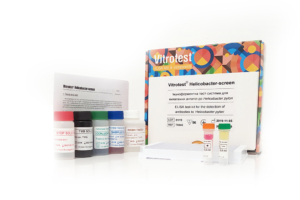
The test-kit Vitrotest® Helicobacter screen is an enzyme linked immunosorbent assay (ELISA) for the detection of IgG, IgA and IgM specific antibodies to Helicobacter pylori in human serum or plasma.
Detection of antibodies to H. pylori in the test-kit Vitrotest® Helicobacter screen is based on a solid phase, indirect ELISA in a two-step incubation procedure.
○ ТК045 - 96 tests- Solid phase: breakable microplate ELISA is coated with recombinant antigens of H. pylori.
- Conjugate: a monoclonal antibodies to human IgA, IgG and IgM conjugated to horseradish peroxidase.
- Chromogen: ready to use TMB solution.
- Volume of sample for analysis: 10 μl.
- Assay time: 1h 15 min.
Helicobacter pylori is a widespread microorganism with which the half of the world’s population has been infected. Its prevalence is very high in developing countries and is quite low in the developed world. According to the World Gastroenterology Organization, the rate of infected adults in Eastern Europe and Asia is about 70-80 %.
Studies during recent decades have shown the key role of bacterium Helicobacter pylori in the pathogenesis of stomach and duodenal lesions. H. pylori is detected almost in 100% of adult patients with duodenal ulcer, approximately in 80 % of patients with peptic ulcer, in 92% of patients with gastric cancer and in 92 % of patients with active chronic gastritis. Research has demonstrated that elimination of helicobacter leads to the disappearance of gastritis and significant reduction in the incidence of duodenal ulcer recurrence.
Helicobacteriosis is a chronic infection with long, often asymptomatic course. Its symptoms do not differ from clinical manifestations of gastro-duodenitis since usual constant pain in the epigastrium occurs. H. pylori is often present in patients with no clinical manifestations of disease.
The infection usually starts from non–acid-secreting antral region of the stomach and stimulates the increased release of gastrin. The increased gastrin levels in turn stimulate excess acid secretion from the more proximal acid-secreting fundic mucosa which is relatively free of inflammation. The increased duodenal acid load damages the duodenal mucosa, causing ulceration. If infection progresses, stomach body is damaged, which could finally cause the development of gastric adenocarcinoma. This tumour is preceded by sequential pathological changes of gastric mucosa, from normal mucosa to superficial gastritis, atrophic gastritis, gastric ulcers and intestinal metaplasia.
Main oncogenic factors are both nitrosating bacteria present in the lumen of hypochloric stomach, capable of generating potentially carcinogenic N-nitrosamines and reactive oxygen species, and H. pylori itself. Duodenal or gastric ulcers are reported to develop in 1 to 10% of infected patients, gastric cancer- in 0.1 to 3%; at the same time, the great majority of patients with H. pylori remain asymptomatic carriers.
H. pylori is usually acquired in childhood. The bacteria are most likely spread through fecal-oral or oral-oral routes from person to person; additional transmission routes, such as water, may be important in developing countries. -
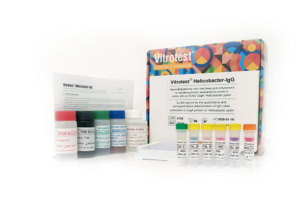
The test kit Vitrotest® Helicobacter-IgG is an enzyme linked immunosorbent assay (ELISA) for the quantitative and semiquantitative determination of IgG class antibodies to CagA protein of Helicobacter pylori in human serum or plasma.
Determination of IgG antibodies to CagA protein of H. pylori in the test kit Vitrotest® Helicobacter-IgG is based on a solid phase, indirect ELISA in a two-step incubation procedure.
○ ТК046 - 96 tests- Solid phase: breakable microplate ELISA is coated with recombinant CagA protein of H. pylori.
- Conjugate: a monoclonal antibodies to human IgG conjugated to horseradish peroxidase.
- Chromogen: ready to use TMB solution.
- Volume of sample for analysis: 10 μl.
- Assay time: 1h 15 min.
- Linearity range: 1,25-200 U/ml.
Helicobacter pylori is a widespread microorganism with which the half of the world’s population has been infected. Its prevalence is very high in developing countries and is quite low in the developed world. According to the World Gastroenterology Organization, the rate of infected adults in Eastern Europe and Asia is about 70-80 %.
Studies during recent decades have shown the key role of bacterium Helicobacter pylori in the pathogenesis of stomach and duodenal lesions. H. pylori is detected almost in 100% of adult patients with duodenal ulcer, approximately in 80 % of patients with peptic ulcer, in 92% of patients with gastric cancer and in 92 % of patients with active chronic gastritis. Research has demonstrated that elimination of helicobacter leads to the disappearance of gastritis and significant reduction in the incidence of duodenal ulcer recurrence.
Helicobacteriosis is a chronic infection with long, often asymptomatic course. Its symptoms do not differ from clinical manifestations of gastro-duodenitis since usual constant pain in the epigastrium occurs. H. pylori is often present in patients with no clinical manifestations of disease.
The infection usually starts from non–acid-secreting antral region of the stomach and stimulates the increased release of gastrin. The increased gastrin levels in turn stimulate excess acid secretion from the more proximal acid-secreting fundic mucosa which is relatively free of inflammation. The increased duodenal acid load damages the duodenal mucosa, causing ulceration. If infection progresses, stomach body is damaged, which could finally cause the development of gastric adenocarcinoma. This tumour is preceded by sequential pathological changes of gastric mucosa, from normal mucosa to superficial gastritis, atrophic gastritis, gastric ulcers and intestinal metaplasia.
Main oncogenic factors are both nitrosating bacteria present in the lumen of hypochloric stomach, capable of generating potentially carcinogenic N-nitrosamines and reactive oxygen species, and H. pylori itself. Duodenal or gastric ulcers are reported to develop in 1 to 10% of infected patients, gastric cancer- in 0.1 to 3%; at the same time, the great majority of patients with H. pylori remain asymptomatic carriers.
H. pylori is usually acquired in childhood. The bacteria are most likely spread through fecal-oral or oral-oral routes from person to person; additional transmission routes, such as water, may be important in developing countries. -
The test kit Vitrotest® Helicobacter-IgА is an enzyme linked immunosorbent assay (ELISA) for the qualitative and semiquantitative determination of IgА class antibodies to CagA protein of Helicobacter pylori in human serum or plasma.
Determination of IgА antibodies to CagA protein of H. pylori in the test kit Vitrotest® Helicobacter-IgА is based on a solid phase, indirect ELISA in a two-step incubation procedure.
○ ТК047 - 96 tests- Solid phase: breakable microplate ELISA is coated with recombinant CagA protein of H. pylori.
- Conjugate: a monoclonal antibodies to human IgА conjugated to horseradish peroxidase.
- Chromogen: ready to use TMB solution.
- Volume of sample for analysis: 10 μl.
- Assay time: 1h 15 min.
Helicobacter pylori is a widespread microorganism with which the half of the world’s population has been infected. Its prevalence is very high in developing countries and is quite low in the developed world. According to the World Gastroenterology Organization, the rate of infected adults in Eastern Europe and Asia is about 70-80 %.
Studies during recent decades have shown the key role of bacterium Helicobacter pylori in the pathogenesis of stomach and duodenal lesions. H. pylori is detected almost in 100% of adult patients with duodenal ulcer, approximately in 80 % of patients with peptic ulcer, in 92% of patients with gastric cancer and in 92 % of patients with active chronic gastritis. Research has demonstrated that elimination of helicobacter leads to the disappearance of gastritis and significant reduction in the incidence of duodenal ulcer recurrence.
Helicobacteriosis is a chronic infection with long, often asymptomatic course. Its symptoms do not differ from clinical manifestations of gastro-duodenitis since usual constant pain in the epigastrium occurs. H. pylori is often present in patients with no clinical manifestations of disease.
The infection usually starts from non–acid-secreting antral region of the stomach and stimulates the increased release of gastrin. The increased gastrin levels in turn stimulate excess acid secretion from the more proximal acid-secreting fundic mucosa which is relatively free of inflammation. The increased duodenal acid load damages the duodenal mucosa, causing ulceration. If infection progresses, stomach body is damaged, which could finally cause the development of gastric adenocarcinoma. This tumour is preceded by sequential pathological changes of gastric mucosa, from normal mucosa to superficial gastritis, atrophic gastritis, gastric ulcers and intestinal metaplasia.
Main oncogenic factors are both nitrosating bacteria present in the lumen of hypochloric stomach, capable of generating potentially carcinogenic N-nitrosamines and reactive oxygen species, and H. pylori itself. Duodenal or gastric ulcers are reported to develop in 1 to 10% of infected patients, gastric cancer- in 0.1 to 3%; at the same time, the great majority of patients with H. pylori remain asymptomatic carriers.
H. pylori is usually acquired in childhood. The bacteria are most likely spread through fecal-oral or oral-oral routes from person to person; additional transmission routes, such as water, may be important in developing countries. -
The test kit Vitrotest® Helicobacter-IgМ is an enzyme linked immunosorbent assay (ELISA) for the qualitative and semiquantitative determination of IgМ class antibodies to CagA protein of Helicobacter pylori in human serum or plasma.
Determination of IgМ antibodies to CagA protein of H. pylori in the test kit Vitrotest® Helicobacter-IgМ is based on a solid phase, indirect ELISA in a two-step incubation procedure.
○ ТК048 - 96 tests- Solid phase: breakable microplate ELISA is coated with recombinant CagA protein of H. pylori.
- Conjugate: a monoclonal antibodies to human IgМ conjugated to horseradish peroxidase.
- Chromogen: ready to use TMB solution.
- Volume of sample for analysis: 10 μl.
- Assay time: 1h 15 min.
Helicobacter pylori is a widespread microorganism with which the half of the world’s population has been infected. Its prevalence is very high in developing countries and is quite low in the developed world. According to the World Gastroenterology Organization, the rate of infected adults in Eastern Europe and Asia is about 70-80 %.
Studies during recent decades have shown the key role of bacterium Helicobacter pylori in the pathogenesis of stomach and duodenal lesions. H. pylori is detected almost in 100% of adult patients with duodenal ulcer, approximately in 80 % of patients with peptic ulcer, in 92% of patients with gastric cancer and in 92 % of patients with active chronic gastritis. Research has demonstrated that elimination of helicobacter leads to the disappearance of gastritis and significant reduction in the incidence of duodenal ulcer recurrence.
Helicobacteriosis is a chronic infection with long, often asymptomatic course. Its symptoms do not differ from clinical manifestations of gastro-duodenitis since usual constant pain in the epigastrium occurs. H. pylori is often present in patients with no clinical manifestations of disease.
The infection usually starts from non–acid-secreting antral region of the stomach and stimulates the increased release of gastrin. The increased gastrin levels in turn stimulate excess acid secretion from the more proximal acid-secreting fundic mucosa which is relatively free of inflammation. The increased duodenal acid load damages the duodenal mucosa, causing ulceration. If infection progresses, stomach body is damaged, which could finally cause the development of gastric adenocarcinoma. This tumour is preceded by sequential pathological changes of gastric mucosa, from normal mucosa to superficial gastritis, atrophic gastritis, gastric ulcers and intestinal metaplasia.
Main oncogenic factors are both nitrosating bacteria present in the lumen of hypochloric stomach, capable of generating potentially carcinogenic N-nitrosamines and reactive oxygen species, and H. pylori itself. Duodenal or gastric ulcers are reported to develop in 1 to 10% of infected patients, gastric cancer- in 0.1 to 3%; at the same time, the great majority of patients with H. pylori remain asymptomatic carriers.
H. pylori is usually acquired in childhood. The bacteria are most likely spread through fecal-oral or oral-oral routes from person to person; additional transmission routes, such as water, may be important in developing countries.


-
The test-kit Vitrotest® Helicobacter screen is an enzyme linked immunosorbent assay (ELISA) for the detection of IgG, IgA and IgM specific antibodies to Helicobacter pylori in human serum or plasma.
Detection of antibodies to H. pylori in the test-kit Vitrotest® Helicobacter screen is based on a solid phase, indirect ELISA in a two-step incubation procedure.
○ ТК045 - 96 tests- Solid phase: breakable microplate ELISA is coated with recombinant antigens of H. pylori.
- Conjugate: a monoclonal antibodies to human IgA, IgG and IgM conjugated to horseradish peroxidase.
- Chromogen: ready to use TMB solution.
- Volume of sample for analysis: 10 μl.
- Assay time: 1h 15 min.
Helicobacter pylori is a widespread microorganism with which the half of the world’s population has been infected. Its prevalence is very high in developing countries and is quite low in the developed world. According to the World Gastroenterology Organization, the rate of infected adults in Eastern Europe and Asia is about 70-80 %.
Studies during recent decades have shown the key role of bacterium Helicobacter pylori in the pathogenesis of stomach and duodenal lesions. H. pylori is detected almost in 100% of adult patients with duodenal ulcer, approximately in 80 % of patients with peptic ulcer, in 92% of patients with gastric cancer and in 92 % of patients with active chronic gastritis. Research has demonstrated that elimination of helicobacter leads to the disappearance of gastritis and significant reduction in the incidence of duodenal ulcer recurrence.
Helicobacteriosis is a chronic infection with long, often asymptomatic course. Its symptoms do not differ from clinical manifestations of gastro-duodenitis since usual constant pain in the epigastrium occurs. H. pylori is often present in patients with no clinical manifestations of disease.
The infection usually starts from non–acid-secreting antral region of the stomach and stimulates the increased release of gastrin. The increased gastrin levels in turn stimulate excess acid secretion from the more proximal acid-secreting fundic mucosa which is relatively free of inflammation. The increased duodenal acid load damages the duodenal mucosa, causing ulceration. If infection progresses, stomach body is damaged, which could finally cause the development of gastric adenocarcinoma. This tumour is preceded by sequential pathological changes of gastric mucosa, from normal mucosa to superficial gastritis, atrophic gastritis, gastric ulcers and intestinal metaplasia.
Main oncogenic factors are both nitrosating bacteria present in the lumen of hypochloric stomach, capable of generating potentially carcinogenic N-nitrosamines and reactive oxygen species, and H. pylori itself. Duodenal or gastric ulcers are reported to develop in 1 to 10% of infected patients, gastric cancer- in 0.1 to 3%; at the same time, the great majority of patients with H. pylori remain asymptomatic carriers.
H. pylori is usually acquired in childhood. The bacteria are most likely spread through fecal-oral or oral-oral routes from person to person; additional transmission routes, such as water, may be important in developing countries. -
The test kit Vitrotest® Helicobacter-IgG is an enzyme linked immunosorbent assay (ELISA) for the quantitative and semiquantitative determination of IgG class antibodies to CagA protein of Helicobacter pylori in human serum or plasma.
Determination of IgG antibodies to CagA protein of H. pylori in the test kit Vitrotest® Helicobacter-IgG is based on a solid phase, indirect ELISA in a two-step incubation procedure.
○ ТК046 - 96 tests- Solid phase: breakable microplate ELISA is coated with recombinant CagA protein of H. pylori.
- Conjugate: a monoclonal antibodies to human IgG conjugated to horseradish peroxidase.
- Chromogen: ready to use TMB solution.
- Volume of sample for analysis: 10 μl.
- Assay time: 1h 15 min.
- Linearity range: 1,25-200 U/ml.
Helicobacter pylori is a widespread microorganism with which the half of the world’s population has been infected. Its prevalence is very high in developing countries and is quite low in the developed world. According to the World Gastroenterology Organization, the rate of infected adults in Eastern Europe and Asia is about 70-80 %.
Studies during recent decades have shown the key role of bacterium Helicobacter pylori in the pathogenesis of stomach and duodenal lesions. H. pylori is detected almost in 100% of adult patients with duodenal ulcer, approximately in 80 % of patients with peptic ulcer, in 92% of patients with gastric cancer and in 92 % of patients with active chronic gastritis. Research has demonstrated that elimination of helicobacter leads to the disappearance of gastritis and significant reduction in the incidence of duodenal ulcer recurrence.
Helicobacteriosis is a chronic infection with long, often asymptomatic course. Its symptoms do not differ from clinical manifestations of gastro-duodenitis since usual constant pain in the epigastrium occurs. H. pylori is often present in patients with no clinical manifestations of disease.
The infection usually starts from non–acid-secreting antral region of the stomach and stimulates the increased release of gastrin. The increased gastrin levels in turn stimulate excess acid secretion from the more proximal acid-secreting fundic mucosa which is relatively free of inflammation. The increased duodenal acid load damages the duodenal mucosa, causing ulceration. If infection progresses, stomach body is damaged, which could finally cause the development of gastric adenocarcinoma. This tumour is preceded by sequential pathological changes of gastric mucosa, from normal mucosa to superficial gastritis, atrophic gastritis, gastric ulcers and intestinal metaplasia.
Main oncogenic factors are both nitrosating bacteria present in the lumen of hypochloric stomach, capable of generating potentially carcinogenic N-nitrosamines and reactive oxygen species, and H. pylori itself. Duodenal or gastric ulcers are reported to develop in 1 to 10% of infected patients, gastric cancer- in 0.1 to 3%; at the same time, the great majority of patients with H. pylori remain asymptomatic carriers.
H. pylori is usually acquired in childhood. The bacteria are most likely spread through fecal-oral or oral-oral routes from person to person; additional transmission routes, such as water, may be important in developing countries. -
The test kit Vitrotest® Helicobacter-IgА is an enzyme linked immunosorbent assay (ELISA) for the qualitative and semiquantitative determination of IgА class antibodies to CagA protein of Helicobacter pylori in human serum or plasma.
Determination of IgА antibodies to CagA protein of H. pylori in the test kit Vitrotest® Helicobacter-IgА is based on a solid phase, indirect ELISA in a two-step incubation procedure.
○ ТК047 - 96 tests- Solid phase: breakable microplate ELISA is coated with recombinant CagA protein of H. pylori.
- Conjugate: a monoclonal antibodies to human IgА conjugated to horseradish peroxidase.
- Chromogen: ready to use TMB solution.
- Volume of sample for analysis: 10 μl.
- Assay time: 1h 15 min.
Helicobacter pylori is a widespread microorganism with which the half of the world’s population has been infected. Its prevalence is very high in developing countries and is quite low in the developed world. According to the World Gastroenterology Organization, the rate of infected adults in Eastern Europe and Asia is about 70-80 %.
Studies during recent decades have shown the key role of bacterium Helicobacter pylori in the pathogenesis of stomach and duodenal lesions. H. pylori is detected almost in 100% of adult patients with duodenal ulcer, approximately in 80 % of patients with peptic ulcer, in 92% of patients with gastric cancer and in 92 % of patients with active chronic gastritis. Research has demonstrated that elimination of helicobacter leads to the disappearance of gastritis and significant reduction in the incidence of duodenal ulcer recurrence.
Helicobacteriosis is a chronic infection with long, often asymptomatic course. Its symptoms do not differ from clinical manifestations of gastro-duodenitis since usual constant pain in the epigastrium occurs. H. pylori is often present in patients with no clinical manifestations of disease.
The infection usually starts from non–acid-secreting antral region of the stomach and stimulates the increased release of gastrin. The increased gastrin levels in turn stimulate excess acid secretion from the more proximal acid-secreting fundic mucosa which is relatively free of inflammation. The increased duodenal acid load damages the duodenal mucosa, causing ulceration. If infection progresses, stomach body is damaged, which could finally cause the development of gastric adenocarcinoma. This tumour is preceded by sequential pathological changes of gastric mucosa, from normal mucosa to superficial gastritis, atrophic gastritis, gastric ulcers and intestinal metaplasia.
Main oncogenic factors are both nitrosating bacteria present in the lumen of hypochloric stomach, capable of generating potentially carcinogenic N-nitrosamines and reactive oxygen species, and H. pylori itself. Duodenal or gastric ulcers are reported to develop in 1 to 10% of infected patients, gastric cancer- in 0.1 to 3%; at the same time, the great majority of patients with H. pylori remain asymptomatic carriers.
H. pylori is usually acquired in childhood. The bacteria are most likely spread through fecal-oral or oral-oral routes from person to person; additional transmission routes, such as water, may be important in developing countries. -
The test kit Vitrotest® Helicobacter-IgМ is an enzyme linked immunosorbent assay (ELISA) for the qualitative and semiquantitative determination of IgМ class antibodies to CagA protein of Helicobacter pylori in human serum or plasma.
Determination of IgМ antibodies to CagA protein of H. pylori in the test kit Vitrotest® Helicobacter-IgМ is based on a solid phase, indirect ELISA in a two-step incubation procedure.
○ ТК048 - 96 tests- Solid phase: breakable microplate ELISA is coated with recombinant CagA protein of H. pylori.
- Conjugate: a monoclonal antibodies to human IgМ conjugated to horseradish peroxidase.
- Chromogen: ready to use TMB solution.
- Volume of sample for analysis: 10 μl.
- Assay time: 1h 15 min.
Helicobacter pylori is a widespread microorganism with which the half of the world’s population has been infected. Its prevalence is very high in developing countries and is quite low in the developed world. According to the World Gastroenterology Organization, the rate of infected adults in Eastern Europe and Asia is about 70-80 %.
Studies during recent decades have shown the key role of bacterium Helicobacter pylori in the pathogenesis of stomach and duodenal lesions. H. pylori is detected almost in 100% of adult patients with duodenal ulcer, approximately in 80 % of patients with peptic ulcer, in 92% of patients with gastric cancer and in 92 % of patients with active chronic gastritis. Research has demonstrated that elimination of helicobacter leads to the disappearance of gastritis and significant reduction in the incidence of duodenal ulcer recurrence.
Helicobacteriosis is a chronic infection with long, often asymptomatic course. Its symptoms do not differ from clinical manifestations of gastro-duodenitis since usual constant pain in the epigastrium occurs. H. pylori is often present in patients with no clinical manifestations of disease.
The infection usually starts from non–acid-secreting antral region of the stomach and stimulates the increased release of gastrin. The increased gastrin levels in turn stimulate excess acid secretion from the more proximal acid-secreting fundic mucosa which is relatively free of inflammation. The increased duodenal acid load damages the duodenal mucosa, causing ulceration. If infection progresses, stomach body is damaged, which could finally cause the development of gastric adenocarcinoma. This tumour is preceded by sequential pathological changes of gastric mucosa, from normal mucosa to superficial gastritis, atrophic gastritis, gastric ulcers and intestinal metaplasia.
Main oncogenic factors are both nitrosating bacteria present in the lumen of hypochloric stomach, capable of generating potentially carcinogenic N-nitrosamines and reactive oxygen species, and H. pylori itself. Duodenal or gastric ulcers are reported to develop in 1 to 10% of infected patients, gastric cancer- in 0.1 to 3%; at the same time, the great majority of patients with H. pylori remain asymptomatic carriers.
H. pylori is usually acquired in childhood. The bacteria are most likely spread through fecal-oral or oral-oral routes from person to person; additional transmission routes, such as water, may be important in developing countries.