
-
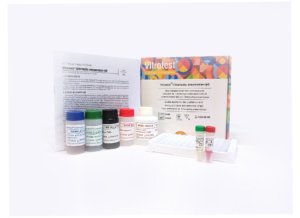
The test kit Vitrotest® Chlamydia pneumoniae-IgG is an enzyme linked immunosorbent assay (ELISA) for the qualitative and semiquantitative determination of IgG class antibodies to Chlamydia pneumoniae in human serum or plasma. Determination of IgG antibodies to Chlamydia pneumoniae in the test kit Vitrotest® Chlamydia pneumoniae-IgG is based on a solid phase indirect ELISA in a two-step incubation procedure. ○ ТК081 - 96 tests
- Solid phase: breakable microplate ELISA is coated with Chlamydia pneumoniae antigens.
- Conjugate: a monoclonal antibodies to human IgG conjugated to horseradish peroxidase.
- Chromogen: ready to use TMB solution.
- Volume of sample for analysis: 10 μl.
- Assay time: 1h 15 min.
Chlamydia (Chlamydophila) pneumoniae is one of the most common types of intracellular obligate bacteria transmitted by airborne droplets and capable of causing respiratory tract infections. Most respiratory tract infections caused by C. pneumoniae are asymptomatic or have minor clinical manifestations. Common symptoms that appear after a 3-4 week incubation period are usually runny nose, nasal congestion, fatigue, low-grade fever, hoarseness, sore throat, cough, and headache. However, about 30% of C. pneumoniae infections are characterized by more severe respiratory diseases, such as community-acquired pneumonia with atypical manifestations, bronchitis, etc. In addition, C. pneumoniae is involved in the pathogenesis of multiple inflammatory conditions, including chronic obstructive pulmonary disease (COPD), asthma, lung cancer, atherosclerosis, arthritis, neurological disorders (Alzheimer's disease, multiple sclerosis, schizophrenia). According to statistics, about 30-50% of people under the age of 20 and 80% aged 60 to 70 have antibodies to this pathogen. With primary infection with C. pneumoniae, IgM antibodies usually appear in the human blood after 2-3 weeks, IgG antibodies - somewhat later, after 3-5 weeks from the onset of the disease. The simultaneous detection of IgM and IgG antibodies indicates acute or manifest chronic infection. In case of re-infection or exacerbation of the chronic process, IgM antibodies may not be detected or may be detected in low titers, while the level of IgG class antibodies increases rapidly, which has diagnostic value in the study of paired sera taken at intervals of 10-14 days. For the diagnosis of C. pneumoniae-mediated diseases, the most widespread are the culture method, immunohistochemistry, polymerase chain reaction and serological methods. Among the latter, the most informative and widespread is ELISA.
-
The test kit Vitrotest® Chlamydia pneumoniae-IgG is an enzyme linked immunosorbent assay (ELISA) for the qualitative and semiquantitative determination of IgG class antibodies to Chlamydia pneumoniae in human serum or plasma. Determination of IgG antibodies to Chlamydia pneumoniae in the test kit Vitrotest® Chlamydia pneumoniae-IgG is based on a solid phase indirect ELISA in a two-step incubation procedure. ○ ТК081 - 96 tests
- Solid phase: breakable microplate ELISA is coated with Chlamydia pneumoniae antigens.
- Conjugate: a monoclonal antibodies to human IgG conjugated to horseradish peroxidase.
- Chromogen: ready to use TMB solution.
- Volume of sample for analysis: 10 μl.
- Assay time: 1h 15 min.
Chlamydia (Chlamydophila) pneumoniae is one of the most common types of intracellular obligate bacteria transmitted by airborne droplets and capable of causing respiratory tract infections. Most respiratory tract infections caused by C. pneumoniae are asymptomatic or have minor clinical manifestations. Common symptoms that appear after a 3-4 week incubation period are usually runny nose, nasal congestion, fatigue, low-grade fever, hoarseness, sore throat, cough, and headache. However, about 30% of C. pneumoniae infections are characterized by more severe respiratory diseases, such as community-acquired pneumonia with atypical manifestations, bronchitis, etc. In addition, C. pneumoniae is involved in the pathogenesis of multiple inflammatory conditions, including chronic obstructive pulmonary disease (COPD), asthma, lung cancer, atherosclerosis, arthritis, neurological disorders (Alzheimer's disease, multiple sclerosis, schizophrenia). According to statistics, about 30-50% of people under the age of 20 and 80% aged 60 to 70 have antibodies to this pathogen. With primary infection with C. pneumoniae, IgM antibodies usually appear in the human blood after 2-3 weeks, IgG antibodies - somewhat later, after 3-5 weeks from the onset of the disease. The simultaneous detection of IgM and IgG antibodies indicates acute or manifest chronic infection. In case of re-infection or exacerbation of the chronic process, IgM antibodies may not be detected or may be detected in low titers, while the level of IgG class antibodies increases rapidly, which has diagnostic value in the study of paired sera taken at intervals of 10-14 days. For the diagnosis of C. pneumoniae-mediated diseases, the most widespread are the culture method, immunohistochemistry, polymerase chain reaction and serological methods. Among the latter, the most informative and widespread is ELISA.