Skip to content
  • Home
  • About us
  • Products
    ELISA kit
    • HIV infection
    • Viral Hepatitis
    • Syphilis
    • Herpes Infections
    • TORCH Infections
    • Vaccine-Preventable Diseases
    • Сovid-19COVID-19 is an infectious disease caused by a new SARS-CoV-2 coronavirus which had not previously been detected in humans. The viral infection leads to the development of a respiratory flu-like disease with symptoms such as cough and fever. In more severe cases pneumonia can develop. The average incubation period of the COVID-19 is 6.5 days, but it can range from 3 to 21 days. SARS-CoV-2 is an RNA-virus with a specific envelope with spikes in the form of a “corona”. The main structural proteins of the virus include envelope protein (E), membrane protein (M), spike (S) glycoprotein, and nucleocapsid (N) protein. S protein on the surface of the SARS-CoV-2 virion mediates the receptor recognition and cell membrane fusion with ACE2 molecules, which are mainly expressed on type II pneumocytes, colon and kidney epithelial cells. It contains three fragments, namely the ectodomain, the transmembrane domain and the short intracellular segment. The ectodomain consists of a receptor-binding subunit S1 containing the RBD domain and a fusion subunit (S2). During viral infection, S1 C-terminal domain binds to the extracellular peptidase (PD) domain of ACE2 to ensure that the virus attaches to the surface of the target cell. The S1 N-terminal domain binds to…
    • Borreliosis
    • Parasites
    • Urogenital Infections
    • Gastroenteric Diseases
    • Tumor Markers
    • Metabolism
    • Allergy
    • Biotinylated Allergens
    • Thyroid function
    • Brucellosis
    Download catalog ELISA kits
    IMMUNOGLOBULINS LEVEL
    Raw materials
    DOWNLOAD CATALOG RAW MATERIALS
  • News
  • Contact
  • EN
  • UA
  • RU
  • Home
  • About us
  • Products
    • ELISA kits
      • HIV infection
      • Parasites
      • Syphilis
      • Borreliosis
      • Viral Hepatitis
      • TORCH Infections
      • Herpes Infections
      • Vaccine-Preventable Diseases
      • Сovid-19COVID-19 is an infectious disease caused by a new SARS-CoV-2 coronavirus which had not previously been detected in humans. The viral infection leads to the development of a respiratory flu-like disease with symptoms such as cough and fever. In more severe cases pneumonia can develop. The average incubation period of the COVID-19 is 6.5 days, but it can range from 3 to 21 days. SARS-CoV-2 is an RNA-virus with a specific envelope with spikes in the form of a “corona”. The main structural proteins of the virus include envelope protein (E), membrane protein (M), spike (S) glycoprotein, and nucleocapsid (N) protein. S protein on the surface of the SARS-CoV-2 virion mediates the receptor recognition and cell membrane fusion with ACE2 molecules, which are mainly expressed on type II pneumocytes, colon and kidney epithelial cells. It contains three fragments, namely the ectodomain, the transmembrane domain and the short intracellular segment. The ectodomain consists of a receptor-binding subunit S1 containing the RBD domain and a fusion subunit (S2). During viral infection, S1 C-terminal domain binds to the extracellular peptidase (PD) domain of ACE2 to ensure that the virus attaches to the surface of the target cell. The S1 N-terminal domain binds to…
      • Urogenital Infections
      • Gastroenteric Diseases
      • Tumor Markers
      • Metabolism
      • Allergy
      • Biotinylated Allergens
      • Thyroid function
    • IMMUNOGLOBULINS LEVEL
    • RAW MATERIALS
    • DOWNLOAD CATALOG ELISA
    • DOWNLOAD CATALOG RAW MATERIALS
  • News
  • Contact
  • EN
    • EN
    • UA
    • RU
  • DOWNLOAD CATALOG ELISA
  • Home
  • About us
  • Products
    • ELISA kits
      • HIV infection
      • Parasites
      • Syphilis
      • Borreliosis
      • Viral Hepatitis
      • TORCH Infections
      • Herpes Infections
      • Vaccine-Preventable Diseases
      • Сovid-19COVID-19 is an infectious disease caused by a new SARS-CoV-2 coronavirus which had not previously been detected in humans. The viral infection leads to the development of a respiratory flu-like disease with symptoms such as cough and fever. In more severe cases pneumonia can develop. The average incubation period of the COVID-19 is 6.5 days, but it can range from 3 to 21 days. SARS-CoV-2 is an RNA-virus with a specific envelope with spikes in the form of a “corona”. The main structural proteins of the virus include envelope protein (E), membrane protein (M), spike (S) glycoprotein, and nucleocapsid (N) protein. S protein on the surface of the SARS-CoV-2 virion mediates the receptor recognition and cell membrane fusion with ACE2 molecules, which are mainly expressed on type II pneumocytes, colon and kidney epithelial cells. It contains three fragments, namely the ectodomain, the transmembrane domain and the short intracellular segment. The ectodomain consists of a receptor-binding subunit S1 containing the RBD domain and a fusion subunit (S2). During viral infection, S1 C-terminal domain binds to the extracellular peptidase (PD) domain of ACE2 to ensure that the virus attaches to the surface of the target cell. The S1 N-terminal domain binds to…
      • Urogenital Infections
      • Gastroenteric Diseases
      • Tumor Markers
      • Metabolism
      • Allergy
      • Biotinylated Allergens
      • Thyroid function
    • IMMUNOGLOBULINS LEVEL
    • RAW MATERIALS
    • DOWNLOAD CATALOG ELISA
    • DOWNLOAD CATALOG RAW MATERIALS
  • News
  • Contact
  • EN
    • EN
    • UA
    • RU
  • DOWNLOAD CATALOG ELISA

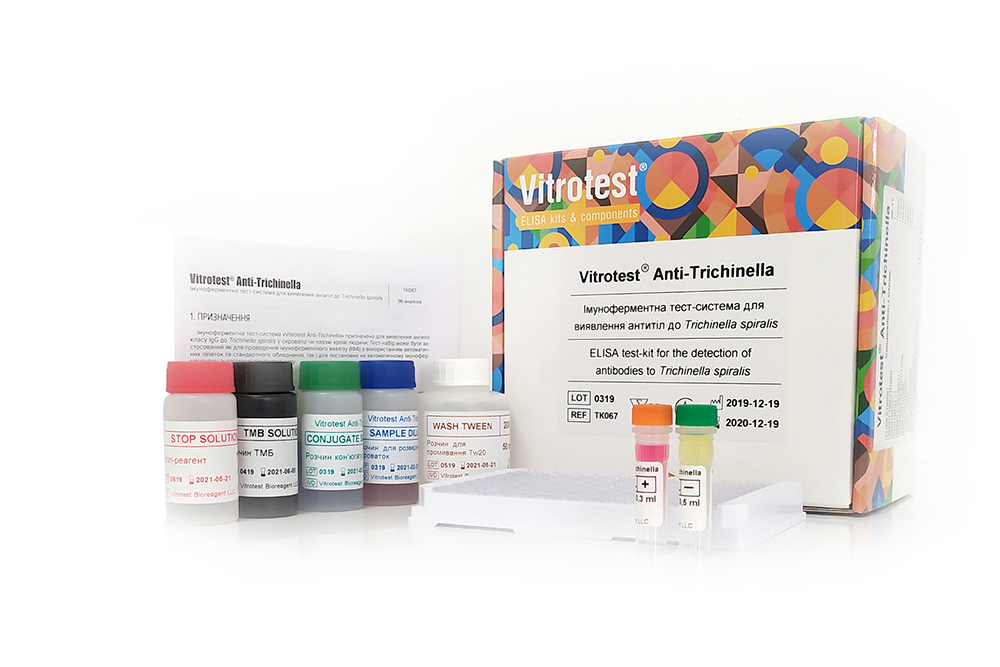
Vitrotest® Anti-Trichinella

  • Description

  • Features

  • Trichinosis

  • Description

The test kit Vitrotest® Anti-Trichinella is an enzyme linked immunosorbent assay (ELISA) for the detection of IgG class antibodies to Trichinella spiralis in human serum or plasma.

Determination of IgG antibodies to Trichinella spiralis in the test kit Vitrotest® Anti-Trichinella is based on a solid phase, indirect ELISA in a two-step incubation procedure.

○ ТК067 – 96 tests

  • Features

  • Solid phase: breakable microplate ELISA is coated Trichinella spiralis larvae antigens.
  • Conjugate: a monoclonal antibodies to human IgG conjugated to horseradish peroxidase.
  • Chromogen: ready to use TMB solution.
  • Volume of sample for analysis: 10 μl.
  • Assay time: 1h 15 min.

  • Trichinosis

Trichinosis is a helminthiasis caused by a nematode Trichinella spiralis. Trichinellas are small, thread-like worms covered with a striped cuticle.

Transmission occurs by ingestion of meat containing encapsulated trichinella larvae. During digestion under the action of the gastric juice larvae release from capsules penetrate the submucosal layer of the small intestine, adhere to the mucosa and begin to proliferate. Soon after fertilization of females, the males die and the females start producing larvae, which enter the blood and lymphatic vessels through tissue mucosa, spread throughout the body and settle in striated muscles. Thereafter this capsule is impregnated with calcium salts leading to calcification. The larvae remain viable for many years.

The incubation period of human trichinosis lasts 10-25 days. Trichinosis is characterized by fever, myalgia, facial swelling, skin rash, blood eosinophilia, and in severe cases – by damage to internal organs and central nervous system.

The diagnosis of trichinosis is based on clinical signs, epidemiological history, serological tests (complement fixation tests, the reaction of indirect hemagglutination) and ELISA. The latter method is recommended by OIE for serological diagnosis of trichinosis.

The most specific and successful method to confirm infestation is the detection of IgG antibodies to trichinella antigens in the blood. These antibodies could be determined from 2-3 to 4-6 weeks after the eating of contaminated meat. Specific IgE class antibodies are also present in the blood during the acute stage of the disease, however, they are rarely detected due to the short period of their circulation in the bloodstream. During the early stage of invasion, specific antibodies might be still undetectable. Therefore, another sample should be taken in 1-2 weeks to confirm or reject suspected trichinosis. Seroconversion usually occurs 2-5 weeks after infection depending on the infectious dose. Assessment of antibody dynamics is a very informative marker of therapy effectiveness. In cases of ineffective or untimely therapy, specific antibodies are detected for up to 20 years if trichinosis is effectively treated in the first two weeks after infection, antibodies disappear within a year.

ELISA kits, Parasites

tel./fax: +380972227672, +380442227672 | e-mail: info@vitrotest.ua, order@vitrotest.ua

© Vitrotest 2006 - 2026 | All Rights Reserved | Privacy policy | Terms of use

Page load link
Go to Top