Skip to content
  • Home
  • About us
  • Products
    ELISA kit
    • HIV infection
    • Viral Hepatitis
    • Syphilis
    • Herpes Infections
    • TORCH Infections
    • Vaccine-Preventable Diseases
    • Сovid-19COVID-19 is an infectious disease caused by a new SARS-CoV-2 coronavirus which had not previously been detected in humans. The viral infection leads to the development of a respiratory flu-like disease with symptoms such as cough and fever. In more severe cases pneumonia can develop. The average incubation period of the COVID-19 is 6.5 days, but it can range from 3 to 21 days. SARS-CoV-2 is an RNA-virus with a specific envelope with spikes in the form of a “corona”. The main structural proteins of the virus include envelope protein (E), membrane protein (M), spike (S) glycoprotein, and nucleocapsid (N) protein. S protein on the surface of the SARS-CoV-2 virion mediates the receptor recognition and cell membrane fusion with ACE2 molecules, which are mainly expressed on type II pneumocytes, colon and kidney epithelial cells. It contains three fragments, namely the ectodomain, the transmembrane domain and the short intracellular segment. The ectodomain consists of a receptor-binding subunit S1 containing the RBD domain and a fusion subunit (S2). During viral infection, S1 C-terminal domain binds to the extracellular peptidase (PD) domain of ACE2 to ensure that the virus attaches to the surface of the target cell. The S1 N-terminal domain binds to…
    • Borreliosis
    • Parasites
    • Urogenital Infections
    • Gastroenteric Diseases
    • Tumor Markers
    • Metabolism
    • Allergy
    • Biotinylated Allergens
    • Thyroid function
    • Brucellosis
    Download catalog ELISA kits
    IMMUNOGLOBULINS LEVEL
    Raw materials
    DOWNLOAD CATALOG RAW MATERIALS
  • News
  • Contact
  • EN
  • UA
  • RU
  • Home
  • About us
  • Products
    • ELISA kits
      • HIV infection
      • Parasites
      • Syphilis
      • Borreliosis
      • Viral Hepatitis
      • TORCH Infections
      • Herpes Infections
      • Vaccine-Preventable Diseases
      • Сovid-19COVID-19 is an infectious disease caused by a new SARS-CoV-2 coronavirus which had not previously been detected in humans. The viral infection leads to the development of a respiratory flu-like disease with symptoms such as cough and fever. In more severe cases pneumonia can develop. The average incubation period of the COVID-19 is 6.5 days, but it can range from 3 to 21 days. SARS-CoV-2 is an RNA-virus with a specific envelope with spikes in the form of a “corona”. The main structural proteins of the virus include envelope protein (E), membrane protein (M), spike (S) glycoprotein, and nucleocapsid (N) protein. S protein on the surface of the SARS-CoV-2 virion mediates the receptor recognition and cell membrane fusion with ACE2 molecules, which are mainly expressed on type II pneumocytes, colon and kidney epithelial cells. It contains three fragments, namely the ectodomain, the transmembrane domain and the short intracellular segment. The ectodomain consists of a receptor-binding subunit S1 containing the RBD domain and a fusion subunit (S2). During viral infection, S1 C-terminal domain binds to the extracellular peptidase (PD) domain of ACE2 to ensure that the virus attaches to the surface of the target cell. The S1 N-terminal domain binds to…
      • Urogenital Infections
      • Gastroenteric Diseases
      • Tumor Markers
      • Metabolism
      • Allergy
      • Biotinylated Allergens
      • Thyroid function
    • IMMUNOGLOBULINS LEVEL
    • RAW MATERIALS
    • DOWNLOAD CATALOG ELISA
    • DOWNLOAD CATALOG RAW MATERIALS
  • News
  • Contact
  • EN
    • EN
    • UA
    • RU
  • DOWNLOAD CATALOG ELISA
  • Home
  • About us
  • Products
    • ELISA kits
      • HIV infection
      • Parasites
      • Syphilis
      • Borreliosis
      • Viral Hepatitis
      • TORCH Infections
      • Herpes Infections
      • Vaccine-Preventable Diseases
      • Сovid-19COVID-19 is an infectious disease caused by a new SARS-CoV-2 coronavirus which had not previously been detected in humans. The viral infection leads to the development of a respiratory flu-like disease with symptoms such as cough and fever. In more severe cases pneumonia can develop. The average incubation period of the COVID-19 is 6.5 days, but it can range from 3 to 21 days. SARS-CoV-2 is an RNA-virus with a specific envelope with spikes in the form of a “corona”. The main structural proteins of the virus include envelope protein (E), membrane protein (M), spike (S) glycoprotein, and nucleocapsid (N) protein. S protein on the surface of the SARS-CoV-2 virion mediates the receptor recognition and cell membrane fusion with ACE2 molecules, which are mainly expressed on type II pneumocytes, colon and kidney epithelial cells. It contains three fragments, namely the ectodomain, the transmembrane domain and the short intracellular segment. The ectodomain consists of a receptor-binding subunit S1 containing the RBD domain and a fusion subunit (S2). During viral infection, S1 C-terminal domain binds to the extracellular peptidase (PD) domain of ACE2 to ensure that the virus attaches to the surface of the target cell. The S1 N-terminal domain binds to…
      • Urogenital Infections
      • Gastroenteric Diseases
      • Tumor Markers
      • Metabolism
      • Allergy
      • Biotinylated Allergens
      • Thyroid function
    • IMMUNOGLOBULINS LEVEL
    • RAW MATERIALS
    • DOWNLOAD CATALOG ELISA
    • DOWNLOAD CATALOG RAW MATERIALS
  • News
  • Contact
  • EN
    • EN
    • UA
    • RU
  • DOWNLOAD CATALOG ELISA

Vitrotest® Specific-IgE

  • Description

  • Features

  • Specific IgE

  • Description

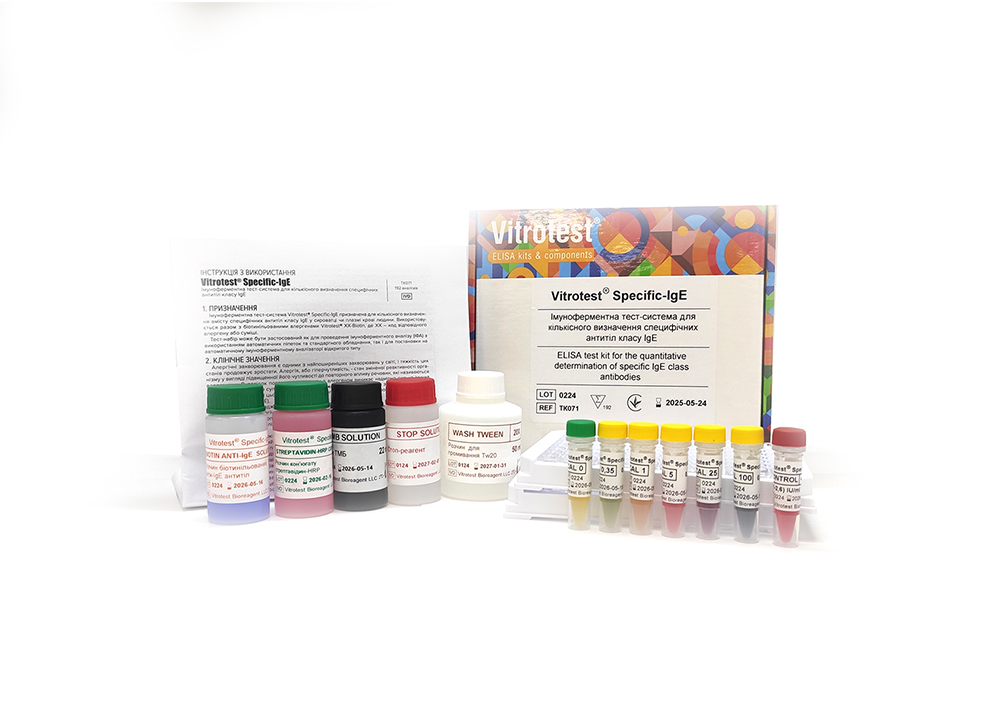
The test kit Vitrotest® Specific-IgE is an enzyme linked immunosorbent assay (ELISA) for the quantitative determination of specific IgE class antibodies in human serum or plasma. The test kit is used together with biotinylated allergens Vitrotest® XX-Biotin, where XX is a code of relevant allergen or mixture.

Quantitative determination of specific IgE antibodies in the Vitrotest® Specific-IgE test kit is based on the principle of capturing IgE antibodies followed by the use of biotin-streptavidin interaction.

○ ТК071 – 192 tests

  • Features

  • Solid phase: breakable microplate ELISA is coated with monoclonal antibodies specific to human IgE.
  • Biotinylated anti-IgE: biotinylated anti-IgE antibodies.
  • Conjugate streptavidin-HRP: streptavidin сonjugated to horseradish peroxidase.
  • Chromogen: ready to use TMB solution.
  • Volume of sample for analysis: 50 μl.
  • Assay time: 1h 30 min.

  • Specific IgE

Allergic diseases are among the most common diseases in the world and the severity of these conditions continues to increase. Allergy, or hypersensitivity, is a state of altered reactivity of the body in the form of increased sensitivity to repeated exposure to substances called allergens. As a result of repeated contact with the allergen, an excessively strong immune reaction of the body occurs, accompanied by tissue damage. One mechanism underlying this process is immunoglobulin E (IgE)-mediated mast cell degranulation.

The most common allergic conditions that require proper diagnosis are: anaphylaxis, allergic rhinitis, allergic conjunctivitis, bronchial asthma, etc. Accurate diagnosis coupled with optimal therapy requires the use of appropriate tests to confirm sensitization to a specific allergen and detailed information about the effect of the suspected allergen.

To diagnose in vivo allergies, several types of skin tests are used (skin prick test, intradermal test, patch test). However, the use of these samples has a number of significant limitations, namely, the need for a highly qualified doctor conducting the test and the lack of laboratories conducting these studies. In addition, in vivo diagnosis is rarely performed in children due to possible adverse reactions.

However, in vitro diagnostics of IgE-mediated allergic diseases are useful for identifying the causative allergen and usually include the following laboratory approaches:
1) determination of the level of total IgE;
2) study of the concentration of specific IgE to various allergens – is the most commonly used in vitro
diagnostic approach, performed using a single or multiplex strategy;
3) basophil activation test (BAT), which is quite specific, but difficult to perform, and therefore limited to selected situations.

Today, to detect specific antibodies of the IgE class, the enzyme-linked immunosorbent assay method, which provides high sensitivity and specificity, has become widely used. A separate supply of a wide range of biotinylated allergens, depending on the needs of the diagnostic laboratory, ensures maximum convenience and cost-effectiveness of the study.

Allergy, ELISA kits

tel./fax: +380972227672, +380442227672 | e-mail: info@vitrotest.ua, order@vitrotest.ua

© Vitrotest 2006 - 2026 | All Rights Reserved | Privacy policy | Terms of use

Page load link
Go to Top