
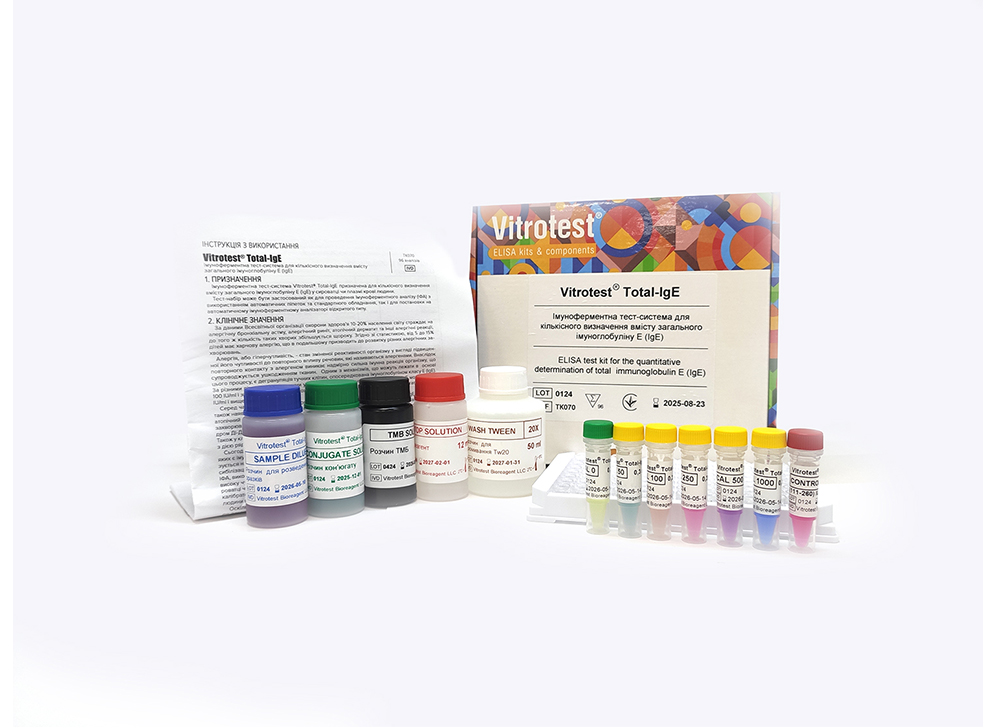
Determination of total IgE content in the test kit Vitrotest® Total-IgE is based on a solid-phase “sandwich” ELISA.
○ ТК070 – 96 tests
- Solid phase: breakable microplate ELISA is coated with monoclonal antibodies specific to human IgE.
- Conjugate: a monoclonal antibodies to human IgЕ conjugated to horseradish peroxidase.
- Chromogen: ready to use TMB solution.
- Volume of sample for analysis: 10 μl.
- Assay time: 1h 15 min.
- Analytical sensitivity: 2,1 IU/ml.
- Linearity range: 2,1-1000 IU/ml.
Allergy or hypersensitivity is a state of altered reactivity of the body in the form of its increased sensitivity to repeated exposure of substances called allergens. As a result of repeated contact with the allergen, an excessively strong immune reaction of the body occurs, accompanied by tissue damage. One of the mechanisms underlying this process is mast cell degranulation mediated by immunoglobulin class E (IgE). According to the literature data, in an adult, the normal concentration of IgE can reach 100 IU/ml and decreases in the elderly. During allergy the IgE level can rise to 2000 IU/ml and above.
Among often diseases that accompanied by an increase in total IgE in the blood, as well as the presence of specific IgE are allergic rhinitis, atopic bronchial asthma, atopic dermatitis, urticaria, aspergillosis and helminthiases, etc. Less common diseases with hyper-IgE syndrome include congenital immunodeficiencies (Job syndrome, DiGeorge syndrome), selective IgA deficiency, WiskottAldridge syndrome and IgEmyeloma. Also, in clinical practice, there are often cases of elevated IgE levels associated with the action of several medications.
Nowadays, the methods of in vitro allergy diagnostics are becoming increasingly popular, one of which is ELISA for the determination of the total IgE content. This method is characterized by several advantages: it has no contraindications to the test, it does not cause additional sensitization and there is no risk of anaphylactic reactions. Most test systems are based on the «sandwich» ELISA, in which the use of monoclonal antibodies to human immunoglobulins E provides high sensitivity and specificity of the analysis. Standardization of the quantitative determination of IgE in human serum or plasma is ensured by using for the manufacture of internal calibrators ELISA kits of the WHO International Standard with an established concentration of human IgE in international units IU/ml.
Since the ELISA method is a highly sensitive and specific analysis and has no contraindications for its application, it can be widely used for the diagnosis of allergic diseases.