Skip to content
  • Home
  • About us
  • Products
    ELISA kit
    • HIV infection
    • Viral Hepatitis
    • Syphilis
    • Herpes Infections
    • TORCH Infections
    • Vaccine-Preventable Diseases
    • Сovid-19COVID-19 is an infectious disease caused by a new SARS-CoV-2 coronavirus which had not previously been detected in humans. The viral infection leads to the development of a respiratory flu-like disease with symptoms such as cough and fever. In more severe cases pneumonia can develop. The average incubation period of the COVID-19 is 6.5 days, but it can range from 3 to 21 days. SARS-CoV-2 is an RNA-virus with a specific envelope with spikes in the form of a “corona”. The main structural proteins of the virus include envelope protein (E), membrane protein (M), spike (S) glycoprotein, and nucleocapsid (N) protein. S protein on the surface of the SARS-CoV-2 virion mediates the receptor recognition and cell membrane fusion with ACE2 molecules, which are mainly expressed on type II pneumocytes, colon and kidney epithelial cells. It contains three fragments, namely the ectodomain, the transmembrane domain and the short intracellular segment. The ectodomain consists of a receptor-binding subunit S1 containing the RBD domain and a fusion subunit (S2). During viral infection, S1 C-terminal domain binds to the extracellular peptidase (PD) domain of ACE2 to ensure that the virus attaches to the surface of the target cell. The S1 N-terminal domain binds to…
    • Borreliosis
    • Parasites
    • Urogenital Infections
    • Gastroenteric Diseases
    • Tumor Markers
    • Metabolism
    • Allergy
    • Biotinylated Allergens
    • Thyroid function
    Download catalog ELISA kits
    IMMUNOGLOBULINS LEVEL
    Raw materials
    DOWNLOAD CATALOG RAW MATERIALS
  • News
  • Contact
  • EN
  • UA
  • RU
  • Home
  • About us
  • Products
    • ELISA kits
      • HIV infection
      • Parasites
      • Syphilis
      • Borreliosis
      • Viral Hepatitis
      • TORCH Infections
      • Herpes Infections
      • Vaccine-Preventable Diseases
      • Сovid-19COVID-19 is an infectious disease caused by a new SARS-CoV-2 coronavirus which had not previously been detected in humans. The viral infection leads to the development of a respiratory flu-like disease with symptoms such as cough and fever. In more severe cases pneumonia can develop. The average incubation period of the COVID-19 is 6.5 days, but it can range from 3 to 21 days. SARS-CoV-2 is an RNA-virus with a specific envelope with spikes in the form of a “corona”. The main structural proteins of the virus include envelope protein (E), membrane protein (M), spike (S) glycoprotein, and nucleocapsid (N) protein. S protein on the surface of the SARS-CoV-2 virion mediates the receptor recognition and cell membrane fusion with ACE2 molecules, which are mainly expressed on type II pneumocytes, colon and kidney epithelial cells. It contains three fragments, namely the ectodomain, the transmembrane domain and the short intracellular segment. The ectodomain consists of a receptor-binding subunit S1 containing the RBD domain and a fusion subunit (S2). During viral infection, S1 C-terminal domain binds to the extracellular peptidase (PD) domain of ACE2 to ensure that the virus attaches to the surface of the target cell. The S1 N-terminal domain binds to…
      • Urogenital Infections
      • Gastroenteric Diseases
      • Tumor Markers
      • Metabolism
      • Allergy
      • Biotinylated Allergens
      • Thyroid function
    • IMMUNOGLOBULINS LEVEL
    • RAW MATERIALS
    • DOWNLOAD CATALOG ELISA
    • DOWNLOAD CATALOG RAW MATERIALS
  • News
  • Contact
  • EN
    • EN
    • UA
    • RU
  • DOWNLOAD CATALOG ELISA
  • Home
  • About us
  • Products
    • ELISA kits
      • HIV infection
      • Parasites
      • Syphilis
      • Borreliosis
      • Viral Hepatitis
      • TORCH Infections
      • Herpes Infections
      • Vaccine-Preventable Diseases
      • Сovid-19COVID-19 is an infectious disease caused by a new SARS-CoV-2 coronavirus which had not previously been detected in humans. The viral infection leads to the development of a respiratory flu-like disease with symptoms such as cough and fever. In more severe cases pneumonia can develop. The average incubation period of the COVID-19 is 6.5 days, but it can range from 3 to 21 days. SARS-CoV-2 is an RNA-virus with a specific envelope with spikes in the form of a “corona”. The main structural proteins of the virus include envelope protein (E), membrane protein (M), spike (S) glycoprotein, and nucleocapsid (N) protein. S protein on the surface of the SARS-CoV-2 virion mediates the receptor recognition and cell membrane fusion with ACE2 molecules, which are mainly expressed on type II pneumocytes, colon and kidney epithelial cells. It contains three fragments, namely the ectodomain, the transmembrane domain and the short intracellular segment. The ectodomain consists of a receptor-binding subunit S1 containing the RBD domain and a fusion subunit (S2). During viral infection, S1 C-terminal domain binds to the extracellular peptidase (PD) domain of ACE2 to ensure that the virus attaches to the surface of the target cell. The S1 N-terminal domain binds to…
      • Urogenital Infections
      • Gastroenteric Diseases
      • Tumor Markers
      • Metabolism
      • Allergy
      • Biotinylated Allergens
      • Thyroid function
    • IMMUNOGLOBULINS LEVEL
    • RAW MATERIALS
    • DOWNLOAD CATALOG ELISA
    • DOWNLOAD CATALOG RAW MATERIALS
  • News
  • Contact
  • EN
    • EN
    • UA
    • RU
  • DOWNLOAD CATALOG ELISA

Vitrotest® Anti-HCV

Home page » Products » Vitrotest® Anti-HCV
  • Description

  • Features

  • Hepatitis C

  • Description

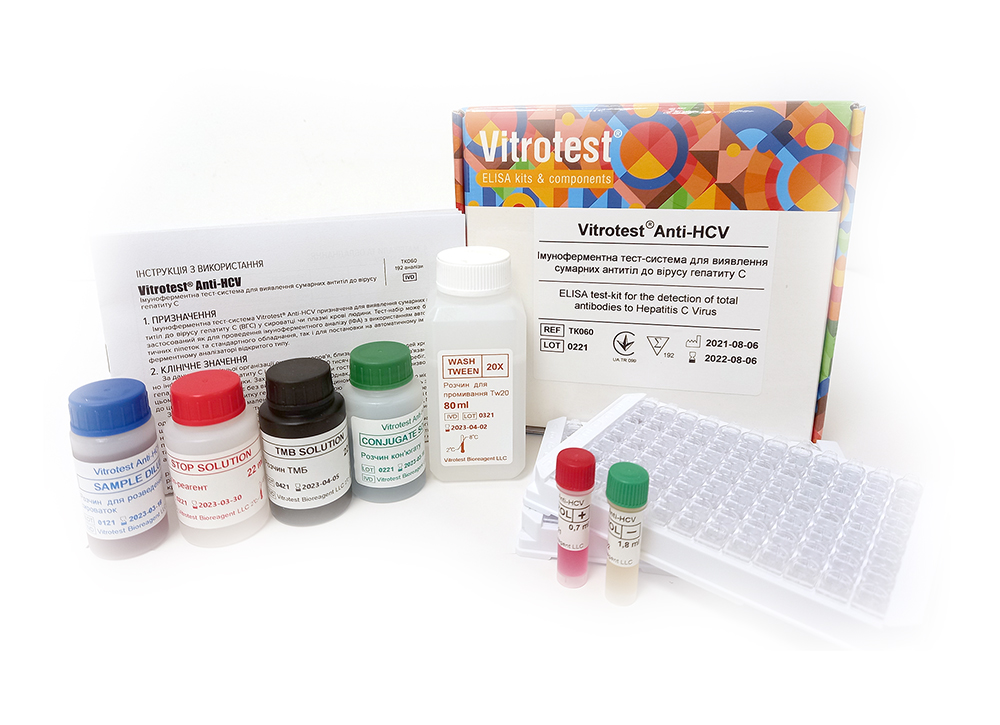
The test kit Vitrotest® Anti-HCV is an enzyme linked immunosorbent assay (ELISA) for the detection of total antibodies to Hepatitis C Virus (HCV) in human serum or plasma.

Determination of antibodies to HCV in the test kit Vitrotest® Anti-HCV is based on a solid phase indirect ELISA in a two-step incubation procedure.

○ TK022 – 96 tests
○ TK060 – 192 tests
○ TK128 – 480 tests

  • Features

  • Solid phase: breakable microplate ELISA is coated with recombinant antigens (core, NS3, NS4 and NS5).
  • Conjugate: monoclonal antibodies to human IgG and IgM conjugated to horseradish peroxidase.
  • Chromogen: ready to use TMB solution.
  • Volume of sample for analysis: 40 μl.
  • Assay time: 2 hours.

  • Hepatitis C

According to the World Health Organization, approximately 150 million people are chronically infected with hepatitis C, and each year more than 350 thousand people die of hepatitis C-related liver disease. The disease may be either acute or chronic, and it often occurs without symptoms. However, chronic infection leads to liver cirrhosis and hepatocellular carcinoma development.

The causative agent of the disease is Hepatitis C Virus (HCV), a small enveloped single-stranded RNA virus (50 nm in diameter), belong to the Flaviviridae family. HCV genome has sequences encoding structural and nonstructural proteins. The structural antigens are nucleocapsid protein (core) and two envelope proteins (E1 and E2). Nonstructural proteins are complex proteins with enzymatic activity (NS2, NS3, NS4a, NS4b, NS5a and NS5b). In response to virus infection specific antibodies to all viral proteins are produced in human bodies.

Incubation period of hepatitis C is 14-180 (average 45) days. After this period, symptoms could arise. They include fever, fatigue, loss of appetite, nausea, vomiting, abdominal pain, joint pain, jaundice. Yet, most (70-80%) people infected with HCV are asymptomatic. Roughly 20% of infected patients clear the virus spontaneously; the rest develop chronic infection. HCV is a leading cause of chronic hepatitis, which progresses into cirrhosis in 5-20% of cases over a period of 20-30 years.

HCV is spread mainly through blood-to-blood contact. Therefore, in developed countries virus infects primarily persons who have injected illicit drugs and recipients of blood transfusions before introduction of regular blood screening for HCV. In developing countries many HCV infections occur in the health-care institutions as a result of unhygienic injections and various surgical manipulations such as tattooing or circumcision. Of other routes of transmission, the most important are sexual and vertical, from mother to fetus. Sexual transmission is regarded as a minor risk factor. Virus transmission from HCV-infected mother to unborn child is possible, with rates of transmission of around several percent.

HCV is divided into six major genotypes that can be further divided into several subtypes from A to L. The amino acid sequences of the major HCV genotypes differ approximately 30% from each other. The genotypes 1, 2 and 3 are found throughout the world whereas the distribution of the other genotypes is much more restricted. The immunity after cleared infection does not result in reliable protection against reinfections.

The overall worldwide prevalence of HCV is approximately 3%. The highest HCV prevalence figures (up to 10–20%) are found in Egypt. The prevalence of HCV infection varies remarkably and, for instance, in different European countries it ranges from 0,1% to 4%.

Adaptive immune responses are typically delayed during acute HCV infection. HCV RNA can be detected 1–3 weeks following infection, but neither HCV-specific T-cells nor HCV-specific antibodies are observed until 1–2 months after infection. The titre of IgG antibodies during the acute phase is relatively low in comparison with other virus infections in the majority of patients, gradually increasing during transformation to chronicity. In patients with resolved infection the titers of IgG after cure are low and often not detectable.

The IgM response in acute HCV infection also does not follow the classical pattern when IgM antibodies precede IgG response. Firstly, it was shown that HCV-specific IgM is more readily detected in chronically than in acutely infected patients (80% and 50% respectively); besides, the IgM titers under chronic infections are higher. Secondly, HCV-specific IgM and IgG are both almost simultaneously detected in acute infection. In individuals recovered from the infection no anti-HCV IgM antibodies are detectable.

A number of diagnostically relevant antigenic epitopes have been found within the C region, E2, NS3, NS4A/B and NS5 proteins, while E1, NS2 and NS5B are less immunogenic. In one study on chronic HCV patients, the following data on prevalence of antibodies were obtained: E2 – 98%, core-97%, NS3-88%, NS5A-68%, and NS4-48%. These data were similar to those observed by other investigators. Antibody titers were highest for core protein while titers for other proteins were considerably lower.

Antibody response against different HCV proteins is temporarily regulated. After infection, relatively early in the acute phase anticore antibodies are produced whereas significant levels of anti-E2 and anti-NS antibodies are detected only during the chronic phase. In recovering patients, anti-core antibodies persist longer than anti-NS antibodies, which often disappear.

ELISA kits, Viral Hepatitis

tel./fax: +380972227672, +380442227672 | e-mail: info@vitrotest.ua, order@vitrotest.ua

© Vitrotest 2006 - 2026 | All Rights Reserved | Privacy policy | Terms of use

Page load link
Go to Top