
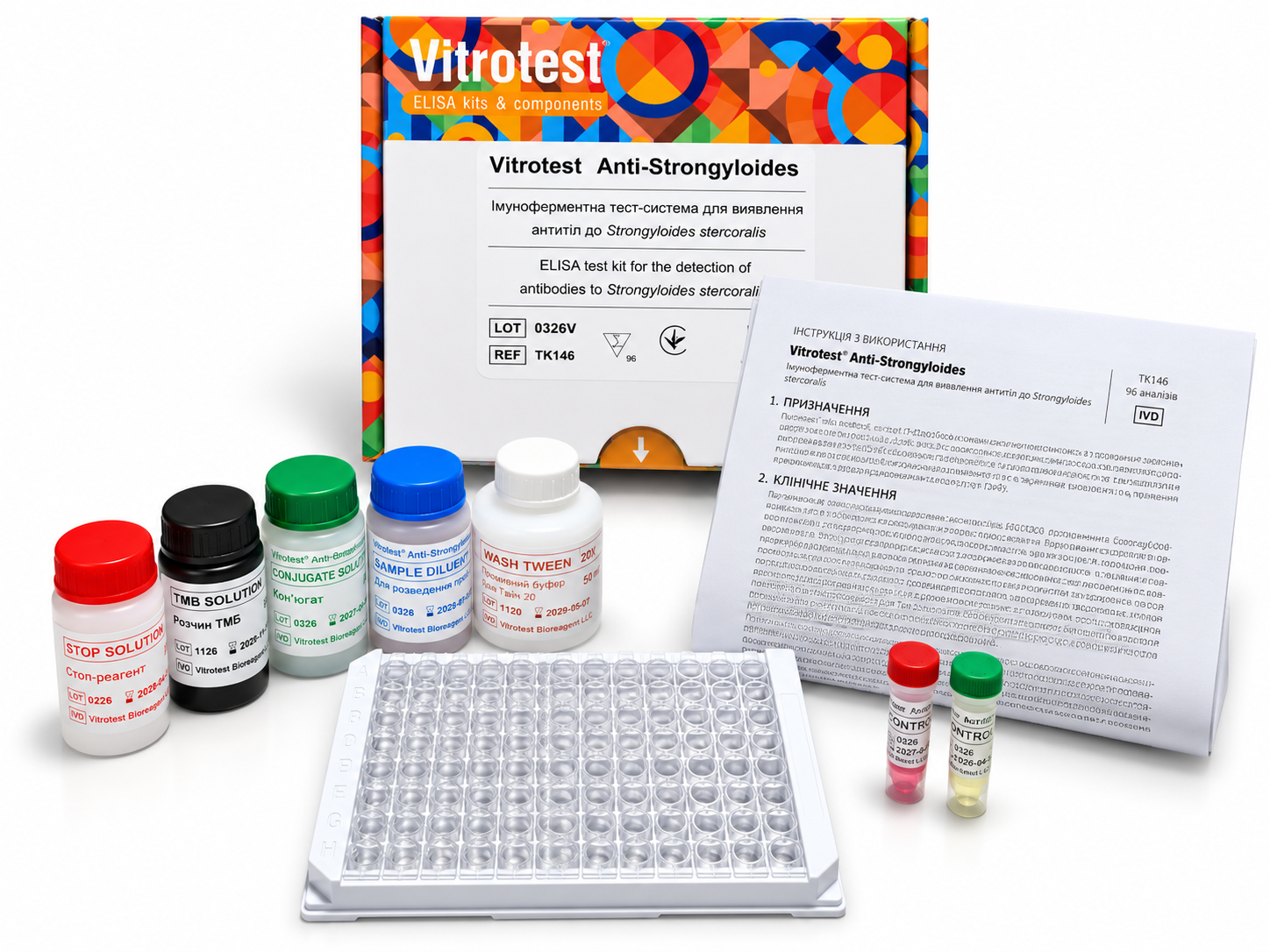
The test kit Vitrotest® Anti-Strongyloides is an enzyme linked immunosorbent assay (ELISA) for the detection of IgG class antibodies to Strongyloides stercoralis in human serum or plasma.
Determination of IgG antibodies to Strongyloides stercoralis in the test kit Vitrotest® Anti-Strongyloides is based on a solid phase, indirect ELISA in a two-step incubation procedure.
- ТК146 – 96 tests
- Solid phase: breakable microplate ELISA is coated Strongyloides stercoralis antigens.
- Conjugate: a monoclonal antibodies to human IgG conjugated to horseradish peroxidase.
- Chromogen: ready to use TMB solution.
- Volume of sample for analysis: 10 μl.
- Assay time: 40 min.
Strongyloidiasis is a chronic parasitic infection of humans caused by Strongyloides stercoralis. This helminth is predominantly found in tropical and subtropical regions but can also be present in temperate climates. It is estimated that approximately 300 to 600 million people worldwide are infected.
Primary infection occurs when S. stercoralis larvae penetrate human skin through direct contact with contaminated soil. The larvae migrate via the bloodstream and lymphatic system to the respiratory tract, where they are then coughed up and swallowed, reaching the intestines. In the intestines, the parasites develop into adult worms, lay eggs, and produce larvae that can be excreted in the feces. A unique feature of S. stercoralis is its ability to cause autoinfection, as larvae may re-enter the intestines or perianal skin without leaving the host, leading to persistent infection.
In immunocompetent individuals, uncomplicated strongyloidiasis may be asymptomatic or present with mild cutaneous and gastrointestinal symptoms. Often, the only sign of infection is unexplained peripheral eosinophilia. However, in cases of heavy infestation or in immunosuppressed patients, the disease can cause severe manifestations such as abdominal pain, watery diarrhea, constipation, weight loss, vomiting, or small bowel obstruction. Hyperinfection syndrome is the most severe manifestation of the disease, with high mortality rates.
Parasitological methods (microscopy, culture) are traditionally used for diagnosis. The sensitivity and specifi city of these tests, however, are not high. The standard stool examination has a sensitivity of only 21% (5). Serological methods, especially enzyme-linked immunosorbent assay (ELISA), are highly sensitive and convenient for detecting antibodies to S. stercoralis larvae. ELISA is widely used for screening, diagnosing strongyloidiasis, and monitoring treatment effi cacy, as antibody titers signifi cantly decline within the fi rst 6 months following successful eradication therapy.