Skip to content
  • Home
  • About us
  • Products
    ELISA kits
    Download catalog ELISA kits
    IMMUNOGLOBULINS LEVEL
    RAW MATERIAL
  • News
  • Contact
  • EN
  • UA
  • RU
  • Home
  • About us
  • Products
    • ELISA KITS
      • HIV infection
      • Parasites
      • Syphilis
      • Borreliosis
      • Viral Hepatitis
      • TORCH Infections
      • Herpes Infections
      • Vaccine-Preventable Diseases
      • Сovid-19COVID-19 is an infectious disease caused by a new SARS-CoV-2 coronavirus which had not previously been detected in humans. The viral infection leads to the development of a respiratory flu-like disease with symptoms such as cough and fever. In more severe cases pneumonia can develop. The average incubation period of the COVID-19 is 6.5 days, but it can range from 3 to 21 days. SARS-CoV-2 is an RNA-virus with a specific envelope with spikes in the form of a “corona”. The main structural proteins of the virus include envelope protein (E), membrane protein (M), spike (S) glycoprotein, and nucleocapsid (N) protein. S protein on the surface of the SARS-CoV-2 virion mediates the receptor recognition and cell membrane fusion with ACE2 molecules, which are mainly expressed on type II pneumocytes, colon and kidney epithelial cells. It contains three fragments, namely the ectodomain, the transmembrane domain and the short intracellular segment. The ectodomain consists of a receptor-binding subunit S1 containing the RBD domain and a fusion subunit (S2). During viral infection, S1 C-terminal domain binds to the extracellular peptidase (PD) domain of ACE2 to ensure that the virus attaches to the surface of the target cell. The S1 N-terminal domain binds to…
      • Urogenital Infections
      • Gastroenteric Diseases
      • Tumor Markers
      • Metabolism
      • Allergy
      • Biotinylated Allergens
      • Thyroid function
    • IMMUNOGLOBULINS LEVEL
    • RAW MATERIALS
    • DOWNLOAD CATALOG ELISA
    • DOWNLOAD CATALOG RAW MATERIALS
  • News
  • Contact
  • EN
    • EN
    • UA
    • RU
  • DOWNLOAD CATALOG ELISA
  • Home
  • About us
  • Products
    • ELISA KITS
      • HIV infection
      • Parasites
      • Syphilis
      • Borreliosis
      • Viral Hepatitis
      • TORCH Infections
      • Herpes Infections
      • Vaccine-Preventable Diseases
      • Сovid-19COVID-19 is an infectious disease caused by a new SARS-CoV-2 coronavirus which had not previously been detected in humans. The viral infection leads to the development of a respiratory flu-like disease with symptoms such as cough and fever. In more severe cases pneumonia can develop. The average incubation period of the COVID-19 is 6.5 days, but it can range from 3 to 21 days. SARS-CoV-2 is an RNA-virus with a specific envelope with spikes in the form of a “corona”. The main structural proteins of the virus include envelope protein (E), membrane protein (M), spike (S) glycoprotein, and nucleocapsid (N) protein. S protein on the surface of the SARS-CoV-2 virion mediates the receptor recognition and cell membrane fusion with ACE2 molecules, which are mainly expressed on type II pneumocytes, colon and kidney epithelial cells. It contains three fragments, namely the ectodomain, the transmembrane domain and the short intracellular segment. The ectodomain consists of a receptor-binding subunit S1 containing the RBD domain and a fusion subunit (S2). During viral infection, S1 C-terminal domain binds to the extracellular peptidase (PD) domain of ACE2 to ensure that the virus attaches to the surface of the target cell. The S1 N-terminal domain binds to…
      • Urogenital Infections
      • Gastroenteric Diseases
      • Tumor Markers
      • Metabolism
      • Allergy
      • Biotinylated Allergens
      • Thyroid function
    • IMMUNOGLOBULINS LEVEL
    • RAW MATERIALS
    • DOWNLOAD CATALOG ELISA
    • DOWNLOAD CATALOG RAW MATERIALS
  • News
  • Contact
  • EN
    • EN
    • UA
    • RU
  • DOWNLOAD CATALOG ELISA

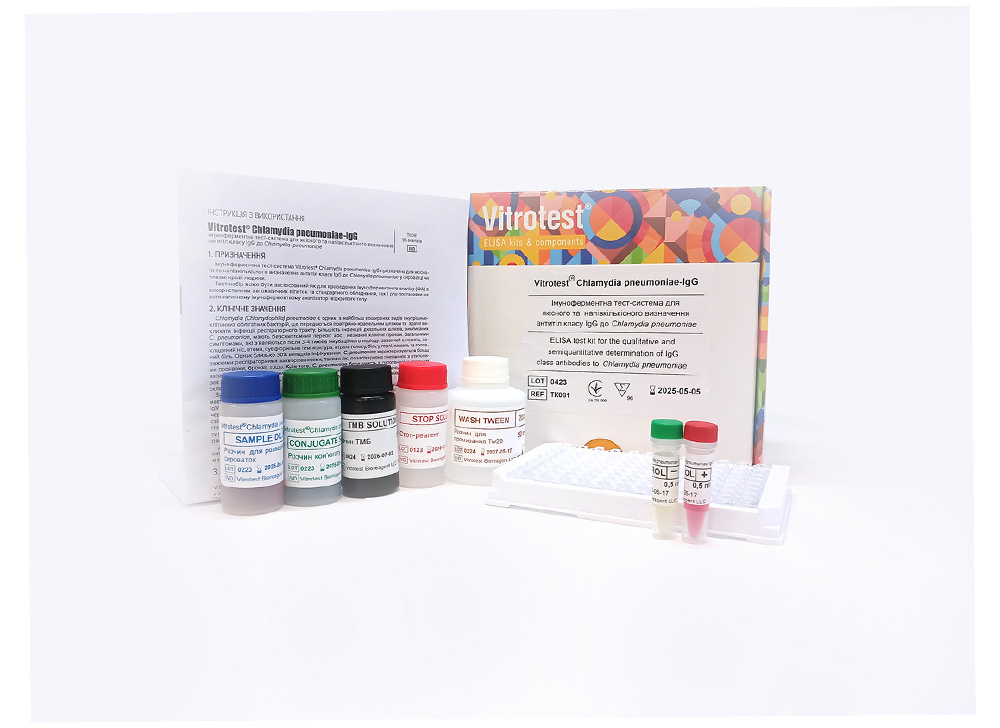
Vitrotest® Chlamydia pneumoniae-IgG

  • Description

  • Features

  • Chlamydial pneumonia

  • Description

The test kit Vitrotest® Chlamydia pneumoniae-IgG is an enzyme linked immunosorbent assay (ELISA) for the qualitative and semiquantitative determination of IgG class antibodies to Chlamydia pneumoniae in human serum or plasma.

Determination of IgG antibodies to Chlamydia pneumoniae in the test kit Vitrotest® Chlamydia pneumoniae-IgG is based on a solid phase indirect ELISA in a two-step incubation procedure.

○ ТК081 – 96 tests

  • Features

  • Solid phase: breakable microplate ELISA is coated with Chlamydia pneumoniae antigens.
  • Conjugate: a monoclonal antibodies to human IgG conjugated to horseradish peroxidase.
  • Chromogen: ready to use TMB solution.
  • Volume of sample for analysis: 10 μl.
  • Assay time: 1h 15 min.

  • Chlamydial pneumonia

Chlamydia (Chlamydophila) pneumoniae is one of the most common types of intracellular obligate bacteria transmitted by airborne droplets and capable of causing respiratory tract infections. Most respiratory tract infections caused by C. pneumoniae are asymptomatic or have minor clinical manifestations. Common symptoms that appear after a 3-4 week incubation period are usually runny nose, nasal congestion, fatigue, low-grade fever, hoarseness, sore throat, cough, and headache. However, about 30% of C. pneumoniae infections are characterized by more severe respiratory diseases, such as community-acquired pneumonia with atypical manifestations, bronchitis, etc. In addition, C. pneumoniae is involved in the pathogenesis of multiple inflammatory conditions, including chronic obstructive pulmonary disease (COPD), asthma, lung cancer, atherosclerosis, arthritis, neurological disorders (Alzheimer’s disease, multiple sclerosis, schizophrenia).

According to statistics, about 30-50% of people under the age of 20 and 80% aged 60 to 70 have antibodies to this pathogen. With primary infection with C. pneumoniae, IgM antibodies usually appear in the human blood after 2-3 weeks, IgG antibodies – somewhat later, after 3-5 weeks from the onset of the disease. The simultaneous detection of IgM and IgG antibodies indicates acute or manifest chronic infection. In case of re-infection or exacerbation of the chronic process, IgM antibodies may not be detected or may be detected in low titers, while the level of IgG class antibodies increases rapidly, which has diagnostic value in the study of paired sera taken at intervals of 10-14 days.

For the diagnosis of C. pneumoniae-mediated diseases, the most widespread are the culture method, immunohistochemistry, polymerase chain reaction and serological methods. Among the latter, the most informative and widespread is ELISA.

Chlamydia pneumoniae, ELISA KITS, Respiratory infections

tel./fax: +380972227672, +380442227672 | e-mail: info@vitrotest.ua, order@vitrotest.ua

© Vitrotest 2006 - 2026 | All Rights Reserved | Privacy policy | Terms of use

Page load link
We use cookies to ensure that we give you the best experience on our website. If you continue to use this site we will assume that you are happy with it.
Attention!

You're now on our Ukrainian website.

This notice will close automatically in 7 seconds.

Go to Top