Skip to content
  • Home
  • About us
  • Products
    ELISA kit
    • HIV infection
    • Viral Hepatitis
    • Syphilis
    • Herpes Infections
    • TORCH Infections
    • Vaccine-Preventable Diseases
    • Сovid-19COVID-19 is an infectious disease caused by a new SARS-CoV-2 coronavirus which had not previously been detected in humans. The viral infection leads to the development of a respiratory flu-like disease with symptoms such as cough and fever. In more severe cases pneumonia can develop. The average incubation period of the COVID-19 is 6.5 days, but it can range from 3 to 21 days. SARS-CoV-2 is an RNA-virus with a specific envelope with spikes in the form of a “corona”. The main structural proteins of the virus include envelope protein (E), membrane protein (M), spike (S) glycoprotein, and nucleocapsid (N) protein. S protein on the surface of the SARS-CoV-2 virion mediates the receptor recognition and cell membrane fusion with ACE2 molecules, which are mainly expressed on type II pneumocytes, colon and kidney epithelial cells. It contains three fragments, namely the ectodomain, the transmembrane domain and the short intracellular segment. The ectodomain consists of a receptor-binding subunit S1 containing the RBD domain and a fusion subunit (S2). During viral infection, S1 C-terminal domain binds to the extracellular peptidase (PD) domain of ACE2 to ensure that the virus attaches to the surface of the target cell. The S1 N-terminal domain binds to…
    • Borreliosis
    • Parasites
    • Urogenital Infections
    • Gastroenteric Diseases
    • Tumor Markers
    • Metabolism
    • Allergy
    • Biotinylated Allergens
    • Thyroid function
    Download catalog ELISA kits
    IMMUNOGLOBULINS LEVEL
    Raw materials
    DOWNLOAD CATALOG RAW MATERIALS
  • News
  • Contact
  • EN
  • UA
  • RU
  • Home
  • About us
  • Products
    • ELISA kits
      • HIV infection
      • Parasites
      • Syphilis
      • Borreliosis
      • Viral Hepatitis
      • TORCH Infections
      • Herpes Infections
      • Vaccine-Preventable Diseases
      • Сovid-19COVID-19 is an infectious disease caused by a new SARS-CoV-2 coronavirus which had not previously been detected in humans. The viral infection leads to the development of a respiratory flu-like disease with symptoms such as cough and fever. In more severe cases pneumonia can develop. The average incubation period of the COVID-19 is 6.5 days, but it can range from 3 to 21 days. SARS-CoV-2 is an RNA-virus with a specific envelope with spikes in the form of a “corona”. The main structural proteins of the virus include envelope protein (E), membrane protein (M), spike (S) glycoprotein, and nucleocapsid (N) protein. S protein on the surface of the SARS-CoV-2 virion mediates the receptor recognition and cell membrane fusion with ACE2 molecules, which are mainly expressed on type II pneumocytes, colon and kidney epithelial cells. It contains three fragments, namely the ectodomain, the transmembrane domain and the short intracellular segment. The ectodomain consists of a receptor-binding subunit S1 containing the RBD domain and a fusion subunit (S2). During viral infection, S1 C-terminal domain binds to the extracellular peptidase (PD) domain of ACE2 to ensure that the virus attaches to the surface of the target cell. The S1 N-terminal domain binds to…
      • Urogenital Infections
      • Gastroenteric Diseases
      • Tumor Markers
      • Metabolism
      • Allergy
      • Biotinylated Allergens
      • Thyroid function
    • IMMUNOGLOBULINS LEVEL
    • RAW MATERIALS
    • DOWNLOAD CATALOG ELISA
    • DOWNLOAD CATALOG RAW MATERIALS
  • News
  • Contact
  • EN
    • EN
    • UA
    • RU
  • DOWNLOAD CATALOG ELISA
  • Home
  • About us
  • Products
    • ELISA kits
      • HIV infection
      • Parasites
      • Syphilis
      • Borreliosis
      • Viral Hepatitis
      • TORCH Infections
      • Herpes Infections
      • Vaccine-Preventable Diseases
      • Сovid-19COVID-19 is an infectious disease caused by a new SARS-CoV-2 coronavirus which had not previously been detected in humans. The viral infection leads to the development of a respiratory flu-like disease with symptoms such as cough and fever. In more severe cases pneumonia can develop. The average incubation period of the COVID-19 is 6.5 days, but it can range from 3 to 21 days. SARS-CoV-2 is an RNA-virus with a specific envelope with spikes in the form of a “corona”. The main structural proteins of the virus include envelope protein (E), membrane protein (M), spike (S) glycoprotein, and nucleocapsid (N) protein. S protein on the surface of the SARS-CoV-2 virion mediates the receptor recognition and cell membrane fusion with ACE2 molecules, which are mainly expressed on type II pneumocytes, colon and kidney epithelial cells. It contains three fragments, namely the ectodomain, the transmembrane domain and the short intracellular segment. The ectodomain consists of a receptor-binding subunit S1 containing the RBD domain and a fusion subunit (S2). During viral infection, S1 C-terminal domain binds to the extracellular peptidase (PD) domain of ACE2 to ensure that the virus attaches to the surface of the target cell. The S1 N-terminal domain binds to…
      • Urogenital Infections
      • Gastroenteric Diseases
      • Tumor Markers
      • Metabolism
      • Allergy
      • Biotinylated Allergens
      • Thyroid function
    • IMMUNOGLOBULINS LEVEL
    • RAW MATERIALS
    • DOWNLOAD CATALOG ELISA
    • DOWNLOAD CATALOG RAW MATERIALS
  • News
  • Contact
  • EN
    • EN
    • UA
    • RU
  • DOWNLOAD CATALOG ELISA

Vitrotest® HBsAg-Confirmation

Home page » Products » Vitrotest® HBsAg-Confirmation
  • Description

  • Features

  • Hepatitis B

  • Description

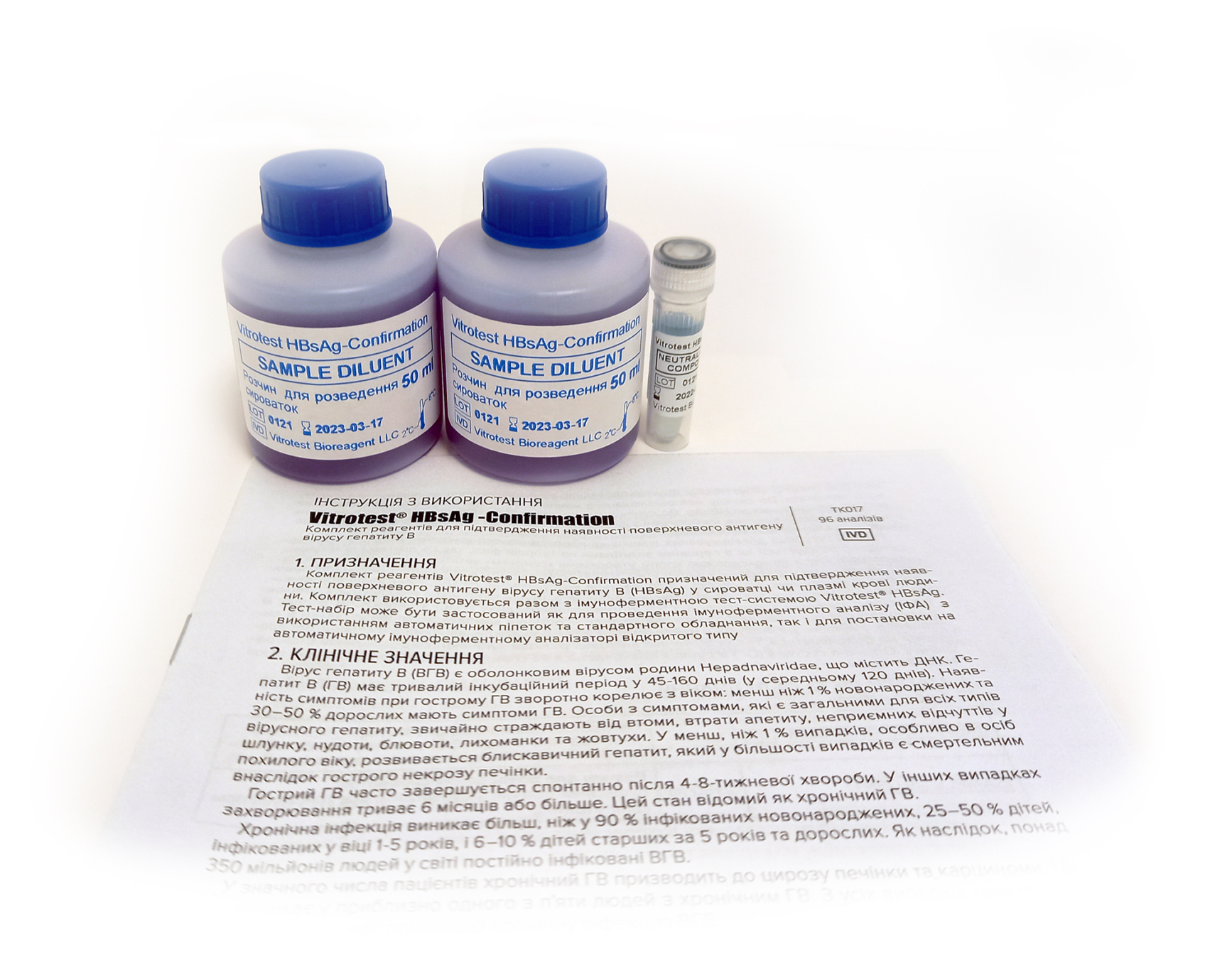
The Vitrotest® HBsAg-Confirmation reagent kit is intended to confirm the presence of the hepatitis B virus surface antigen (HBsAg) in human serum or plasma. The kit is used together with the test kit Vitrotest® HBsAg.

Confirmation of the presence of the hepatitis B virus surface antigen (HBsAg) is based on the solid-phase “sandwich” ELISA using the reagent kit Vitrotest® HBsAg-Confirmation and the test kit Vitrotest® HBsAg .

○ TK017 – 100 tests

  • Features

Сomposition of the set:
- sample diluent
- neutralizing component (monoclonal antibodies specific for HBsAg)

  • Hepatitis B

Hepatitis B virus (HBV) is an enveloped DNA virus of the family Hepadnaviridae. The aetiology of ‘‘serum hepatitis’’, as it was known for many years, was not identified, until the discovery of the so-called Au antigen by Blumberg et al. in 1965 [Blumberg et al., 1965] led to the identification of viral particles by Dane et al. several years later [Dane et al., 1970].

Hepatitis B (HB) has a long incubation period of 45 to 160 days (average: 120 days). The length of incubation period is related to the amount of virus in the inoculum, the mode of transmission and host factors.

The appearance of symptoms under acute HB is inversely related to age: less than 1% of newborns and 30%–50% adults develop symptoms. Those who do get symptoms, which are similar for all types of viral hepatitis, usually suffer from tiredness, loss of appetite, abdominal discomfort, nausea, vomiting, fever and jaundice. In less then 1 % of cases, especially in the elderly, fulminating HB develops, which is mostly fatal due to acute hepatic necrosis.

The acute HB often resolves spontaneously after a 4-8 week illness. Otherwise, the infection can last for six months or more. This condition is known as chronic HB.
More than 90 % of infected infants, 25–50 % of children infected between 1 and 5 years of age, and 6–10 % of acutely infected older children and adults develop chronic infection. As a result, more than 350 million people in the world today are estimated to be persistently infected with HBV.

In a considerable number of patients, chronic HB may lead to liver cirrhosis and hepatocellular carcinoma. Cirrhosis affects around one in five people with chronic hepatitis B. Of all causes of cirrhosis, approximately one third can be attributed to chronic HBV infection.

Transmission occurs by percutaneous and permucosal (through broken skin) exposure to such infective body fluids as blood, vaginal and menstrual fluids, and semen. The main ways of transmission include: vertical – from an infected mother during delivery (rate of transmission around 50%); sexual; horizontal – household contact with an infected person (for example, contact of infected blood with cutaneous scratches), sharing of contaminated injection drug equipment by injection drug users, or unhygienic injection procedures in health-care institutions.

ELISA kits, Viral Hepatitis

tel./fax: +380972227672, +380442227672 | e-mail: info@vitrotest.ua, order@vitrotest.ua

© Vitrotest 2006 - 2026 | All Rights Reserved | Privacy policy | Terms of use

Page load link
Go to Top