Skip to content
  • Home
  • About us
  • Products
    ELISA kit
    • HIV infection
    • Viral Hepatitis
    • Syphilis
    • Herpes Infections
    • TORCH Infections
    • Vaccine-Preventable Diseases
    • Сovid-19COVID-19 is an infectious disease caused by a new SARS-CoV-2 coronavirus which had not previously been detected in humans. The viral infection leads to the development of a respiratory flu-like disease with symptoms such as cough and fever. In more severe cases pneumonia can develop. The average incubation period of the COVID-19 is 6.5 days, but it can range from 3 to 21 days. SARS-CoV-2 is an RNA-virus with a specific envelope with spikes in the form of a “corona”. The main structural proteins of the virus include envelope protein (E), membrane protein (M), spike (S) glycoprotein, and nucleocapsid (N) protein. S protein on the surface of the SARS-CoV-2 virion mediates the receptor recognition and cell membrane fusion with ACE2 molecules, which are mainly expressed on type II pneumocytes, colon and kidney epithelial cells. It contains three fragments, namely the ectodomain, the transmembrane domain and the short intracellular segment. The ectodomain consists of a receptor-binding subunit S1 containing the RBD domain and a fusion subunit (S2). During viral infection, S1 C-terminal domain binds to the extracellular peptidase (PD) domain of ACE2 to ensure that the virus attaches to the surface of the target cell. The S1 N-terminal domain binds to…
    • Borreliosis
    • Parasites
    • Urogenital Infections
    • Gastroenteric Diseases
    • Tumor Markers
    • Metabolism
    • Allergy
    • Biotinylated Allergens
    • Thyroid function
    • Brucellosis
    Download catalog ELISA kits
    IMMUNOGLOBULINS LEVEL
    Raw materials
    DOWNLOAD CATALOG RAW MATERIALS
  • News
  • Contact
  • EN
  • UA
  • RU
  • Home
  • About us
  • Products
    • ELISA kits
      • HIV infection
      • Parasites
      • Syphilis
      • Borreliosis
      • Viral Hepatitis
      • TORCH Infections
      • Herpes Infections
      • Vaccine-Preventable Diseases
      • Сovid-19COVID-19 is an infectious disease caused by a new SARS-CoV-2 coronavirus which had not previously been detected in humans. The viral infection leads to the development of a respiratory flu-like disease with symptoms such as cough and fever. In more severe cases pneumonia can develop. The average incubation period of the COVID-19 is 6.5 days, but it can range from 3 to 21 days. SARS-CoV-2 is an RNA-virus with a specific envelope with spikes in the form of a “corona”. The main structural proteins of the virus include envelope protein (E), membrane protein (M), spike (S) glycoprotein, and nucleocapsid (N) protein. S protein on the surface of the SARS-CoV-2 virion mediates the receptor recognition and cell membrane fusion with ACE2 molecules, which are mainly expressed on type II pneumocytes, colon and kidney epithelial cells. It contains three fragments, namely the ectodomain, the transmembrane domain and the short intracellular segment. The ectodomain consists of a receptor-binding subunit S1 containing the RBD domain and a fusion subunit (S2). During viral infection, S1 C-terminal domain binds to the extracellular peptidase (PD) domain of ACE2 to ensure that the virus attaches to the surface of the target cell. The S1 N-terminal domain binds to…
      • Urogenital Infections
      • Gastroenteric Diseases
      • Tumor Markers
      • Metabolism
      • Allergy
      • Biotinylated Allergens
      • Thyroid function
    • IMMUNOGLOBULINS LEVEL
    • RAW MATERIALS
    • DOWNLOAD CATALOG ELISA
    • DOWNLOAD CATALOG RAW MATERIALS
  • News
  • Contact
  • EN
    • EN
    • UA
    • RU
  • DOWNLOAD CATALOG ELISA
  • Home
  • About us
  • Products
    • ELISA kits
      • HIV infection
      • Parasites
      • Syphilis
      • Borreliosis
      • Viral Hepatitis
      • TORCH Infections
      • Herpes Infections
      • Vaccine-Preventable Diseases
      • Сovid-19COVID-19 is an infectious disease caused by a new SARS-CoV-2 coronavirus which had not previously been detected in humans. The viral infection leads to the development of a respiratory flu-like disease with symptoms such as cough and fever. In more severe cases pneumonia can develop. The average incubation period of the COVID-19 is 6.5 days, but it can range from 3 to 21 days. SARS-CoV-2 is an RNA-virus with a specific envelope with spikes in the form of a “corona”. The main structural proteins of the virus include envelope protein (E), membrane protein (M), spike (S) glycoprotein, and nucleocapsid (N) protein. S protein on the surface of the SARS-CoV-2 virion mediates the receptor recognition and cell membrane fusion with ACE2 molecules, which are mainly expressed on type II pneumocytes, colon and kidney epithelial cells. It contains three fragments, namely the ectodomain, the transmembrane domain and the short intracellular segment. The ectodomain consists of a receptor-binding subunit S1 containing the RBD domain and a fusion subunit (S2). During viral infection, S1 C-terminal domain binds to the extracellular peptidase (PD) domain of ACE2 to ensure that the virus attaches to the surface of the target cell. The S1 N-terminal domain binds to…
      • Urogenital Infections
      • Gastroenteric Diseases
      • Tumor Markers
      • Metabolism
      • Allergy
      • Biotinylated Allergens
      • Thyroid function
    • IMMUNOGLOBULINS LEVEL
    • RAW MATERIALS
    • DOWNLOAD CATALOG ELISA
    • DOWNLOAD CATALOG RAW MATERIALS
  • News
  • Contact
  • EN
    • EN
    • UA
    • RU
  • DOWNLOAD CATALOG ELISA

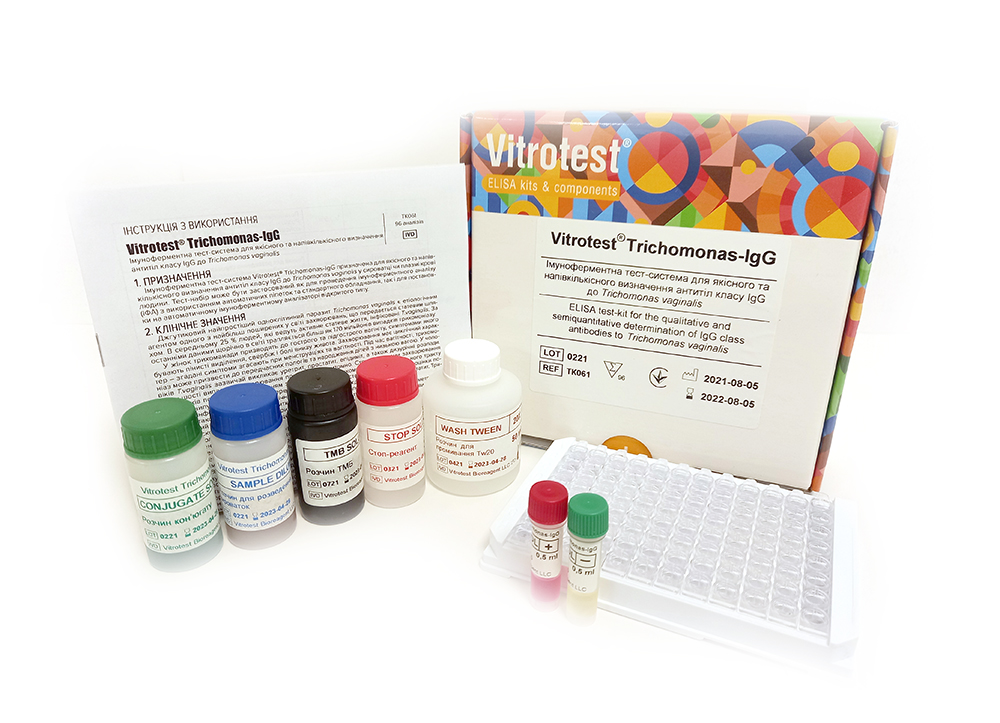
Vitrotest® Trichomonas-IgG

  • Description

  • Features

  • Urogenital trichomoniasis

  • Description

The test kit Vitrotest® Trichomonas-IgG is an enzyme linked immunosorbent assay (ELISA) for the qualitative and semiquantitative determination of IgG class antibodies to Trichomonas vaginalis in human serum or plasma.

Determination of IgG antibodies to Trichomonas vaginalis in the test kit Vitrotest® Trichomonas-IgG is based on a solid phase, indirect ELISA in a two-step incubation procedure.

○ ТК061 – 96 tests

  • Features

  • Solid phase: breakable microplate ELISA is coated with Trichomonas vaginalis antigens.
  • Conjugate: a monoclonal antibodies to human IgG conjugated to horseradish peroxidase.
  • Chromogen: ready to use TMB solution.
  • Volume of sample for analysis: 10 μl.
  • Assay time: 1h 15 min.

  • Urogenital trichomoniasis

The flagellated protozoan Trichomonas vaginalis is the etiologic agent of one of the most common sexually transmitted diseases in the world. On average, 25% of sexually active individuals are infected with T. vaginalis. According to the latest data, more than 170 million cases of trichomoniasis are reported worldwide each year.

In women, trichomonads cause acute and subacute vaginitis, with symptoms including frothy discharge, itching, and lower abdominal pain. The disease is cyclical – these symptoms subside during menstruation and pregnancy. During pregnancy, trichomoniasis can lead to premature birth and low birth weight in infants. In men, T. vaginalis typically causes urethritis, prostatitis, epididymitis, and dysuria. In most cases, the disease is asymptomatic. The mild symptoms in men are attributed to the flushing out of a significant portion of trichomonads from the urogenital tract during urination. The latent nature of the disease often leads to an underestimation of its spread. Chronic infection almost always results in chronic prostatitis. Trichomoniasis has also been associated with the development of prostate cancer in men.

Currently, the following laboratory methods are used to diagnose trichomoniasis:

  • microscopy of vaginal or cervical secretions in women and urinary tract secretions in men;
  • culture of trichomonads;
  • detection of pathogen DNA by polymerase chain reaction (PCR);
  • detection of antibodies specific to T. vaginalis by enzyme-linked immunosorbent assay (ELISA).

According to several studies, the sensitivity of direct parasite detection methods ranges from 38% to 82%. It is also known that infected individuals develop a humoral, secretory, and cellular immune response to the parasite, which allows for the use of serological studies for diagnostic purposes. Antibodies to the trichomonad surface antigen p270 and α-actinin are produced in almost all infected individuals, and serum antibody levels correlate with active infection. Serological diagnostic methods are particularly valuable in individuals who do not exhibit clinical manifestations of trichomoniasis and in men who may be asymptomatic carriers of the parasite.

ELISA kits, Urogenital Infections

tel./fax: +380972227672, +380442227672 | e-mail: info@vitrotest.ua, order@vitrotest.ua

© Vitrotest 2006 - 2026 | All Rights Reserved | Privacy policy | Terms of use

Page load link
Go to Top