Skip to content
  • Home
  • About us
  • Products
    ELISA kit
    • HIV infection
    • Viral Hepatitis
    • Syphilis
    • Herpes Infections
    • TORCH Infections
    • Vaccine-Preventable Diseases
    • Сovid-19COVID-19 is an infectious disease caused by a new SARS-CoV-2 coronavirus which had not previously been detected in humans. The viral infection leads to the development of a respiratory flu-like disease with symptoms such as cough and fever. In more severe cases pneumonia can develop. The average incubation period of the COVID-19 is 6.5 days, but it can range from 3 to 21 days. SARS-CoV-2 is an RNA-virus with a specific envelope with spikes in the form of a “corona”. The main structural proteins of the virus include envelope protein (E), membrane protein (M), spike (S) glycoprotein, and nucleocapsid (N) protein. S protein on the surface of the SARS-CoV-2 virion mediates the receptor recognition and cell membrane fusion with ACE2 molecules, which are mainly expressed on type II pneumocytes, colon and kidney epithelial cells. It contains three fragments, namely the ectodomain, the transmembrane domain and the short intracellular segment. The ectodomain consists of a receptor-binding subunit S1 containing the RBD domain and a fusion subunit (S2). During viral infection, S1 C-terminal domain binds to the extracellular peptidase (PD) domain of ACE2 to ensure that the virus attaches to the surface of the target cell. The S1 N-terminal domain binds to…
    • Borreliosis
    • Parasites
    • Urogenital Infections
    • Gastroenteric Diseases
    • Tumor Markers
    • Metabolism
    • Allergy
    • Biotinylated Allergens
    • Thyroid function
    Download catalog ELISA kits
    IMMUNOGLOBULINS LEVEL
    Raw materials
    DOWNLOAD CATALOG RAW MATERIALS
  • News
  • Contact
  • EN
  • UA
  • RU
  • Home
  • About us
  • Products
    • ELISA kits
      • HIV infection
      • Parasites
      • Syphilis
      • Borreliosis
      • Viral Hepatitis
      • TORCH Infections
      • Herpes Infections
      • Vaccine-Preventable Diseases
      • Сovid-19COVID-19 is an infectious disease caused by a new SARS-CoV-2 coronavirus which had not previously been detected in humans. The viral infection leads to the development of a respiratory flu-like disease with symptoms such as cough and fever. In more severe cases pneumonia can develop. The average incubation period of the COVID-19 is 6.5 days, but it can range from 3 to 21 days. SARS-CoV-2 is an RNA-virus with a specific envelope with spikes in the form of a “corona”. The main structural proteins of the virus include envelope protein (E), membrane protein (M), spike (S) glycoprotein, and nucleocapsid (N) protein. S protein on the surface of the SARS-CoV-2 virion mediates the receptor recognition and cell membrane fusion with ACE2 molecules, which are mainly expressed on type II pneumocytes, colon and kidney epithelial cells. It contains three fragments, namely the ectodomain, the transmembrane domain and the short intracellular segment. The ectodomain consists of a receptor-binding subunit S1 containing the RBD domain and a fusion subunit (S2). During viral infection, S1 C-terminal domain binds to the extracellular peptidase (PD) domain of ACE2 to ensure that the virus attaches to the surface of the target cell. The S1 N-terminal domain binds to…
      • Urogenital Infections
      • Gastroenteric Diseases
      • Tumor Markers
      • Metabolism
      • Allergy
      • Biotinylated Allergens
      • Thyroid function
    • IMMUNOGLOBULINS LEVEL
    • RAW MATERIALS
    • DOWNLOAD CATALOG ELISA
    • DOWNLOAD CATALOG RAW MATERIALS
  • News
  • Contact
  • EN
    • EN
    • UA
    • RU
  • DOWNLOAD CATALOG ELISA
  • Home
  • About us
  • Products
    • ELISA kits
      • HIV infection
      • Parasites
      • Syphilis
      • Borreliosis
      • Viral Hepatitis
      • TORCH Infections
      • Herpes Infections
      • Vaccine-Preventable Diseases
      • Сovid-19COVID-19 is an infectious disease caused by a new SARS-CoV-2 coronavirus which had not previously been detected in humans. The viral infection leads to the development of a respiratory flu-like disease with symptoms such as cough and fever. In more severe cases pneumonia can develop. The average incubation period of the COVID-19 is 6.5 days, but it can range from 3 to 21 days. SARS-CoV-2 is an RNA-virus with a specific envelope with spikes in the form of a “corona”. The main structural proteins of the virus include envelope protein (E), membrane protein (M), spike (S) glycoprotein, and nucleocapsid (N) protein. S protein on the surface of the SARS-CoV-2 virion mediates the receptor recognition and cell membrane fusion with ACE2 molecules, which are mainly expressed on type II pneumocytes, colon and kidney epithelial cells. It contains three fragments, namely the ectodomain, the transmembrane domain and the short intracellular segment. The ectodomain consists of a receptor-binding subunit S1 containing the RBD domain and a fusion subunit (S2). During viral infection, S1 C-terminal domain binds to the extracellular peptidase (PD) domain of ACE2 to ensure that the virus attaches to the surface of the target cell. The S1 N-terminal domain binds to…
      • Urogenital Infections
      • Gastroenteric Diseases
      • Tumor Markers
      • Metabolism
      • Allergy
      • Biotinylated Allergens
      • Thyroid function
    • IMMUNOGLOBULINS LEVEL
    • RAW MATERIALS
    • DOWNLOAD CATALOG ELISA
    • DOWNLOAD CATALOG RAW MATERIALS
  • News
  • Contact
  • EN
    • EN
    • UA
    • RU
  • DOWNLOAD CATALOG ELISA

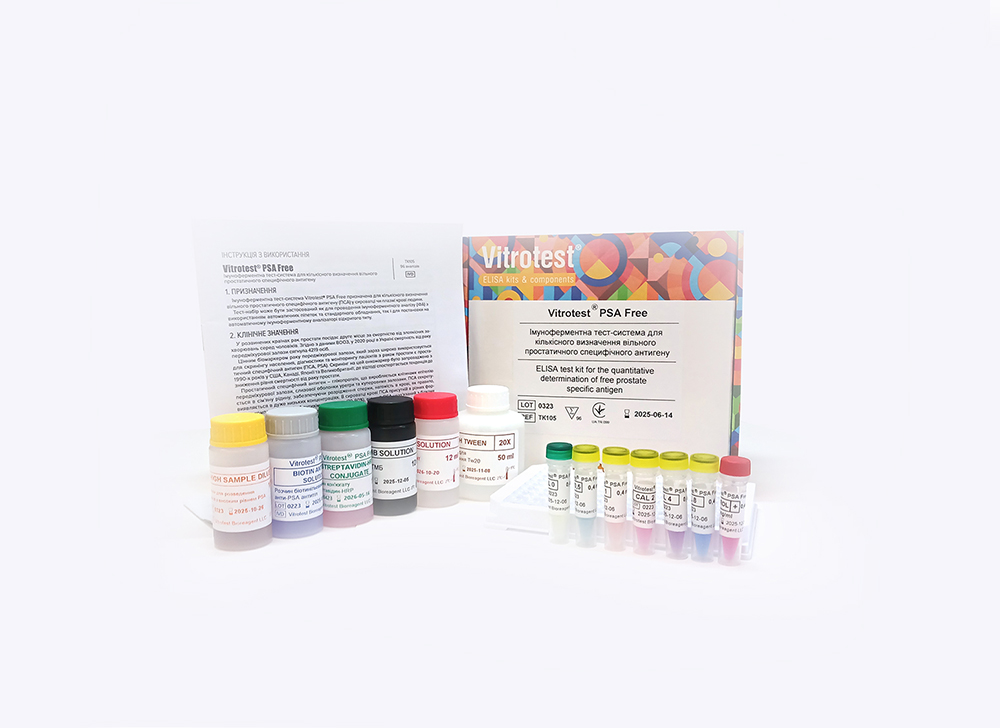
Vitrotest® PSA Free

Home page » Products » Vitrotest® PSA Free
  • Description

  • Features

  • PSA

  • Description

The test kit Vitrotest® PSA Free is an enzyme linked immunosorbent assay (ELISA) for the quantitative determination of free prostate-specific antigen (PSA) in human serum or plasma.

Determination of concentration free PSA in the test kit Vitrotest® PSA Free is based on on a solid-phase “sandwich” ELISA followed by the use of biotin-streptavidin interaction.

○ ТК105 – 96 tests

  • Features

  • Solid phase: breakable microplate ELISA is coated with monoclonal antibodies specific to human PSA.
  • Biotinylated anti-PSA antibody solution: biotinylated monoclonal antibodies to human PSA.
  • Streptavidin-HRP conjugate: streptavidin solution conjugated with horseradish peroxidase.
  • Chromogen: ready to use TMB solution.
  • Volume of sample for analysis: 25 μl.
  • Assay time: 1 hour.

  • PSA

In developed countries, prostate cancer ranks second in mortality from malignant diseases among men. According to WHO data, in 2020, prostate cancer mortality in Ukraine reached 4,219 cases.

A valuable biomarker for prostate cancer, which is now widely used for population screening, diagnosis, and monitoring of patients with prostate cancer, is the prostate-specific antigen (PSA). Screening for this tumor marker was introduced in the 1990s in the USA, Canada, Japan, and the UK, where a subsequent trend of decreased prostate cancer mortality has been observed.

Prostate-specific antigen is a glycoprotein produced by the epithelial cells of the prostate gland, the urethral mucosa, and the Cowper’s glands. PSA is secreted into the seminal fluid, ensuring semen liquefaction, but is typically found in very low concentrations in the blood. In blood serum, PSA is present in various forms: complexed with α1-antichymotrypsin (70-90%), free PSA not bound to serum proteins (10-30%), and bound to alpha-2-macroglobulin.

In men’s blood serum, the normal concentration of total PSA does not exceed 4 ng/ml. Elevated levels of this tumor marker may indicate a risk of prostate cancer. According to the American Cancer Society, the likelihood of prostate cancer with serum total PSA levels of 4-10 ng/ml is 25%, while with concentrations above 10 ng/ml, this figure approaches 50%. An increase in PSA levels can also be observed with prostate hypertrophy and prostatitis. Therefore, when elevated serum PSA levels are detected, a digital rectal examination (DRE) of the prostate is recommended to differentiate pathological conditions.

For laboratory identification of prostate cancer, the measurement of total and free prostate-specific antigen in blood serum is used. When PSA concentration is in the range of 4 to 10 ng/ml, determining the percentage of free PSA can be helpful in deciding whether a prostate biopsy is necessary. Typically, a biopsy is recommended when the percentage of free PSA is below 10%, although some doctors consider a threshold level of 25%.

The serum PSA level is an informative marker not only for screening patients for prostate cancer but also for monitoring treatment effectiveness and prognosis after surgical intervention.

ELISA kits, Tumor Markers

tel./fax: +380972227672, +380442227672 | e-mail: info@vitrotest.ua, order@vitrotest.ua

© Vitrotest 2006 - 2026 | All Rights Reserved | Privacy policy | Terms of use

Page load link
Go to Top