Skip to content
  • Home
  • About us
  • Products
    ELISA kit
    • HIV infection
    • Viral Hepatitis
    • Syphilis
    • Herpes Infections
    • TORCH Infections
    • Vaccine-Preventable Diseases
    • Сovid-19COVID-19 is an infectious disease caused by a new SARS-CoV-2 coronavirus which had not previously been detected in humans. The viral infection leads to the development of a respiratory flu-like disease with symptoms such as cough and fever. In more severe cases pneumonia can develop. The average incubation period of the COVID-19 is 6.5 days, but it can range from 3 to 21 days. SARS-CoV-2 is an RNA-virus with a specific envelope with spikes in the form of a “corona”. The main structural proteins of the virus include envelope protein (E), membrane protein (M), spike (S) glycoprotein, and nucleocapsid (N) protein. S protein on the surface of the SARS-CoV-2 virion mediates the receptor recognition and cell membrane fusion with ACE2 molecules, which are mainly expressed on type II pneumocytes, colon and kidney epithelial cells. It contains three fragments, namely the ectodomain, the transmembrane domain and the short intracellular segment. The ectodomain consists of a receptor-binding subunit S1 containing the RBD domain and a fusion subunit (S2). During viral infection, S1 C-terminal domain binds to the extracellular peptidase (PD) domain of ACE2 to ensure that the virus attaches to the surface of the target cell. The S1 N-terminal domain binds to…
    • Borreliosis
    • Parasites
    • Urogenital Infections
    • Gastroenteric Diseases
    • Tumor Markers
    • Metabolism
    • Allergy
    • Biotinylated Allergens
    • Thyroid function
    • Brucellosis
    Download catalog ELISA kits
    IMMUNOGLOBULINS LEVEL
    Raw materials
    DOWNLOAD CATALOG RAW MATERIALS
  • News
  • Contact
  • EN
  • UA
  • RU
  • Home
  • About us
  • Products
    • ELISA kits
      • HIV infection
      • Parasites
      • Syphilis
      • Borreliosis
      • Viral Hepatitis
      • TORCH Infections
      • Herpes Infections
      • Vaccine-Preventable Diseases
      • Сovid-19COVID-19 is an infectious disease caused by a new SARS-CoV-2 coronavirus which had not previously been detected in humans. The viral infection leads to the development of a respiratory flu-like disease with symptoms such as cough and fever. In more severe cases pneumonia can develop. The average incubation period of the COVID-19 is 6.5 days, but it can range from 3 to 21 days. SARS-CoV-2 is an RNA-virus with a specific envelope with spikes in the form of a “corona”. The main structural proteins of the virus include envelope protein (E), membrane protein (M), spike (S) glycoprotein, and nucleocapsid (N) protein. S protein on the surface of the SARS-CoV-2 virion mediates the receptor recognition and cell membrane fusion with ACE2 molecules, which are mainly expressed on type II pneumocytes, colon and kidney epithelial cells. It contains three fragments, namely the ectodomain, the transmembrane domain and the short intracellular segment. The ectodomain consists of a receptor-binding subunit S1 containing the RBD domain and a fusion subunit (S2). During viral infection, S1 C-terminal domain binds to the extracellular peptidase (PD) domain of ACE2 to ensure that the virus attaches to the surface of the target cell. The S1 N-terminal domain binds to…
      • Urogenital Infections
      • Gastroenteric Diseases
      • Tumor Markers
      • Metabolism
      • Allergy
      • Biotinylated Allergens
      • Thyroid function
    • IMMUNOGLOBULINS LEVEL
    • RAW MATERIALS
    • DOWNLOAD CATALOG ELISA
    • DOWNLOAD CATALOG RAW MATERIALS
  • News
  • Contact
  • EN
    • EN
    • UA
    • RU
  • DOWNLOAD CATALOG ELISA
  • Home
  • About us
  • Products
    • ELISA kits
      • HIV infection
      • Parasites
      • Syphilis
      • Borreliosis
      • Viral Hepatitis
      • TORCH Infections
      • Herpes Infections
      • Vaccine-Preventable Diseases
      • Сovid-19COVID-19 is an infectious disease caused by a new SARS-CoV-2 coronavirus which had not previously been detected in humans. The viral infection leads to the development of a respiratory flu-like disease with symptoms such as cough and fever. In more severe cases pneumonia can develop. The average incubation period of the COVID-19 is 6.5 days, but it can range from 3 to 21 days. SARS-CoV-2 is an RNA-virus with a specific envelope with spikes in the form of a “corona”. The main structural proteins of the virus include envelope protein (E), membrane protein (M), spike (S) glycoprotein, and nucleocapsid (N) protein. S protein on the surface of the SARS-CoV-2 virion mediates the receptor recognition and cell membrane fusion with ACE2 molecules, which are mainly expressed on type II pneumocytes, colon and kidney epithelial cells. It contains three fragments, namely the ectodomain, the transmembrane domain and the short intracellular segment. The ectodomain consists of a receptor-binding subunit S1 containing the RBD domain and a fusion subunit (S2). During viral infection, S1 C-terminal domain binds to the extracellular peptidase (PD) domain of ACE2 to ensure that the virus attaches to the surface of the target cell. The S1 N-terminal domain binds to…
      • Urogenital Infections
      • Gastroenteric Diseases
      • Tumor Markers
      • Metabolism
      • Allergy
      • Biotinylated Allergens
      • Thyroid function
    • IMMUNOGLOBULINS LEVEL
    • RAW MATERIALS
    • DOWNLOAD CATALOG ELISA
    • DOWNLOAD CATALOG RAW MATERIALS
  • News
  • Contact
  • EN
    • EN
    • UA
    • RU
  • DOWNLOAD CATALOG ELISA

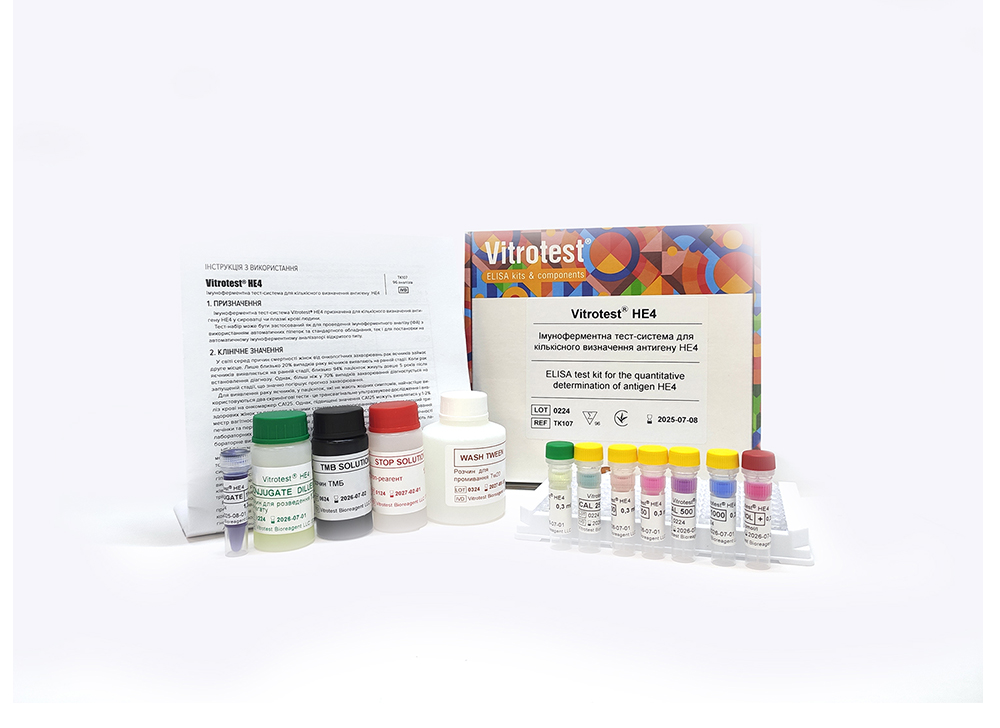
Vitrotest® HE4

  • Description

  • Features

  • HE4

  • Description

The test kit Vitrotest® HE4 is an enzyme linked immunosorbent assay (ELISA) for the quantitative determination of antigen HE4 in human serum or plasma.

Determination of concentration antigen HE4 in the test kit Vitrotest® HE4 is based on a solid-phase “sandwich” ELISA.

○ ТК107 – 96 tests

  • Features

  • Solid phase: breakable microplate ELISA is coated with monoclonal antibodies specific to antigen HE4.
  • Conjugate: a monoclonal antibodies to antigen HE4 conjugated to horseradish peroxidase.
  • Chromogen: ready to use TMB solution.
  • Volume of sample for analysis: 10 μl.
  • Assay time: 1h 15 min.

  • HE4

Ovarian cancer ranks as the second leading cause of cancer-related deaths among women worldwide. Only about 20% of ovarian cancer cases are detected at an early stage. When ovarian cancer is diagnosed at an early stage, approximately 94% of patients survive longer than five years after diagnosis. However, more than 70% of cases are diagnosed at an advanced stage, which significantly worsens the prognosis.

For the detection of ovarian cancer in patients without symptoms, two screening tests are most commonly used: transvaginal ultrasound and a blood test for the CA125 tumor marker. However, elevated CA125 levels can be found in 1-2% of healthy women and in patients with other conditions and diseases, including the first trimester of pregnancy, menstruation, endometriosis, uterine fibroids, acute salpingitis, liver disease, and peritonitis. To improve the sensitivity and specificity of laboratory diagnostic tools in patients with benign tumors, the combined determination of serum levels of two tumor markers, CA125 and HE4, is currently used.

HE4 (Human Epididymis Protein 4) is a secretory low-molecular-weight glycoprotein predominantly expressed in the epithelial cells of the fallopian tube, as well as normally in the epithelium of the mammary glands, reproductive system organs, intestines, and lungs. Although the physiological functions of this protein have not been fully studied, overexpression of HE4 is observed in serous and endometrioid ovarian carcinomas. Elevated levels of this tumor marker are found both in the early stages of ovarian cancer and in endometrial cancer. Unlike CA125, HE4 levels do not increase in endometriosis, benign gynecological diseases, or ovarian cysts.

The serum level of HE4 is an informative marker not only for screening patients for ovarian cancer but also as an important prognostic marker. High concentrations of HE4 in plasma are an independent preoperative marker of poor prognosis for ovarian cancer patients.

To improve the assessment of laboratory tests, the Risk of Ovarian Malignancy Algorithm (ROMA) was developed, which is a mathematical model that analyzes HE4 in combination with CA125, taking into account the patient’s menopausal status. The ROMA algorithm allows for a high probability of distinguishing malignant tumors from benign neoplasms in postmenopausal women.

ELISA kits, Tumor Markers

tel./fax: +380972227672, +380442227672 | e-mail: info@vitrotest.ua, order@vitrotest.ua

© Vitrotest 2006 - 2026 | All Rights Reserved | Privacy policy | Terms of use

Page load link
Go to Top