Skip to content
  • Home
  • About us
  • Products
    ELISA kit
    • HIV infection
    • Viral Hepatitis
    • Syphilis
    • Herpes Infections
    • TORCH Infections
    • Vaccine-Preventable Diseases
    • Сovid-19COVID-19 is an infectious disease caused by a new SARS-CoV-2 coronavirus which had not previously been detected in humans. The viral infection leads to the development of a respiratory flu-like disease with symptoms such as cough and fever. In more severe cases pneumonia can develop. The average incubation period of the COVID-19 is 6.5 days, but it can range from 3 to 21 days. SARS-CoV-2 is an RNA-virus with a specific envelope with spikes in the form of a “corona”. The main structural proteins of the virus include envelope protein (E), membrane protein (M), spike (S) glycoprotein, and nucleocapsid (N) protein. S protein on the surface of the SARS-CoV-2 virion mediates the receptor recognition and cell membrane fusion with ACE2 molecules, which are mainly expressed on type II pneumocytes, colon and kidney epithelial cells. It contains three fragments, namely the ectodomain, the transmembrane domain and the short intracellular segment. The ectodomain consists of a receptor-binding subunit S1 containing the RBD domain and a fusion subunit (S2). During viral infection, S1 C-terminal domain binds to the extracellular peptidase (PD) domain of ACE2 to ensure that the virus attaches to the surface of the target cell. The S1 N-terminal domain binds to…
    • Borreliosis
    • Parasites
    • Urogenital Infections
    • Gastroenteric Diseases
    • Tumor Markers
    • Metabolism
    • Allergy
    • Biotinylated Allergens
    • Thyroid function
    Download catalog ELISA kits
    IMMUNOGLOBULINS LEVEL
    Raw materials
    DOWNLOAD CATALOG RAW MATERIALS
  • News
  • Contact
  • EN
  • UA
  • RU
  • Home
  • About us
  • Products
    • ELISA kits
      • HIV infection
      • Parasites
      • Syphilis
      • Borreliosis
      • Viral Hepatitis
      • TORCH Infections
      • Herpes Infections
      • Vaccine-Preventable Diseases
      • Сovid-19COVID-19 is an infectious disease caused by a new SARS-CoV-2 coronavirus which had not previously been detected in humans. The viral infection leads to the development of a respiratory flu-like disease with symptoms such as cough and fever. In more severe cases pneumonia can develop. The average incubation period of the COVID-19 is 6.5 days, but it can range from 3 to 21 days. SARS-CoV-2 is an RNA-virus with a specific envelope with spikes in the form of a “corona”. The main structural proteins of the virus include envelope protein (E), membrane protein (M), spike (S) glycoprotein, and nucleocapsid (N) protein. S protein on the surface of the SARS-CoV-2 virion mediates the receptor recognition and cell membrane fusion with ACE2 molecules, which are mainly expressed on type II pneumocytes, colon and kidney epithelial cells. It contains three fragments, namely the ectodomain, the transmembrane domain and the short intracellular segment. The ectodomain consists of a receptor-binding subunit S1 containing the RBD domain and a fusion subunit (S2). During viral infection, S1 C-terminal domain binds to the extracellular peptidase (PD) domain of ACE2 to ensure that the virus attaches to the surface of the target cell. The S1 N-terminal domain binds to…
      • Urogenital Infections
      • Gastroenteric Diseases
      • Tumor Markers
      • Metabolism
      • Allergy
      • Biotinylated Allergens
      • Thyroid function
    • IMMUNOGLOBULINS LEVEL
    • RAW MATERIALS
    • DOWNLOAD CATALOG ELISA
    • DOWNLOAD CATALOG RAW MATERIALS
  • News
  • Contact
  • EN
    • EN
    • UA
    • RU
  • DOWNLOAD CATALOG ELISA
  • Home
  • About us
  • Products
    • ELISA kits
      • HIV infection
      • Parasites
      • Syphilis
      • Borreliosis
      • Viral Hepatitis
      • TORCH Infections
      • Herpes Infections
      • Vaccine-Preventable Diseases
      • Сovid-19COVID-19 is an infectious disease caused by a new SARS-CoV-2 coronavirus which had not previously been detected in humans. The viral infection leads to the development of a respiratory flu-like disease with symptoms such as cough and fever. In more severe cases pneumonia can develop. The average incubation period of the COVID-19 is 6.5 days, but it can range from 3 to 21 days. SARS-CoV-2 is an RNA-virus with a specific envelope with spikes in the form of a “corona”. The main structural proteins of the virus include envelope protein (E), membrane protein (M), spike (S) glycoprotein, and nucleocapsid (N) protein. S protein on the surface of the SARS-CoV-2 virion mediates the receptor recognition and cell membrane fusion with ACE2 molecules, which are mainly expressed on type II pneumocytes, colon and kidney epithelial cells. It contains three fragments, namely the ectodomain, the transmembrane domain and the short intracellular segment. The ectodomain consists of a receptor-binding subunit S1 containing the RBD domain and a fusion subunit (S2). During viral infection, S1 C-terminal domain binds to the extracellular peptidase (PD) domain of ACE2 to ensure that the virus attaches to the surface of the target cell. The S1 N-terminal domain binds to…
      • Urogenital Infections
      • Gastroenteric Diseases
      • Tumor Markers
      • Metabolism
      • Allergy
      • Biotinylated Allergens
      • Thyroid function
    • IMMUNOGLOBULINS LEVEL
    • RAW MATERIALS
    • DOWNLOAD CATALOG ELISA
    • DOWNLOAD CATALOG RAW MATERIALS
  • News
  • Contact
  • EN
    • EN
    • UA
    • RU
  • DOWNLOAD CATALOG ELISA

Vitrotest® Rubella-IgG

Home page » Products » Vitrotest® Rubella-IgG
  • Description

  • Features

  • Rubella

  • Description

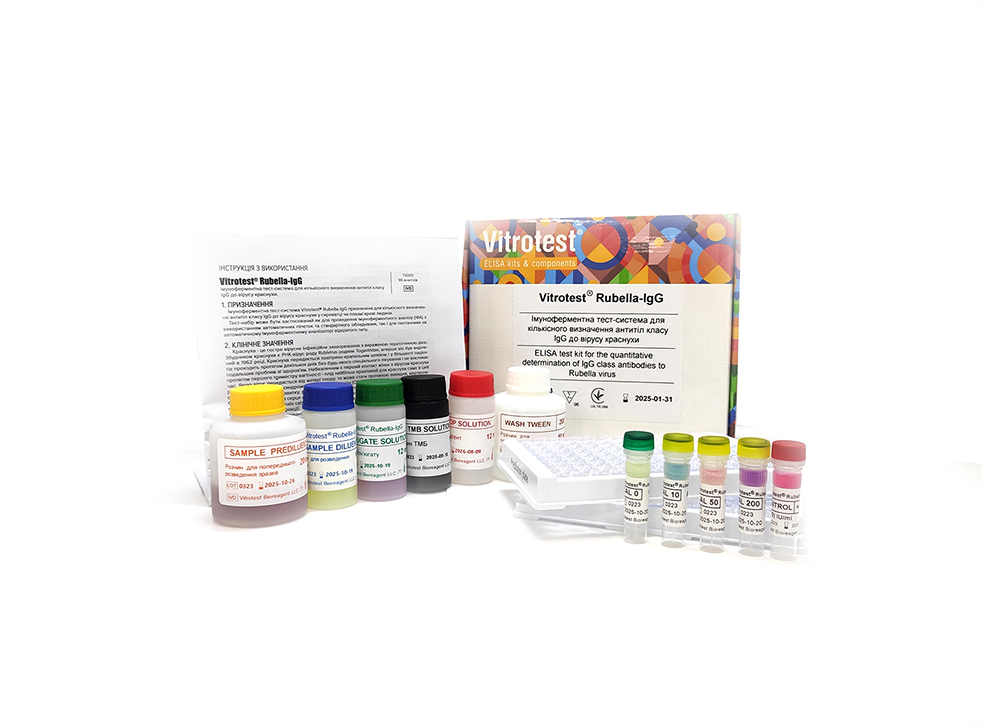
The test kit Vitrotest® Rubella-IgG is an enzyme linked immunosorbent assay (ELISA) for the quantitative determination of IgG class antibodies to Rubella virus in human serum or plasma.

Determination of IgG antibodies to Rubella virus in the test kit Vitrotest® Rubella-IgG is based on a solid phase, indirect ELISA in a two-step incubation procedure.

○ ТК003 – 96 tests

  • Features

  • Solid phase: breakable microplate ELISA is coated with Rubella virus antigens.
  • Conjugate: a monoclonal antibodies to human IgG conjugated to horseradish peroxidase.
  • Chromogen: ready to use TMB solution.
  • Volume of sample for analysis: 10 μl.
  • Assay time: 1h 15 min.

  • Rubella

Rubella is an acute viral infectious disease with significant teratogenic effects. The causative agent of rubella is an RNA virus Rubivirus genus Togaviridae family and was first isolated in 1962. Rubella is an air-bourne disease, takes few days to pass without a special treatment in most patients and does not cause health problems later. The main danger occurs during the first contact of a pregnant woman with the Rubella virus during the first trimester of pregnancy when the foetus is the most vulnerable to rubella. If the virus is being passed on from mother to foetus, it can be cause of a misbirth, a stillbirth or congenital rubella syndrome (CRS) – all of which comprise a group of serious deficiencies that can cause a developmental delay, mental retardation, deafness, cataracts, microcephaly, liver problems and a newborn heart disease. Because of the strong teratogenic effect of the Rubella virus a large-scale vaccination that provides permanent immunity to infection is conducted in most countries.

Extensive vaccination against rubella over the past decade has led to the near eradication of rubella and CRS in many developed countries and some developing countries. Before the introduction of vaccination, up to 4 children with CRS were born per 1,000 live births worldwide. Even now, more than 100,000 children are born with CRS annually in developing countries. In Ukraine, the incidence of rubella is about 4 cases per 100,000 population per year.

Many studies have shown that viral protection is mostly induced by neutralizing antibodies. The rubella specific IgM antibodies are usually detected within 4 days after the onset of rash and for 4–8 weeks thereafter, but in some cases these antibodies can persist for over a year. IgG antibodies appear during the acute phase (7 to 30 days postonset) and persist at varying levels for life. During viral infection, antibodies specific to three structural proteins of the rubella virus develop; the protective immune response is predominantly directed toward the glycoproteins, mainly against the glycoprotein E1.

Since the symptoms of rubella are often not specific, and many cases of rubella are asymptomatic, the diagnosis of rubella is rarely based upon clinical symptoms. The presence of rubella virus in nasal, throat, urine, blood, and cerebrospinal fluid specimens from persons with suspected rubella should be proven by virus isolation or alternatively viral nucleic acid should be detected by polymerase chain reaction. Immunological tests are by far the most popular in the diagnostics of rubella.
Serum assays are used for 3 main purposes:
1) for determining seroconversion after RV vaccination by the level of IgG;
2) for evaluation of the immunity to virus by the level of IgG, determining the need to vaccinate women at reproductive age;
3) to diagnose possible infection in pregnant women by the level of IgM and by the avidity of IgG.

Detection of rubella-specific IgM alone cannot be considered absolute proof of a recent primary infection for several reasons. IgM response after primary infection may be prolonged, lasting up to several years. Furthermore, sometimes rubella IgM is detectable in the case of mild secondary infection occuring despite a vaccination. This secondary infection is regarded as safe for the fetus. False-positive IgM results may also be artifacts due to various reasons.

This issue of doubtful IgM results is especially important when investigating suspected rubella in pregnant women because of the risk of CRS, so additional diagnostic tests should be used in such situations. Аvidity of IgG, which in most cases begins to increase 3 months following rubella infection, is another independent parameter allowing to differentiate between recent and past infection. For example, in one study low avidity specific IgG was detected in 91% of sera taken at 3–4 months after exposure to rubella virus; at 5–7 months after exposure only 21% of sera remained low avidity.

The IgG avidity assay is gaining popularity as a diagnostic method for the assessment of the time of infection. According to the recommendations of the Center for Disease Control and Prevention, USA, if IgM of the first probe is positive, avidity of IgG of the second probe, collected in 5-10 days, should be also measured. If the IgM and IgG of this second probe are positive, but the IgG avidity is high, this may indicate either a false-positive IgM result or a benign secondary infection.

ELISA kits, TORCH Infections

tel./fax: +380972227672, +380442227672 | e-mail: info@vitrotest.ua, order@vitrotest.ua

© Vitrotest 2006 - 2026 | All Rights Reserved | Privacy policy | Terms of use

Page load link
Go to Top