Skip to content
  • Home
  • About us
  • Products
    ELISA kit
    • HIV infection
    • Viral Hepatitis
    • Syphilis
    • Herpes Infections
    • TORCH Infections
    • Vaccine-Preventable Diseases
    • Сovid-19COVID-19 is an infectious disease caused by a new SARS-CoV-2 coronavirus which had not previously been detected in humans. The viral infection leads to the development of a respiratory flu-like disease with symptoms such as cough and fever. In more severe cases pneumonia can develop. The average incubation period of the COVID-19 is 6.5 days, but it can range from 3 to 21 days. SARS-CoV-2 is an RNA-virus with a specific envelope with spikes in the form of a “corona”. The main structural proteins of the virus include envelope protein (E), membrane protein (M), spike (S) glycoprotein, and nucleocapsid (N) protein. S protein on the surface of the SARS-CoV-2 virion mediates the receptor recognition and cell membrane fusion with ACE2 molecules, which are mainly expressed on type II pneumocytes, colon and kidney epithelial cells. It contains three fragments, namely the ectodomain, the transmembrane domain and the short intracellular segment. The ectodomain consists of a receptor-binding subunit S1 containing the RBD domain and a fusion subunit (S2). During viral infection, S1 C-terminal domain binds to the extracellular peptidase (PD) domain of ACE2 to ensure that the virus attaches to the surface of the target cell. The S1 N-terminal domain binds to…
    • Borreliosis
    • Parasites
    • Urogenital Infections
    • Gastroenteric Diseases
    • Tumor Markers
    • Metabolism
    • Allergy
    • Biotinylated Allergens
    • Thyroid function
    • Brucellosis
    Download catalog ELISA kits
    IMMUNOGLOBULINS LEVEL
    Raw materials
    DOWNLOAD CATALOG RAW MATERIALS
  • News
  • Contact
  • EN
  • UA
  • RU
  • Home
  • About us
  • Products
    • ELISA kits
      • HIV infection
      • Parasites
      • Syphilis
      • Borreliosis
      • Viral Hepatitis
      • TORCH Infections
      • Herpes Infections
      • Vaccine-Preventable Diseases
      • Сovid-19COVID-19 is an infectious disease caused by a new SARS-CoV-2 coronavirus which had not previously been detected in humans. The viral infection leads to the development of a respiratory flu-like disease with symptoms such as cough and fever. In more severe cases pneumonia can develop. The average incubation period of the COVID-19 is 6.5 days, but it can range from 3 to 21 days. SARS-CoV-2 is an RNA-virus with a specific envelope with spikes in the form of a “corona”. The main structural proteins of the virus include envelope protein (E), membrane protein (M), spike (S) glycoprotein, and nucleocapsid (N) protein. S protein on the surface of the SARS-CoV-2 virion mediates the receptor recognition and cell membrane fusion with ACE2 molecules, which are mainly expressed on type II pneumocytes, colon and kidney epithelial cells. It contains three fragments, namely the ectodomain, the transmembrane domain and the short intracellular segment. The ectodomain consists of a receptor-binding subunit S1 containing the RBD domain and a fusion subunit (S2). During viral infection, S1 C-terminal domain binds to the extracellular peptidase (PD) domain of ACE2 to ensure that the virus attaches to the surface of the target cell. The S1 N-terminal domain binds to…
      • Urogenital Infections
      • Gastroenteric Diseases
      • Tumor Markers
      • Metabolism
      • Allergy
      • Biotinylated Allergens
      • Thyroid function
    • IMMUNOGLOBULINS LEVEL
    • RAW MATERIALS
    • DOWNLOAD CATALOG ELISA
    • DOWNLOAD CATALOG RAW MATERIALS
  • News
  • Contact
  • EN
    • EN
    • UA
    • RU
  • DOWNLOAD CATALOG ELISA
  • Home
  • About us
  • Products
    • ELISA kits
      • HIV infection
      • Parasites
      • Syphilis
      • Borreliosis
      • Viral Hepatitis
      • TORCH Infections
      • Herpes Infections
      • Vaccine-Preventable Diseases
      • Сovid-19COVID-19 is an infectious disease caused by a new SARS-CoV-2 coronavirus which had not previously been detected in humans. The viral infection leads to the development of a respiratory flu-like disease with symptoms such as cough and fever. In more severe cases pneumonia can develop. The average incubation period of the COVID-19 is 6.5 days, but it can range from 3 to 21 days. SARS-CoV-2 is an RNA-virus with a specific envelope with spikes in the form of a “corona”. The main structural proteins of the virus include envelope protein (E), membrane protein (M), spike (S) glycoprotein, and nucleocapsid (N) protein. S protein on the surface of the SARS-CoV-2 virion mediates the receptor recognition and cell membrane fusion with ACE2 molecules, which are mainly expressed on type II pneumocytes, colon and kidney epithelial cells. It contains three fragments, namely the ectodomain, the transmembrane domain and the short intracellular segment. The ectodomain consists of a receptor-binding subunit S1 containing the RBD domain and a fusion subunit (S2). During viral infection, S1 C-terminal domain binds to the extracellular peptidase (PD) domain of ACE2 to ensure that the virus attaches to the surface of the target cell. The S1 N-terminal domain binds to…
      • Urogenital Infections
      • Gastroenteric Diseases
      • Tumor Markers
      • Metabolism
      • Allergy
      • Biotinylated Allergens
      • Thyroid function
    • IMMUNOGLOBULINS LEVEL
    • RAW MATERIALS
    • DOWNLOAD CATALOG ELISA
    • DOWNLOAD CATALOG RAW MATERIALS
  • News
  • Contact
  • EN
    • EN
    • UA
    • RU
  • DOWNLOAD CATALOG ELISA

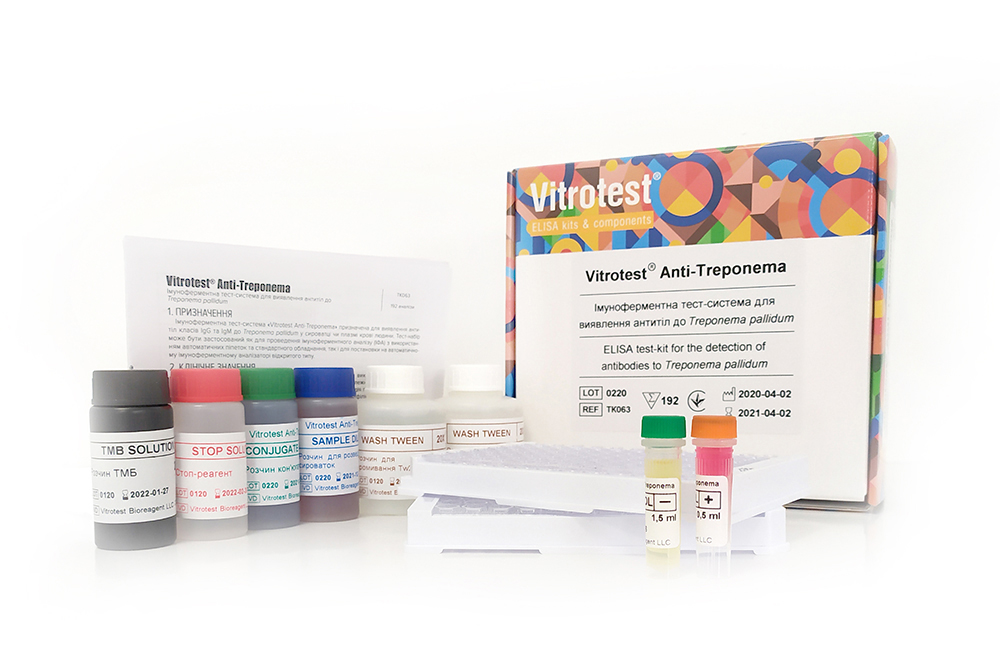
Vitrotest® Anti-Treponema

  • Description

  • Features

  • Syphilis

  • Description

The test kit Vitrotest® Anti-Treponema is an enzyme linked immunosorbent assay (ELISA) for the detection of IgG and IgM class antibodies to Treponema pallidum in human serum or plasma.

Detection of antibodies to T. pallidum in the test kit Vitrotest® Anti-Treponema is based on a solid phase, indirect ELISA in a two-step incubation procedure.

○ ТК063 – 192 tests

  • Features

  • Solid phase: breakable microplate ELISA is coated with recombinant Treponema pallidum antigens.
  • Conjugate: monoclonal antibodies to human IgG and IgM conjugated to horseradish peroxidase.
  • Chromogen: ready to use TMB solution.
  • Volume of sample for analysis: 20 μl.
  • Assay time: 1h 15 min.

  • Syphilis


Syphilis is a sexually transmitted infection (STI) caused by the bacterium Treponema pallidum. Syphilis develops in four successive stages, primary, secondary, latent, and tertiary. The primary ulcer at entry site (“primary chancre”, 10-90 days postinfection), is followed by spread of the treponemes to the regional lymph nodes and haematogenous dissemination to other parts of the body. The ulcer is classically indurated and painless. While the local immunity leads to ulcer healing in approximately 3-6 weeks, systemic dissemination results in intense immune response to the deposited treponemes, leading to secondary syphilis soon after healing of primary chancre. Rash is the presenting complaint in majority of patients with secondary syphilis, and it is found on physical examination in more than 90% of patients. Rash frequently covers palms and soles, it is usually maculopapular and never vesicular. Other symptoms include fever, sore throat, malaise, headache, and lymphadenopathy. Neurological symptoms (meningitis, ocular complaints), although more characteristic for tertiary syphilis, could arise already at secondary stage. Secondary syphilis resolves without treatment, followed by latent stage. Latent stage is asymptomatic, the bacteria remain dormant and are undetected by traditional methods in blood and issues. Tertiary syphilis represents an activation of dormant infection, occuring in about one-third of affected individuals several decades after primary infection. Tertiary syphilis can affect multiple organ systems, including brain, nerves, eyes, heart, blood vessels, liver, bones, and joints, and is often fatal. Symptoms of tertiary syphilis vary depending on the organ system affected.

The fundamental histological changes at all stages are vasculitis and its consequences, necrosis and fibrosis.
Syphilis could be transmitted:
1) by direct contact of skin/mucosa with infective treponema-rich ulcers;
2) vertically from infected mother to her unborn child;
3) by blood sharing.

The main routes of transmission are sexual and congenital. Sexual transmission occurs by inoculation of bacteria into tiny abrasions resulting from sexual trauma. Minor routes of transmission are by blood transfusion, by needle sharing, and by fomites among medical personnel .
Persons with syphilis are infective for sexual transmission only during primary and secondary stage. On the contrary, women with syphilis could transmit the disease congenitally also during the latent stage.

T. pallidum gains access to the fetal compartment as early as 9–10 weeks after conception. Pregnancy in women with syphilis could result in spontaneous abortion, newborn death, and congenital syphilis. For women with syphilis, the probability of delivering a healthy infant is only 1/3.

ELISA kits, Syphilis

tel./fax: +380972227672, +380442227672 | e-mail: info@vitrotest.ua, order@vitrotest.ua

© Vitrotest 2006 - 2026 | All Rights Reserved | Privacy policy | Terms of use

Page load link
Go to Top