
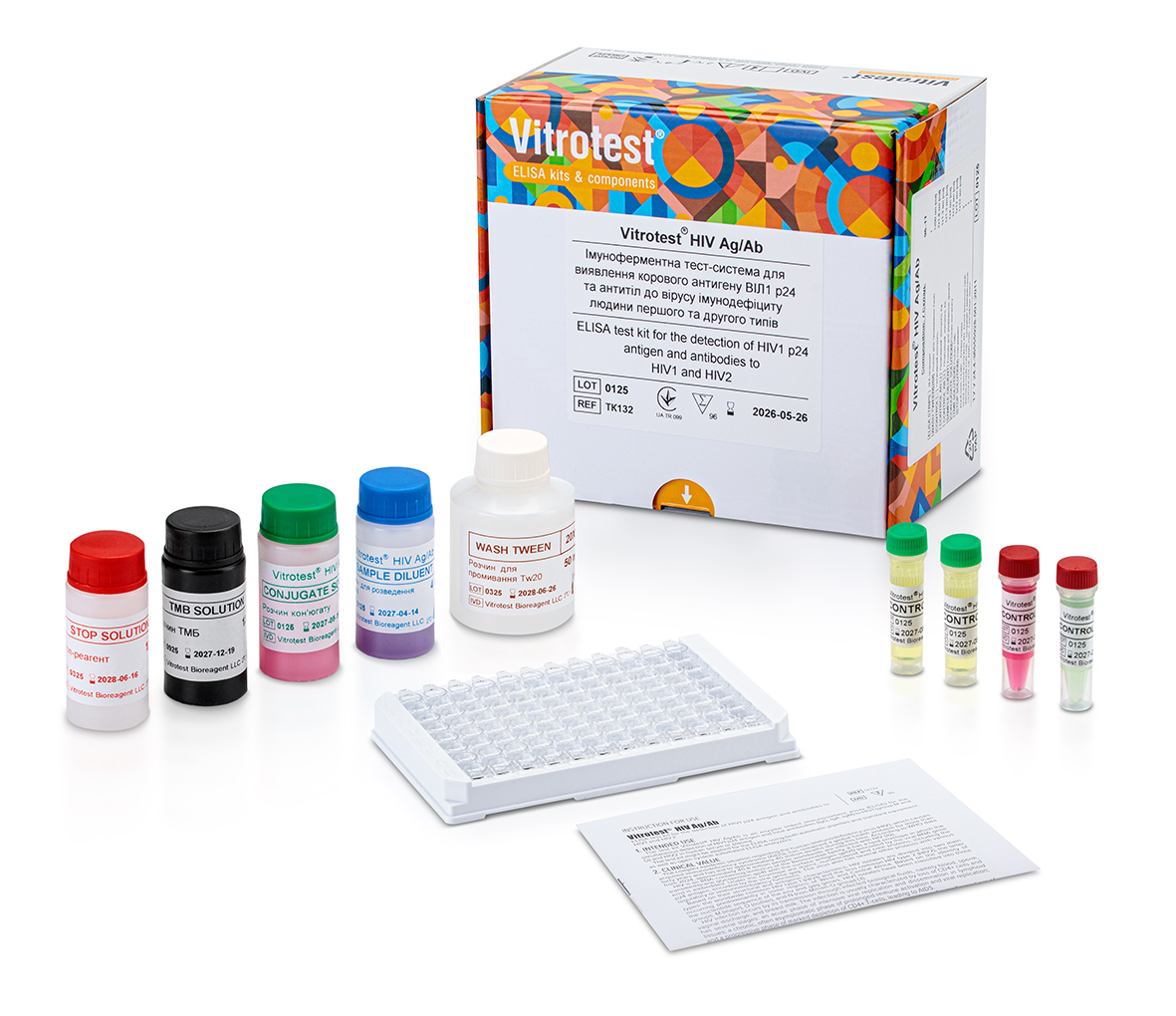
The test kit Vitrotest® HIV Ag/Ab is an enzyme linked immunosorbent assay (ELISA) for the simultaneous detection of HIV p24 antigen and total antibodies (IgG, IgA, IgM) to HIV1 (group M and O) and HIV2 in human serum or plasma.
Simultaneous detection of the HIV1 p24 core antigen and total antibodies to human immunodeficiency virus types 1 and 2 (HIV1/2) in the Vitrotest® HIV Ab/Ag test kit is based on a solid-phase sandwich ELISA in a two-step incubation procedure.
○ TK132 – 96 tests
○ TK133 – 192 tests
○ TK134 – 480 tests
- Solid phase: breakable microplate ELISA is coated with monoclonal antibodies specific to p24 HIV1 and recombinant HIV 1/2 antigens.
- Conjugate: solution of streptavidin and recombinant HIV1/2 antigens conjugated to horseradish peroxidase.
- Chromogen: ready to use TMB solution.
- Volume of sample for analysis: 70 μl.
- Assay time: 1 hour 45 minutes.
The complex epidemic situation regarding the human immunodeficiency virus (HIV), which causes acquired immunodeficiency syndrome (AIDS), has remained a global health problem for more than forty years and has led to approximately 40 million deaths during this time. According to WHO data from 2023, approximately 39.9 million people worldwide are infected with HIV.
HIV is an RNA-containing lentivirus of the Retroviridae family. It has a lipid envelope in which the transmembrane glycoprotein gp41 with the surface antigen gp120 (encoded by the viral RNA gene env) is embedded. Under the envelope are matrix, nucleocapsid and core proteins, including the p24 antigen, encoded by the viral gene gag. The virus also has several other proteins with various regulatory or immunomodulatory functions.
Based on their structural and antigenic characteristics, HIV isolates are divided into two main types: the worldwide common HIV type 1 (HIV1) and the less common HIV type 2 (HIV2), the latter occurring predominantly in some regions of West and Central Africa. Based on the identity of the nucleotide sequence of the env and gag genes, HIV1 isolates have been classified into three groups: M (major), O (outlier), and N (non-M/non-O group).
HIV infection occurs by its transmission through infected biological fluids, namely blood, sperm, vaginal discharge, and breast milk. The infection is usually characterized by loss of CD4+ cells and has several stages: an acute phase of intensive viral replication and dissemination in lymphoid tissues; a chronic, often asymptomatic phase of prolonged immune activation and viral replication; and a progressive phase of marked depletion of CD4+ T-cells, leading to AIDS.
Modern laboratory diagnostics of HIV infection is based on the detection of specific markers of infection, namely RNA of the pathogen, core antigen p24 and antibodies to HIV1/2. The choice of markers for testing depends on the purpose of diagnostics and should be consistent with the kinetics and time of their appearance in the patient’s blood. Viral RNA is detected by polymerase chain reaction (PCR) in blood plasma within 10-14 days after infection. Its quantity increases intensively for several months, and after the inclusion of humoral and cellular mechanisms of the immune response, the RNA level drops sharply to a constant level. In the late stages of HIV infection, the RNA level gradually increases to high concentrations with the appearance of symptoms of AIDS-associated diseases. Viral antigen p24 is detected in the blood of an infected person several days later than HIV RNA and remains at the detection level for about 1.5 months. HIV-specific antibodies usually appear 3-4 weeks after infection (the so-called seroconversion “window”), and can be detected in almost all infected individuals within 1-2 months. Detection of total HIV antibodies by enzyme immunoassay is widely used both for diagnosing HIV infection and for screening donor blood. The use of “fourth” generation enzyme-linked immunosorbent test kits, which make it possible to detect not only specific antibodies, but also the HIV p24 core antigen, can increase the sensitivity of the analysis, reducing the seroconversion “window” by 7-10 days.