
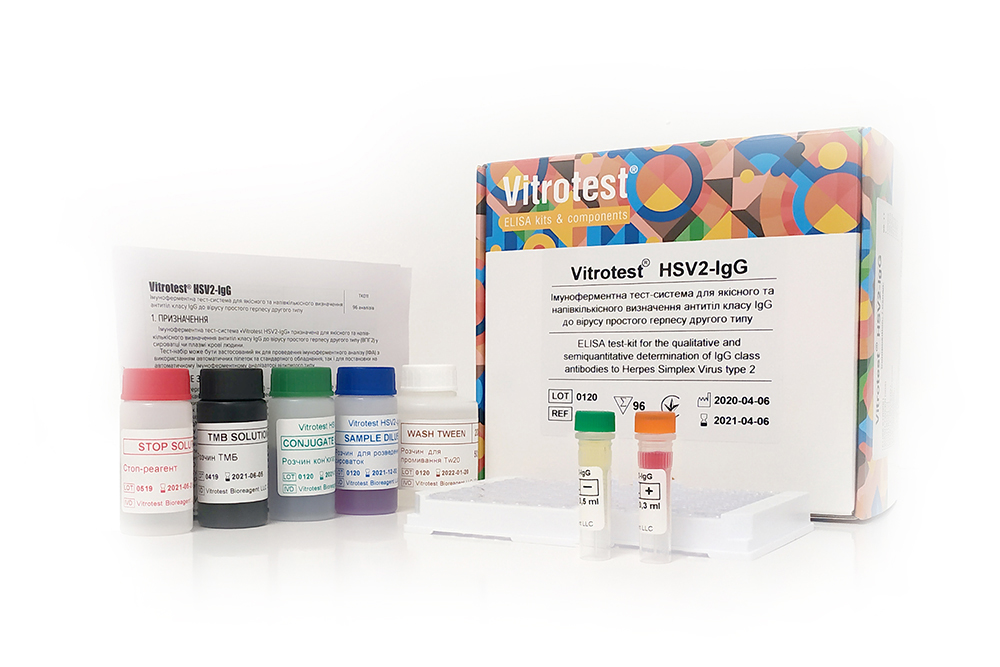
Determination of IgG antibodies to HSV-2 in the test kit Vitrotest® HSV2-IgG is based on a solid phase, indirect ELISA in a two-step incubation procedure.
○ ТК011 – 96 tests
- Solid phase: breakable microplate ELISA is coated with recombinant antigens of herpes simplex virus type 2.
- Conjugate: a monoclonal antibodies to human IgG conjugated to horseradish peroxidase.
- Chromogen: ready to use TMB solution.
- Volume of sample for analysis: 10 μl.
- Assay time: 1h 15 min.
There are two closely related species of HSV, HSV-1 and HSV-2. Both are large enveloped viruses containing double-stranded DNA. HSV-1 is normally (but not always) associated with orofacial infections whereas HSV-2 causes mainly GH (though it could also cause orofacial infections, clinically indistinguishable from those caused by HSV-1). Both viruses could be transmitted from infected mothers to neonates.
HSV infects its host at mucosal or epithelial surfaces and causes primary infection of the epithelium. Then the virus enters sensory neurons and is transported by retrograde flow along axons that connect the point of entry into the body to nuclei of sensory neurons. Viral multiplication occurs in a small number of sensory neurons; the viral genome then remains in a latent state for the life of the host.
HSV frequently reactivates from latency and infects epithelial cells adjacent to neuron where it resides. This process results in lesions with viral shedding or with asymptomatic shedding alone. Reactivation is triggered by another infection, psychological stress, tissue damage, etc.
HSV causes benign vesicular and ulcerative lesions in immunocompetent adults and may cause severe systemic disease in neonates and immunosuppressed hosts. In children >5 years old and immunocompetent adults duration of the first attack is 2-4 weeks. Symptoms of recurrent outbreaks are typically shorter in duration (7-10 days) and even less severe than the first outbreak of genital herpes.
The course of disease is more severe in small children (the so-called neonatal herpes (NH) and immunocompromised persons. Complications of herpes in these patients could remain localized and affect only eyes, mouth and skin; infection could spread to the central nervous system causing meningitis, myelitis, and encephalitis; in the last, disseminated, stage, infection involves multiple organs.
To initiate infection, HSV must contact either mucosal surfaces or abraded skin. Transmission usually occurs by direct oral-oral, oral-genital or genital-genital contact. Orofacial herpes is transmitted mainly by household contact during childhood whereas GH is a disease mainly transmitted by sex. Neonatal HSV infection most commonly results from contact between the newborn and HSV that is present in the birth canal of the mother during delivery.
HSV can be transmitted to child under primary or recurrent herpes, both in the presence or absence of symptoms. However, under recurrent herpes, the risk of transmission to a newborn is low even if open sores are present at the time of birth (the risk is 3/100). On the contrary, the risk is considerably higher if the primary infection is acquired in the third trimester, and especially in the last 6 weeks of pregnancy (the risk increases to around 50%). As a result, seronegative women in the third trimester of pregnancy are the main group at risk, especially, if their partner is seropositive. Intrauterine infection, contrary to neonatal one, is a relatively rare event.