
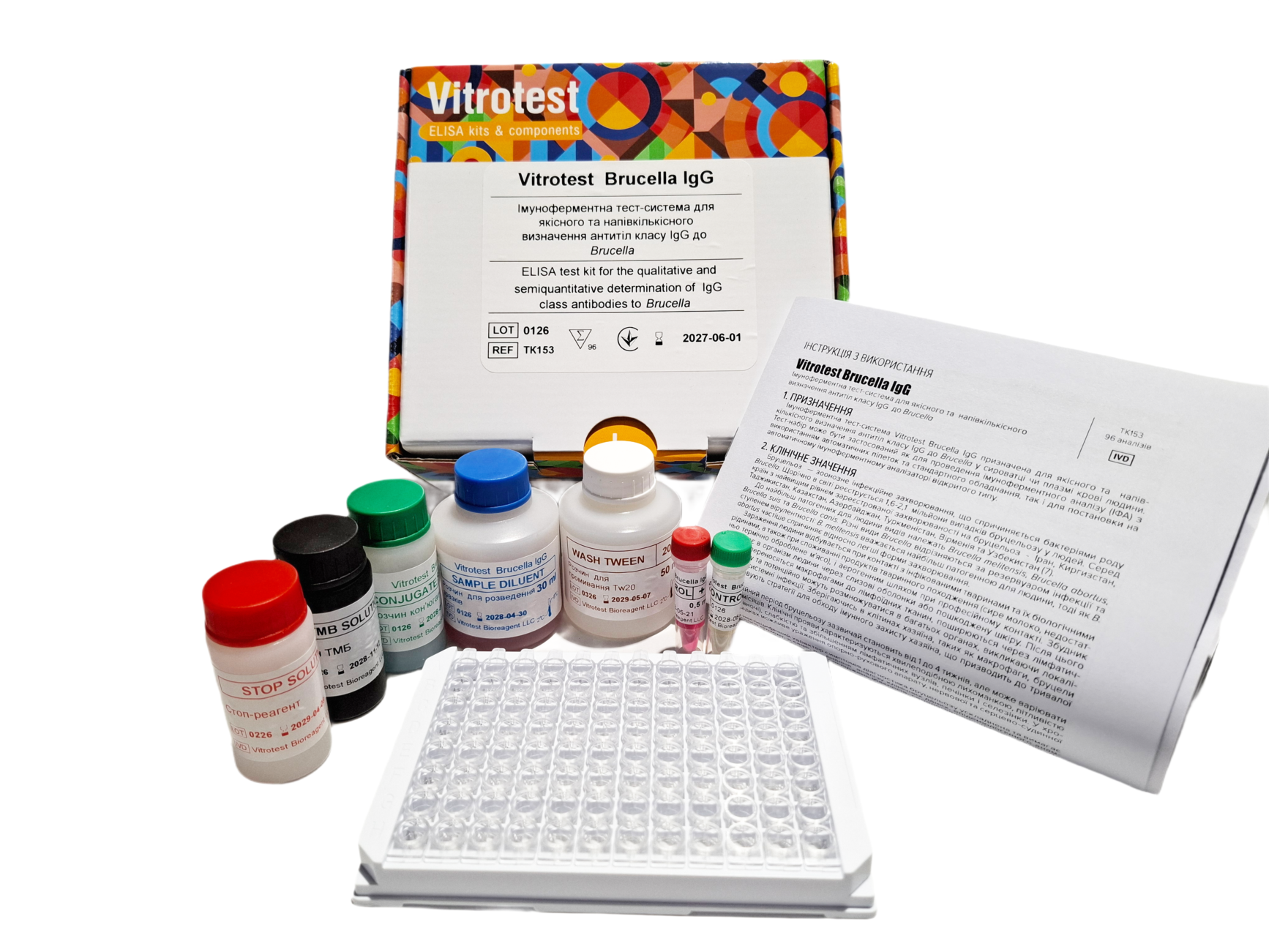
The test kit Vitrotest® Brucella-IgG is an enzyme linked immunosorbent assay (ELISA) for the qualitative and semiquantitative determination of igG class antibodies to Brucella in human serum or plasma.
Determination of IgG antibodies to Brucella in the test kit Vitrotest® Brucella-IgG is based on a solid phase, indirect ELISA in a two-step incubation procedure.
- TK153 – 96 tests
- Solid phase: strip ELISA plate pre-coated with antigens of Brucella.
- Conjugate: monoclonal antibodies to human IgG conjugated with horseradish peroxidase.
- Chromogen: ready to use TMB solution.
- Sample volume: 10 μl.
- Assay time: 1 h 15 min.
Brucellosis is a zoonotic infectious disease caused by bacteria of the genus Brucella. Globally, 1.6–2.1 million human cases of brucellosis are reported annually. Among the countries with the highest reported incidence of brucellosis are Iran, Kyrgyzstan, Tajikistan, Kazakhstan, Azerbaijan, Turkmenistan, Armenia, and Uzbekistan.
The species most pathogenic to humans include Brucella melitensis, Brucella abortus, Brucella suis, and Brucella canis. Different species of Brucella vary in their reservoir hosts and degree of virulence: B. melitensis is considered the most pathogenic for humans, whereas B. abortus more commonly causes relatively milder forms of the disease.
Human infection occurs through contact with infected animals and their biological fluids, as well as through the consumption of animal-derived products (raw milk and insufficiently heat-treated meat), and by the airborne route during occupational exposure. The pathogen enters the human body through mucous membranes or damaged skin. Subsequently, the bacteria are transported by macrophages to lymphoid tissues, spread through the lymphatic system, and may potentially proliferate in multiple organs, causing localized and systemic infections. By persisting within host cells such as macrophages, Brucella spp. employ strategies to evade the host immune response, resulting in prolonged infection.
The incubation period of brucellosis usually ranges from 1 to 4 weeks but may extend to several months. Clinical manifestations are characterized by undulating fever, sweating (especially at night), weakness, and enlargement of the lymph nodes, liver, and spleen. In chronic cases, the musculoskeletal, nervous, and cardiovascular systems may also be affected.
Due to the nonspecific nature of its symptoms, the diagnosis of brucellosis is challenging and requires a comprehensive approach, including the evaluation of clinical findings, epidemiological history, and laboratory test results (bacterial culture, serological assays, and PCR). Serological methods used for the diagnosis of brucellosis include the agglutination test, complement fixation test, and enzyme-linked immunosorbent assay (ELISA).
Using the ELISA method, IgM antibodies are detected during the early stages of infection, whereas IgG antibodies are detected later and may persist for a long period after previous infection or successful treatment. A rapid decline in IgG antibody titers usually indicates a favorable response to antibiotic therapy, while persistently high or increasing titers may indicate treatment failure, residual disease, or an impending clinical relapse. Therefore, the detection of IgG antibodies specific to Brucella is an important marker of current or past infection, particularly in subacute and chronic forms of brucellosis.